
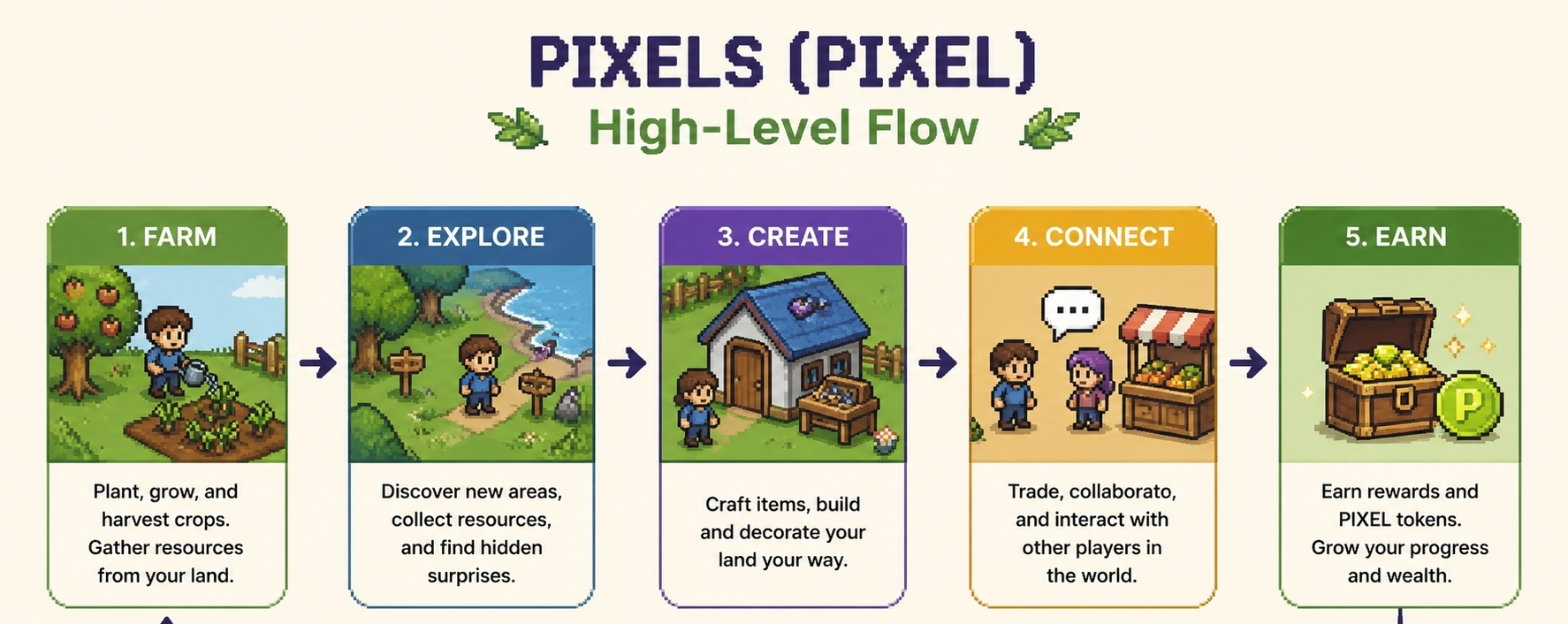
There’s something oddly comforting about games that don’t rush you. The kind where you can log in, take a breath, and just… exist for a while. That’s the feeling Pixels (PIXEL) leans into—a quiet, steady world where farming, exploring, and creating aren’t side activities, but the heart of the experience.
At first glance, Pixels might look like another farming game. You plant crops, gather resources, maybe decorate your land a bit. But spend a little more time in it, and you start to notice something different. It’s not just about managing a farm—it’s about being part of a living world that’s shaped by the people in it.
The game runs on the Ronin Network, which means it’s part of the Web3 space. Now, if that sounds technical or intimidating, don’t worry—it doesn’t feel that way when you’re actually playing. The blockchain side mostly works behind the scenes. What you notice instead is that your time and effort in the game have a bit more weight. The items you earn, the land you work on, the things you create—they feel like they belong to you in a more real way.
But let’s keep it simple. Imagine waking up in a pixel-style world where your main job is to take care of your land. You plant seeds, water crops, wait for them to grow. It’s slow in a good way. There’s no pressure to rush through tasks or hit milestones as fast as possible. You can take your time, maybe check in a couple of times a day, and still feel like you’re making progress.
That slower pace is part of the charm. In a world where most games push you to grind or compete, Pixels feels like it’s giving you permission to relax.
Of course, farming is just the beginning. Once you start exploring, things open up. There are different areas to visit, resources to collect, and small surprises tucked around the map. It’s not overwhelming, though. The game doesn’t throw everything at you at once. Instead, it lets you discover things naturally, like taking a walk and stumbling across something interesting.
And then there’s the social side of it.
Pixels isn’t meant to be played alone, even if you can. Other players are always around—farming their own land, trading items, or just moving through the world. You might not talk to everyone, but you feel their presence. It makes the game feel alive in a quiet, steady way.
Sometimes you’ll find yourself helping someone without even thinking about it. Maybe you trade resources, or share tips, or just observe how others design their spaces. It’s not loud or chaotic like some multiplayer games. It’s more like being part of a small community where everyone’s doing their own thing, but still connected.
The “creation” part of Pixels is where things get a little more personal. You’re not just following tasks—you’re shaping your own space. How your land looks, what you focus on, how you spend your time—it’s all up to you.
Some players go all-in on efficiency, trying to grow as much as possible. Others take a more relaxed approach, focusing on how things look or experimenting with different setups. There’s no single “right” way to play, which makes it easier to enjoy without second-guessing yourself.
That flexibility is important. It means the game can fit into your routine instead of taking over it. You can play for a few minutes or a few hours, depending on your mood. Either way, it still feels worthwhile.
Now, about the PIXEL token—the in-game currency.
In many games, currencies feel a bit disconnected from your actual experience. You earn them, spend them, and move on. In Pixels, the token ties into the idea that your in-game efforts have value beyond just progression. You can earn rewards through gameplay, trade items, and take part in an economy that’s driven by players.
But here’s the key thing: you don’t need to obsess over it to enjoy the game.
If you’re someone who likes the idea of earning while playing, that option is there. If you’re just here to relax and build your little farm, that works too. The game doesn’t force you into one path.
That balance is what makes Pixels feel approachable. It sits somewhere between a casual game and a more involved Web3 experience, without fully leaning too hard in either direction.
Visually, the game keeps things simple. The pixel art style is clean and easy on the eyes. It doesn’t try to impress you with flashy graphics. Instead, it creates a space that feels familiar and comfortable. There’s a certain nostalgia to it—like older games you might have played, but updated in a way that still feels fresh.
And honestly, that simplicity works in its favor. You’re not distracted by too many details. You can focus on what you’re doing, whether that’s planting crops, exploring new areas, or just walking around and seeing what others have built.
Over time, small routines start to form. You log in, check your crops, maybe collect some resources, see what’s changed. It becomes part of your day in a low-pressure way. Not something you have to do, but something you kind of look forward to.
That’s where Pixels really stands out. It’s not trying to overwhelm you with features or push you into constant action. It’s offering a space—a steady, evolving world where you can spend time however you like.
And in a way, that’s what makes it memorable.
It doesn’t shout for your attention. It doesn’t demand hours of commitment. It just sits there, quietly inviting you back whenever you feel like it.
If you’ve ever wanted a game that feels less like a race and more like a place you can return to, Pixels might be worth a look. Not because it’s groundbreaking or intense, but because it understands something simple: sometimes, people just want to slow down, do a few small things, and feel like they matter.
