One thing I keep getting stuck on is how game economies try to reduce selling pressure without quietly breaking utility. A system can look open, efficient, or fair at launch and still become something very different later.
Pixels’ introduction of $vPIXEL feels like an attempt to deal with that tension directly. Not by restricting users, but by changing what “using a token” actually means.What problem $vPIXEL is solvingMost crypto game economies share the same structural weakness: rewards are liquid too quickly. Tokens flow from the system to users, and from users straight to the market. That loop is efficient, but it creates constant extraction pressure.
When rewards equal immediate sellability, participation often turns into short-term farming. Users optimize for exit, not engagement. Over time, that erodes both token value and in-game activity.
$vPIXEL is trying to interrupt that loop.Instead of every reward becoming potential sell pressure, it introduces a parallel path—one where value stays inside the ecosystem long enough to be used, not just withdrawn.
Why spend-only matters.A spend-only token sounds restrictive on paper. But its real function is behavioral, not technical.By design, $vPIXEL removes the “should I sell now?” decision. That decision disappears because selling is not an option. What remains is a simpler question: where is this worth spending?
That shift matters more than it looks.When users are not constantly evaluating market timing, their interaction with the game becomes less financial and more experiential. Spending becomes tied to progression, access, or advantage—not liquidity.
In theory, this increases the likelihood that rewards translate into actual in-game demand instead of external sell pressure.Fee-free utility versus immediate sellabilityThere’s a trade-off embedded here.Traditional tokens offer freedom: earn, transfer, sell. But that freedom comes with friction—fees, slippage, and market impact. More importantly, it creates a default behavior of exiting.
$vPIXEL flips that trade-off. It removes sellability but replaces it with frictionless utility. No fees, no market considerations, just direct spending.
The question is whether users value that enough.
If the utility layer is strong, fee-free spending can feel more efficient than selling and re-entering. If it’s weak, the token risks feeling like a constrained version of value—something earned but not fully owned.Relationship between and $vPIXELThe dynamic between the two tokens is where this design becomes more strategic.
$PIXEL remains the liquid asset—the store of value, the market-facing layer. It absorbs speculation, price discovery, and external demand.
$vPIXEL, on the other hand, works more like an in-game currency—something you use naturally inside the ecosystem rather than something you think about selling.It carries purchasing power without directly translating into sell pressure.In effect, Pixels is trying to separate two roles that are usually combined:
* Value storage and exit (handled by $PIXEL)
* Value usage and circulation (handled by $vPIXEL)
If this separation holds, it could stabilize both sides. $PIXEL faces less constant dumping, while $vPIXEL keeps the in-game economy active.
Ecosystem effects if partner games adopt it well The real potential of $vPIXEL is not limited to a single game.
If partner games integrate it meaningfully, it becomes a shared spending layer across multiple experiences. That creates a broader demand surfacemore places to use the same unit of value.
This is where things could compound.A spend-only asset becomes more valuable when its utility expands horizontally. Each new integration increases the probability that users find something worth spending on, which in turn reinforces the entire system.
But this only works if integrations are genuine. Superficial use cases won’t hold attention. The spending has to feel necessary, not forced.Risk: utility must feel realThe biggest risk is straightforward.Closed-loop spend tokens only work if users actually want what they can buy.
If spending options feel cosmetic, inflated, or disconnected from meaningful progress, users will mentally discount the value of $vPIXEL. Once that happens, rewards start to feel less real even if their nominal value remains.
At that point, the system risks recreating the same problem in a different form: users disengage, not because they can’t sell, but because they don’t see a reason to spend.
So the real question is not whether a spend-only asset can reduce selling pressure. It is whether it can preserve the feeling of value while removing the option to exit.#pixel @Pixels $PIXEL 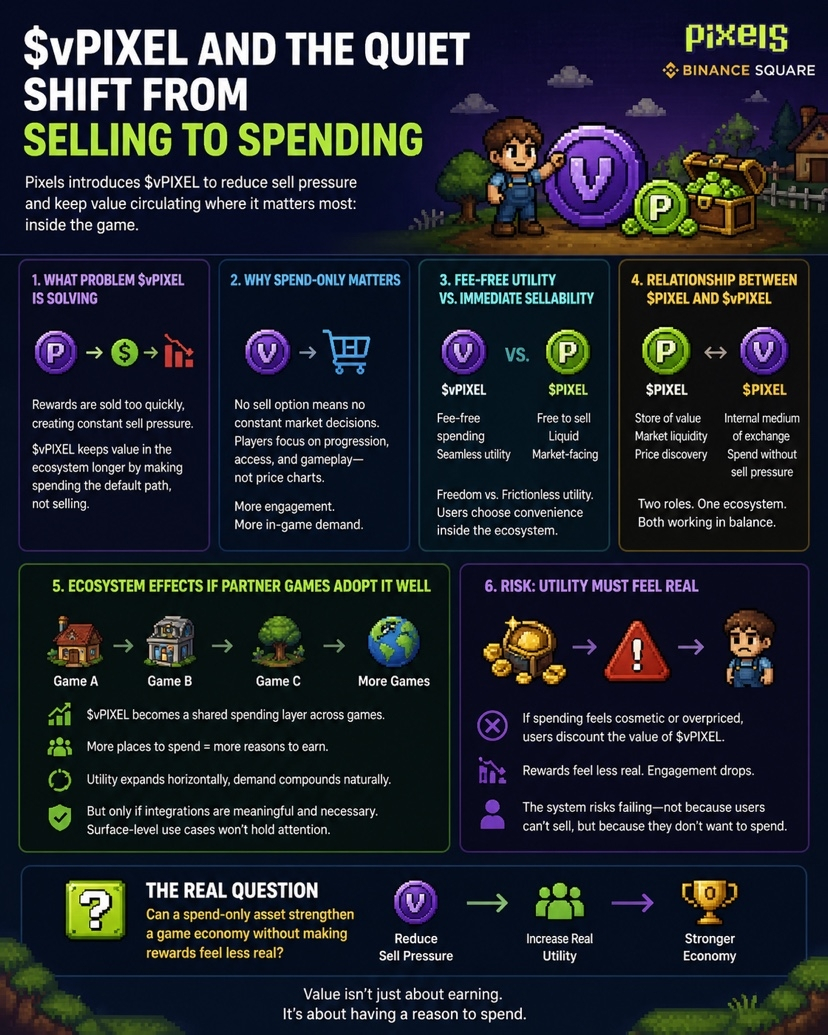

Статья
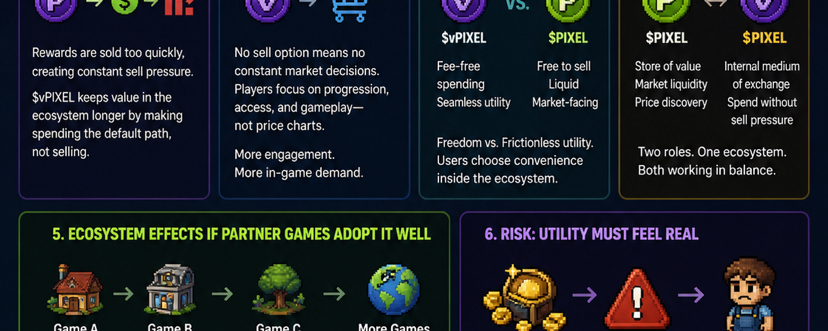
$vPIXEL and the Quiet Shift From Selling to Spending
--
Отказ от ответственности: на платформе опубликованы материалы и мнения третьих лиц. Не является финансовой рекомендацией. Может содержать спонсируемый контент. См. Правила и условия.