
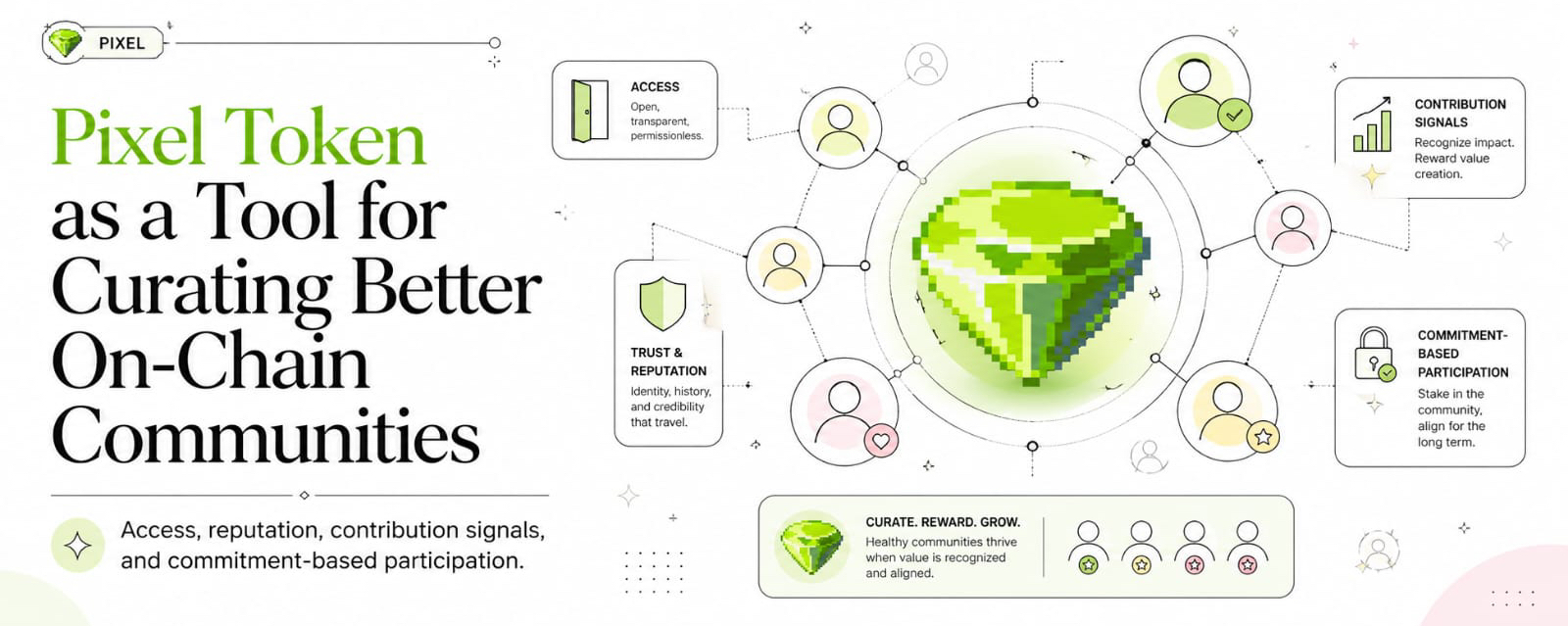
i watched someone get removed from a guild last week… not for cheating, not for breaking rules… just for never showing up when it mattered.
and that stuck with me longer than it should have.
because the guild was open. anyone could join. the token requirements were low. the entry was frictionless. and somehow it still ended up full of people who were present without being there… collecting rewards, passing through, leaving nothing behind.
that's when the word "open" started feeling incomplete to me.
i used to think open on-chain communities were strongest when everyone could enter, earn, trade, and leave with the same access. that sounds fair. but a community can be open and still become hollow if the system cannot tell the difference between someone who contributes and someone who only extracts.
openness without memory is just noise with better branding.
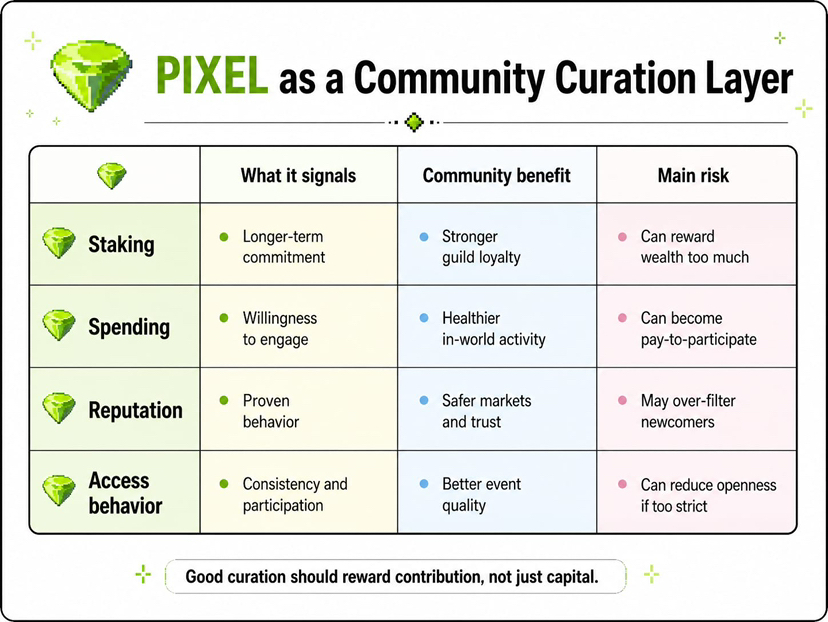
so that's where curation starts to matter. not curation as gatekeeping… not the ugly version where only rich or early users get treated seriously. something quieter. a way for the system to notice who keeps showing up, who participates with consistency, who adds value to the economy instead of only draining rewards from it.
at the surface, pixel looks like a token used for access, spending, upgrades, participation.
underneath, it can become a signal.
when someone stakes, spends carefully, builds reputation, joins events, supports guild activity, keeps interacting with meaningful parts of the economy… they're not just using a token. they're leaving behavioral evidence behind. evidence that Stacked can read across sessions, that RORS can factor into how reward budget moves, that trust score can convert into how cleanly value exits through Ronin.
the token isn't just circulating.
it's accumulating proof.
and that matters because on-chain communities have a strange problem.
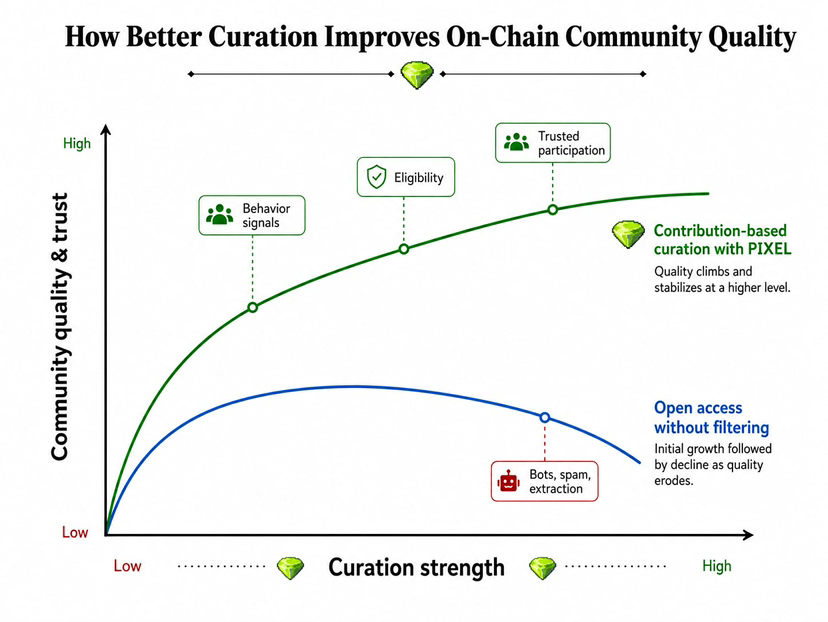
they want to be open, but openness attracts everything at once. real users, curious players, builders but also bots, spam accounts, short-term farmers, extractors who show up for the reward window and disappear before the community feels their absence.
if everyone receives equal trust from day one, the community can look active while its social quality quietly decays.
a community that can't tell the difference between a builder and an extractor will eventually be run by extractors.
not loudly. not dramatically.
just… through accumulated presence that never became contribution.
so pixel becomes interesting as a curation layer.
it doesn't need to shout. it doesn't need to become a wall. its better role is to help create degrees of eligibility… where some users get deeper access after proving consistency, where events reward people who showed up before the reward was announced, where guilds become stronger when reputation and token behavior reveal who is likely to stay versus who disappears after the window closes.
the numbers make this more sensitive. max supply around 5 billion, circulating around 3.38 billion, market cap near the mid-$20 million range… this isn't a deeply insulated asset. it's a system where trust, volume, and retention still matter a lot. daily volume around the high single-digit millions can be healthy… or it can simply be rotation.
the difference is whether users are returning to build or only moving through.
but this has to be handled carefully.
because there's a reasonable case for the opposite view. any token-based filter can become unfair if it rewards wealth more than contribution. if holding or spending pixel becomes the only proof of value, curation turns into exclusion. new users feel smaller. older users become too protected. the community starts rewarding financial position instead of useful participation.
so the distinction isn't more filters.
it's better filters.
and the difference matters because one version rewards whoever arrived with the most capital. the other version rewards whoever kept showing up after the reward window closed.
that's how curation improves openness without killing it.
in a market where Bitcoin dominance holds near 60%… where ETF inflows logged roughly $2.1 billion across eight straight days through April 23… capital is being selective. smaller tokens can't survive on attention alone. they need visible utility and reasons for users to return.
and that's where most community thinking quietly fails.
it protects the idea of openness instead of measuring the behavior underneath it.
i keep thinking about that player who got removed from the guild.
he wasn't malicious. he was just absent in all the ways that matter. present on paper. invisible in practice. and the guild had no language for that until it became a pattern repeated enough times that the community finally felt the cost.
pixel could be that language.
not as punishment. not as a wall.
the strongest on-chain communities won't be the most open ones.
they'll be the ones that figured out how to remember.
because presence and contribution look identical from the outside same login, same loop, same reward collected.
the difference only becomes visible when the window closes and some players stay anyway.
pixels could be what makes that difference visible.
not loudly. not as a wall.
just as a quiet record of who was actually there.