
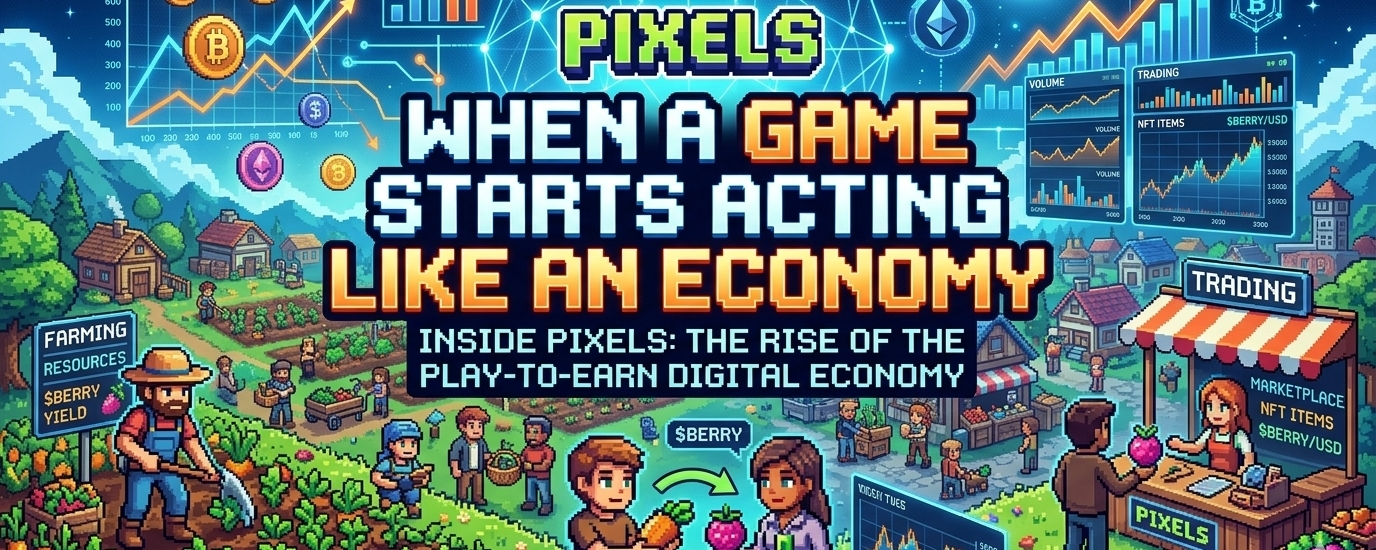

The first time I spent a few hours inside Pixels, I didn’t really think about blockchain at all. I was just planting crops, moving around a soft colored world occasionally bumping into other players doing the same quiet routines. It felt closer to an idle browser game than anything tied to wallets or tokens. And maybe that’s what made it interesting later when the underlying structure started to show through.
There’s something slightly unusual about how Pixels sits on top of its infrastructure. It doesn’t announce itself loudly as a Web3 experience at least not in the moment-to-moment play. Instead the blockchain layer feels like it’s waiting in the background only becoming visible when you start noticing patterns why certain resources matter more over time why some actions feel subtly incentivized or why the economy doesn’t behave like a typical game economy that resets or inflates without consequence.
The use of Ronin as the underlying network plays into this quietness. Ronin was built with games in mind and you can feel that bias in how interactions are smoothed out. Transactions don’t interrupt the flow in obvious ways. You’re not constantly reminded that something is being recorded or validated somewhere else. And yet that somewhere else is doing a lot of work. Ownership scarcity and transferability exist whether you think about them or not.
What I keep coming back to is how Pixels treats time. In most casual games time is either a barrier or a monetization tool. You wait for crops to grow or you pay to skip the wait. In Pixels, time starts to feel more like a variable in a broader system. The longer you play the more you begin to notice that not all actions age the same way. Some loops that felt efficient early on become less rewarding, almost as if the system is nudging you to reconsider your habits.
This is where the blockchain layer quietly changes things. Because assets and rewards aren’t entirely confined to a closed system the game can’t rely on the usual tricks forever. Inflation for example becomes more visible. If too many players follow the same profitable loop, the value of that loop naturally erodes. It’s not just a balancing patch from developers it’s a kind of emergent pressure created by the structure itself.
At times this makes the experience feel less like a game and more like a small evolving economy. But not in the grand idealized sense that Web3 often promises. It’s messier than that. Some players optimize aggressively extracting value wherever they can. Others drift through the world barely engaging with the economic layer at all. And both approaches seem to coexist even if the system subtly favors one over the other over time.
I find myself wondering how intentional all of this really is. Is the shifting reward landscape a carefully designed mechanism or is it just what happens when you attach persistent assets to a live game world? There’s a difference, but it’s not always easy to tell from the outside. Sometimes it feels like the developers are guiding the economy with a light touch. Other times it feels like they’re reacting to it, adjusting things as player behavior reveals unexpected imbalances.
There’s also a quieter question underneath all of this about ownership. In theory, having assets on-chain means players have more control, more permanence. But in practice, that ownership is still shaped heavily by the game itself. If the rules change, or if certain activities become less viable, the value of what you own shifts with it. It’s not the kind of independence that early blockchain narratives suggested. It’s more conditional, more entangled with the system than it first appears.
And yet there’s something compelling about that tension. Pixels doesn’t fully resolve the question of what a Web3 game should be. It doesn’t lean entirely into financialization nor does it hide from it. Instead it exists in this in between space where playing earning experimenting, and even making mistakes all feel connected in subtle ways.
I’m not sure if that makes it a model for future games or just an interesting case study. Maybe it’s both or maybe it’s neither. What stands out is that the infrastructure isn’t just supporting the game it’s shaping it sometimes in ways that aren’t immediately obvious.
After a while you stop asking whether it “feels like Web3 and start noticing how your own behavior changes inside it. You hesitate before repeating a loop that once worked. You pay a bit more attention to timing. You wonder briefly, whether slowing down might actually be the smarter move.
And that’s where it lingers for me not as a clear success or failure but as a system that quietly asks you to think a little differently about how games economies and infrastructure overlap. Not in theory but in practice one small decision at a time.
