
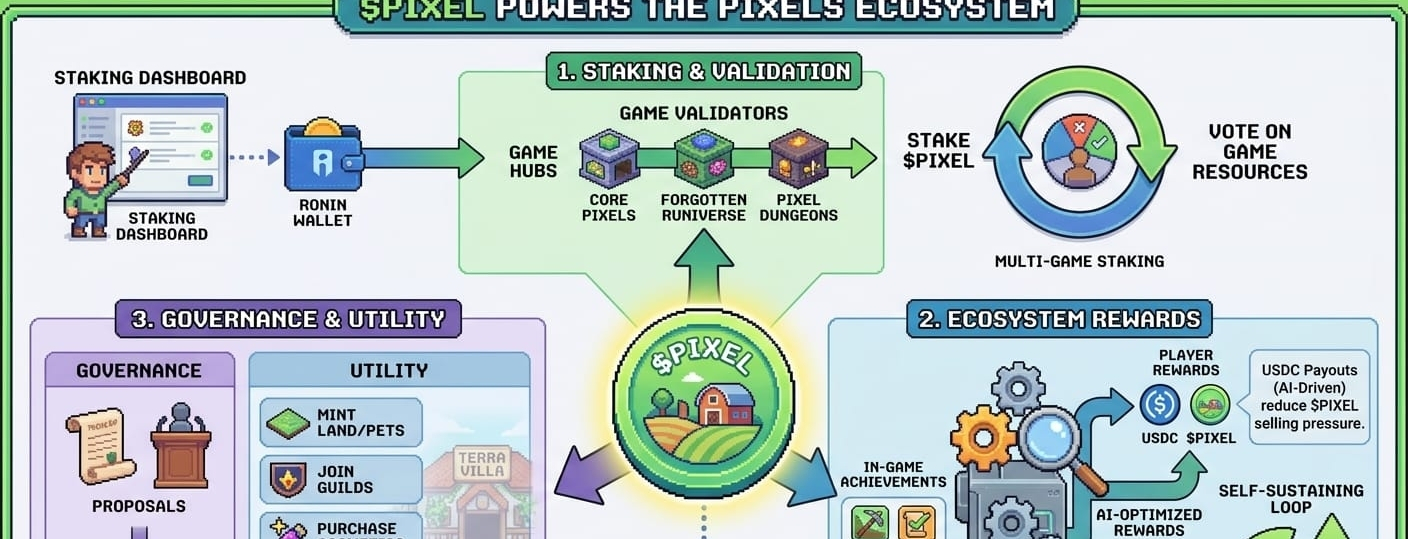
When I first started playing Pixels, I thought of as just another in-game token. It was used to buy items, craft, and complete various tasks—standard stuff for most Web3 games. But as I spent more time in the game, I realized that $PIXEL was designed to serve a much deeper function in the Pixels ecosystem. It’s not just a transactional token it’s the heartbeat of a carefully crafted economy, driving engagement, shaping behavior, and ensuring long-term sustainability.
At first, play-to-earn (P2E) games seemed like a great way to earn rewards and quickly cash out. However, that model often leads to unsustainable ecosystems, with players coming and going as quickly as they earned their rewards. What I started to notice in Pixels is that has evolved into something far more powerful: a tool for ensuring genuine, sustainable engagement. It’s not about rewarding people for doing the bare minimum; it’s about rewarding consistent involvement in the ecosystem.
One of the standout features of Pixels is its ability to integrate into various aspects of the game. From farming to crafting to quests, $PIXEL is the token that powers it all. But it doesn’t stop there. $PIXEL is used in a decentralized governance system, where players can stake their tokens and vote on which games or activities should be funded within the ecosystem. This kind of player-driven governance ensures that the community has a say in the direction of the game, making it a truly decentralized experience.
But there’s more to $PIXEL than just staking and voting. The introduction of $vPIXEL, a spend-only token, has added a layer of depth to the economy. It allows players to reinvest their earnings into the game, rather than simply cashing out and leaving the ecosystem. The fact that $vPIXEL can only be used for in-game transactions encourages long-term commitment to the Pixels world, ensuring that the value generated remains inside the ecosystem rather than being extracted.
I think this is one of the reasons $PIXEL is such a game-changer in the Web3 space. While other projects might focus solely on the rewards, Pixels focuses on building a sustainable ecosystem where the value players generate is used to fuel further growth. The ecosystem doesn’t rely on speculation or hype; it relies on real engagement and long-term contribution.
However, the system also includes the Trust Score—a feature that really intrigued me. At first, I thought the Trust Score was just a tool to prevent bots and exploitative behavior, but I quickly realized it’s much more than that. It’s actually an economic permission layer that determines whether the value you’ve earned through gameplay can be moved outside the game. Simply put, the Trust Score isn’t about banning players; it’s about making sure that players who engage sustainably with the game are rewarded with lower friction when they want to withdraw their earnings.
This means that players who contribute positively to the Pixels economy don’t just get rewards—they also get easier access to those rewards when they choose to withdraw. On the other hand, players who try to exploit the system or act only in their own self-interest face more friction and higher fees. This system ensures that the game economy remains stable, and that the value generated by players is properly aligned with their ongoing commitment to the ecosystem.
Looking ahead, s poised to play an even more central role as the Pixels ecosystem continues to grow. As more games join the ecosystem, the demand for $PIXEL will increase, cementing its place as the primary currency that drives both in-game activity and governance. This creates a virtuous cycle where players who contribute positively are rewarded, and the ecosystem as a whole benefits from sustained, meaningful engagement.
In the end, not just a currency—it’s the fuel that powers a sustainable and decentralized gaming ecosystem. As the game continues to evolve, so too will the role of $PIXEL, ensuring that players are rewarded for their genuine engagement and contributions, while also making sure that the ecosystem remains healthy and resilient in the long term.
@Pixels ,