Honestly... I didn't expect to feel this specific kind of clarity reading through how Pixels structures every stage of the relationship between a player and their capital inside the game.
Not excitement. not skepticism. something closer to the feeling you get when you realize that a game you thought you understood has been running a complete and coherent economic philosophy the entire time, and the philosophy only becomes visible when you trace a single unit of capital from the moment it enters the ecosystem to the moment it leaves.
because there's a pattern in how players think about Web3 game economies that this space accepts without examining what the full picture actually looks like end to end. the standard framing picks a single stage and optimizes it. buy land cheap, hold for appreciation. stake tokens, earn yield. farm resources, sell for profit. each stage is analyzed in isolation as though it were the complete strategy. the question of how each stage connects to the next, and what the transition costs and timing decisions look like across the full cycle, is almost never examined as a single coherent question.
but Pixels built an economy where every stage of the capital cycle is a genuine design decision with its own mechanics, its own timing considerations, and its own relationship to every other stage. and when you examine it that way, the game looks fundamentally different from any single-stage analysis.
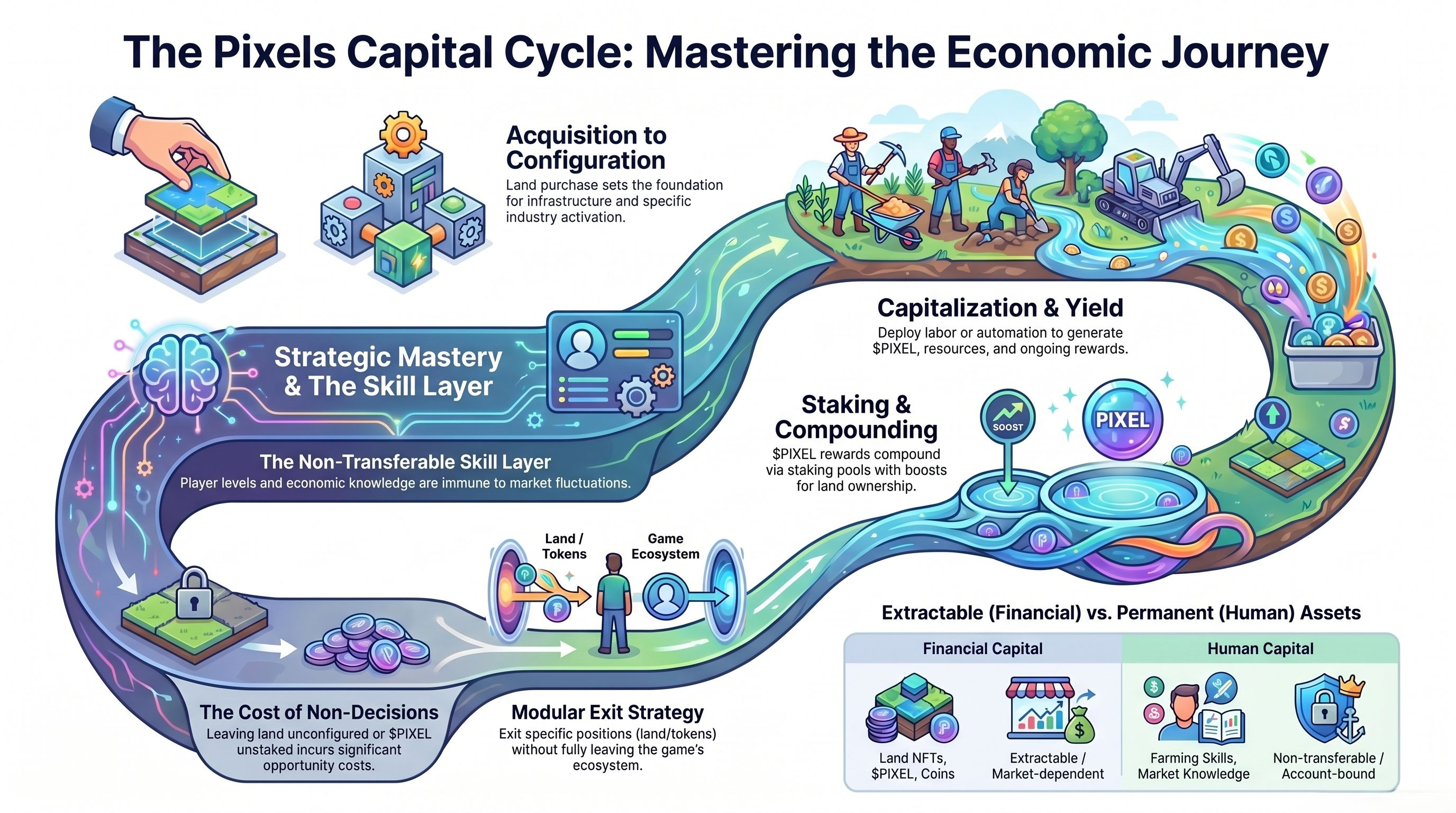
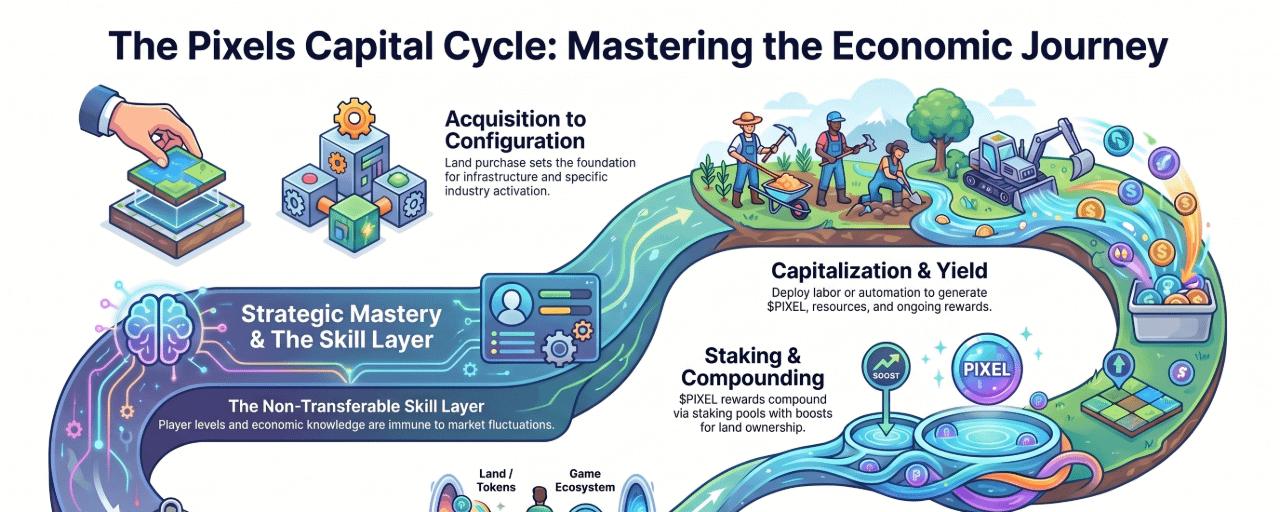
because the architecture is real and complete. the cycle begins with acquisition, land NFTs purchased on the secondary market at prices that reflect current and anticipated future productivity. it moves through configuration, which industries to activate, which crops to prioritize, how to build the plot's infrastructure toward its intended economic function. then capitalization, bringing in sharecroppers to deploy labor against the configured infrastructure, or activating automation to decouple output from active play time. then yield extraction, the ongoing harvest of Coins, resources, and PIXEL that the configured land generates across normal play cycles. then the staking layer, where PIXEL accumulated through play and sharecropper commissions compounds through the monthly reward pool with a 10% boost for each land NFT held. and finally, optionally, exit, the decision to liquidate a position by selling land NFTs, withdrawing PIXEL to the market, or restructuring the portfolio toward different assets within the same ecosystem.
so yeah... the full capital cycle is real and navigable.
but navigating it has never been the hard part of participating in a complex economy.
the hard part is understanding that each stage of the cycle is not independent. every decision made at acquisition constrains what is possible at configuration. every configuration decision shapes what is achievable at the yield stage. the player who buys land without modeling its intended configuration is not just making an acquisition decision. they are making every subsequent decision simultaneously, with less information than the configuration stage will eventually demand.
because here's what I keep coming back to. the most consequential decisions in the Pixels capital cycle are the invisible ones made by not deciding. a land owner who acquires a plot and leaves it at base configuration is not in a holding pattern. they are paying the opportunity cost of every yield the configured plot would have generated during that period. a player who accumulates PIXEL through farming and does not engage the staking layer is not preserving optionality. they are declining the compounding that the staking architecture was designed to deliver. a sharecropper arrangement that is never renegotiated as the land's configuration improves is not a stable partnership. it is a contract whose terms were set at a point when the land was worth less than it is now.
the Pixels capital cycle rewards players who treat each stage as an active decision, not a default state. and the transitions between stages are where the most value is either captured or left on the table.
then comes the exit question. because of course.
and here's where the full cycle reveals something genuinely important about how the game thinks about player incentives at the deepest level. exit in Pixels is not a single action. it is a spectrum. a player can exit their time investment by automating their land and stepping back from active play. they can exit their yield exposure by staking PIXEL into vPIXEL and spending it inside the game rather than withdrawing to the market. they can exit a specific game within the multi-game ecosystem by reallocating their staking weight toward a different title without touching their core PIXEL position. they can exit their land position by selling the NFT while retaining their staked PIXEL and their skill profile, which cannot be sold because it is not an asset in the traditional sense.
the architecture is designed so that a player can exit any individual component of their position without necessarily exiting the ecosystem. that modularity is not accidental. it is the mechanism through which the game retains capital that might otherwise leave entirely, by offering partial exits that satisfy the immediate pressure without requiring full liquidation.
there's also a dimension nobody talks about enough.
the skill layer of the Pixels capital cycle is the one asset that cannot be transferred, sold, or extracted. farming skills, crafting levels, and accumulated knowledge of the economy's behavior across chapter transitions are embedded in the player account and move with the player regardless of what happens to their token or land positions. a player who exits their entire financial position in Pixels but retains their account retains something with genuine productive value in any future configuration of the economy. the skill profile is the one investment in the Pixels capital cycle that is immune to market conditions, vesting schedules, and NFT floor movements.
that asymmetry, between financial capital that can be extracted and human capital that cannot, is one of the most interesting structural features of the Pixels economy and one that almost no analysis of the game ever reaches.
still... I'll say this.
the decision to build a complete capital cycle with genuine mechanics at every stage rather than optimizing a single earn loop reflects a real understanding of what makes an economy worth participating in over a multi-year time horizon. a game where every stage of the capital relationship is a thoughtful design decision rather than a default setting is a game that can hold the attention of players who are actually thinking about what they are building inside it.
the question for every player currently inside the Pixels economy is not which stage of the cycle they are in. it is whether they have examined the stages they have not yet entered carefully enough to know what decisions they are already making by not making them.
and in this world, the players who have walked the full cycle in their head before committing capital at any single stage are the ones who consistently end up where they intended.
@Pixels #pixel $PIXEL $DAM $ZKJ