
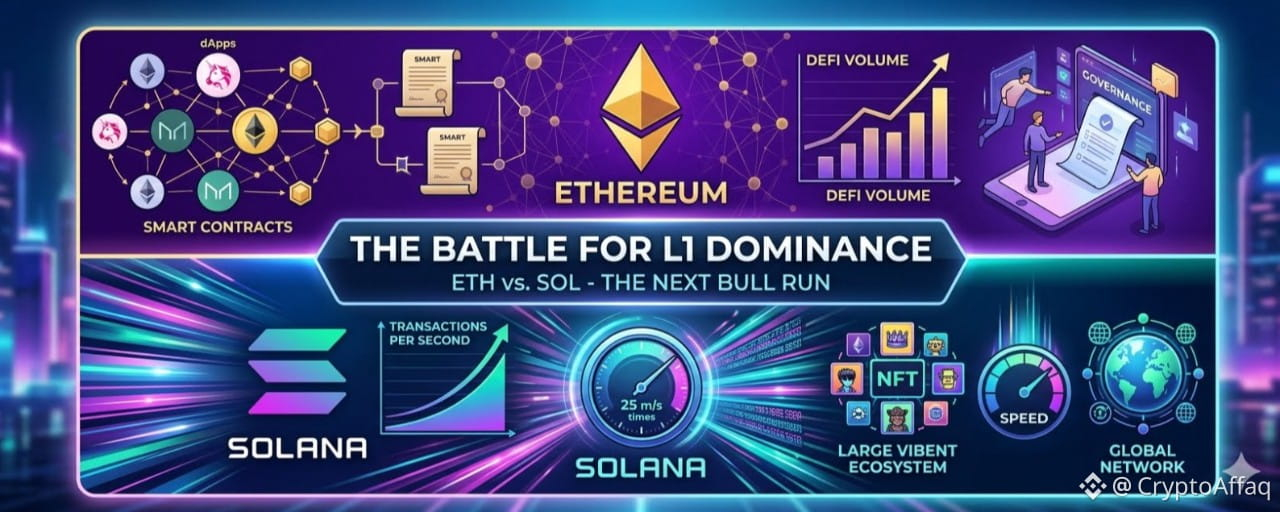
⚔️ ETH vs. SOL: The Ultimate Smart Contract Battle in 2026
The debate over blockchain dominance has taken a definitive turn this year. We are no longer just comparing transaction speeds; we are looking at two completely fundamentally different visions for the future of decentralized finance (DeFi) and Web3 infrastructure.
If you are trying to decide where to allocate your capital right now, understanding the underlying mechanics of Ethereum
and Solana is critical.
🏛️ The Institutional Heavyweight: Ethereum ($ETH)
Ethereum remains the undeniable foundation of decentralized finance. While retail users sometimes complain about mainnet speeds, Ethereum's architectural strategy relies heavily on its Layer-2 (L2) ecosystem—such as Arbitrum and Optimism—to manage retail traffic while keeping the main layer exceptionally secure.
Market Position: ETH commands over 60% of global stablecoin volume and more than 63% of the Total Value Locked (TVL) in DeFi ecosystems.
The 2026 Catalyst: All eyes are on the upcoming Glamsterdam upgrade slated for Q3 2026. This upgrade plans to elevate the network's gas limit floor to 200 million, integrating massive parallel processing to aggressively reduce network friction.
Ecosystem Health: Thanks to its maturity and security, institutional investors and exchange-traded funds (ETFs) consistently choose Ethereum as their primary layer-1 asset.
⚡ The High-Speed Disruptor: Solana (SOL)
Solana has carved out its empire by taking the exact opposite approach. Instead of relying on auxiliary Layer-2 networks, Solana handles all transactions on its main Layer-1 blockchain using a unique combination of Proof-of-Stake (PoS) and Proof-of-History (PoH) consensus mechanisms.
Market Position: Solana boasts massive active wallet addresses, driven largely by intense retail activity and decentralized exchange (DEX) platforms.
The Edge: Solana processes thousands of transactions per second with fees that cost mere fractions of a single cent. This frictionless environment has made it the undisputed capital for viral crypto projects and retail day-trading.
The Risk Factor: The complex, monolithic nature of its high-throughput network means validator hardware costs are steep, which continues to trigger ongoing centralization and occasional network stability debates within the community.
🔮 The Investor's Verdict: Which Belongs in Your Wallet?
Your portfolio allocation depends heavily on your risk appetite and investment horizon:
Choose Ethereum if you value institutional-grade security, long-term asset scarcity, and a time-tested decentralized network that acts as the global settlement layer for billions of dollars.
Choose Solana if you are chasing rapid ecosystem growth, high capital efficiency, vibrant retail communities, and ultra-fast application performance.
💬 Over to You! Both networks are successfully executing their respective playbooks this year. But as an investor, you have to draw a line in the sand.
Drop a comment below: Are you accumulation-heavy in $ETH or $SOL this month? Let's discuss!