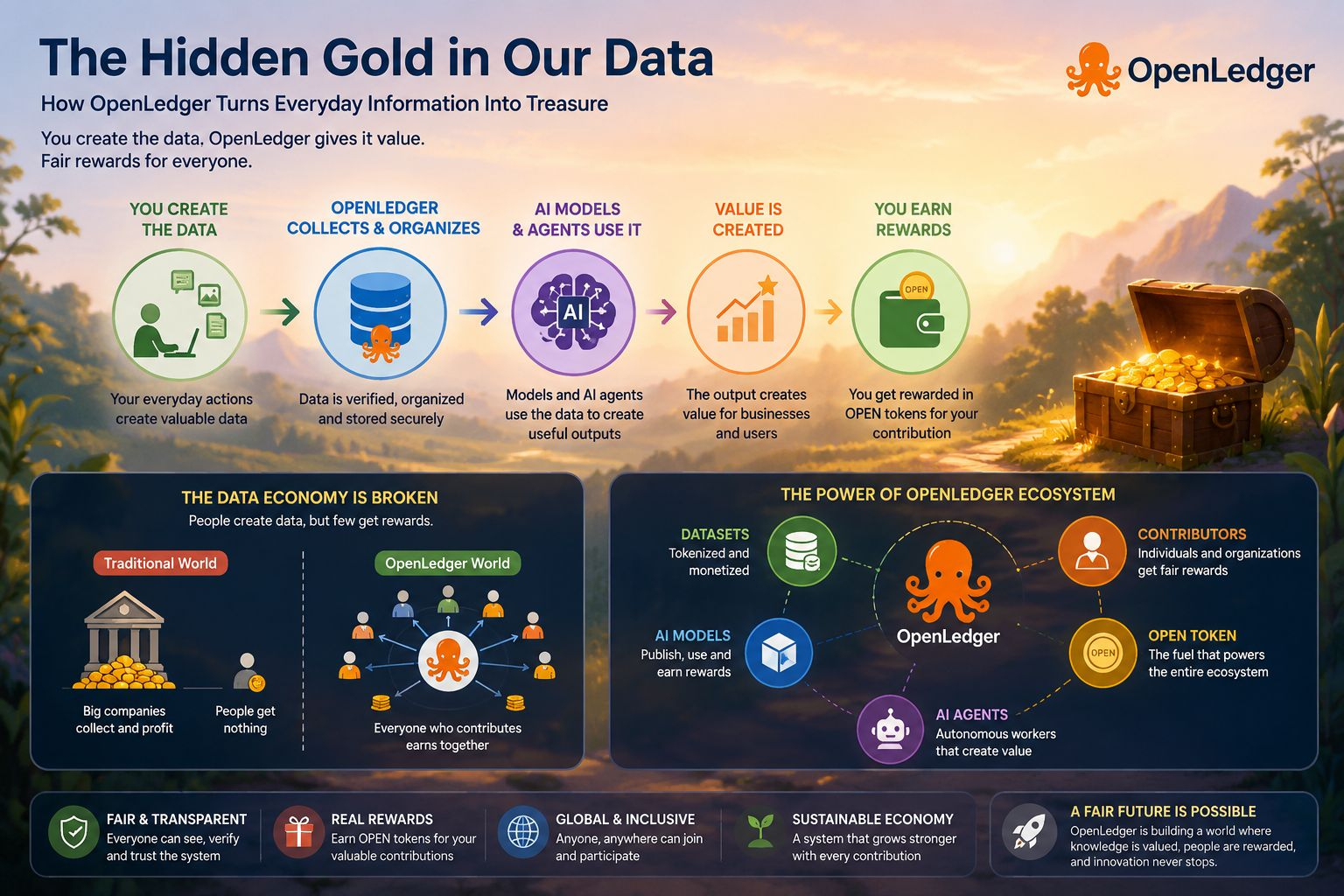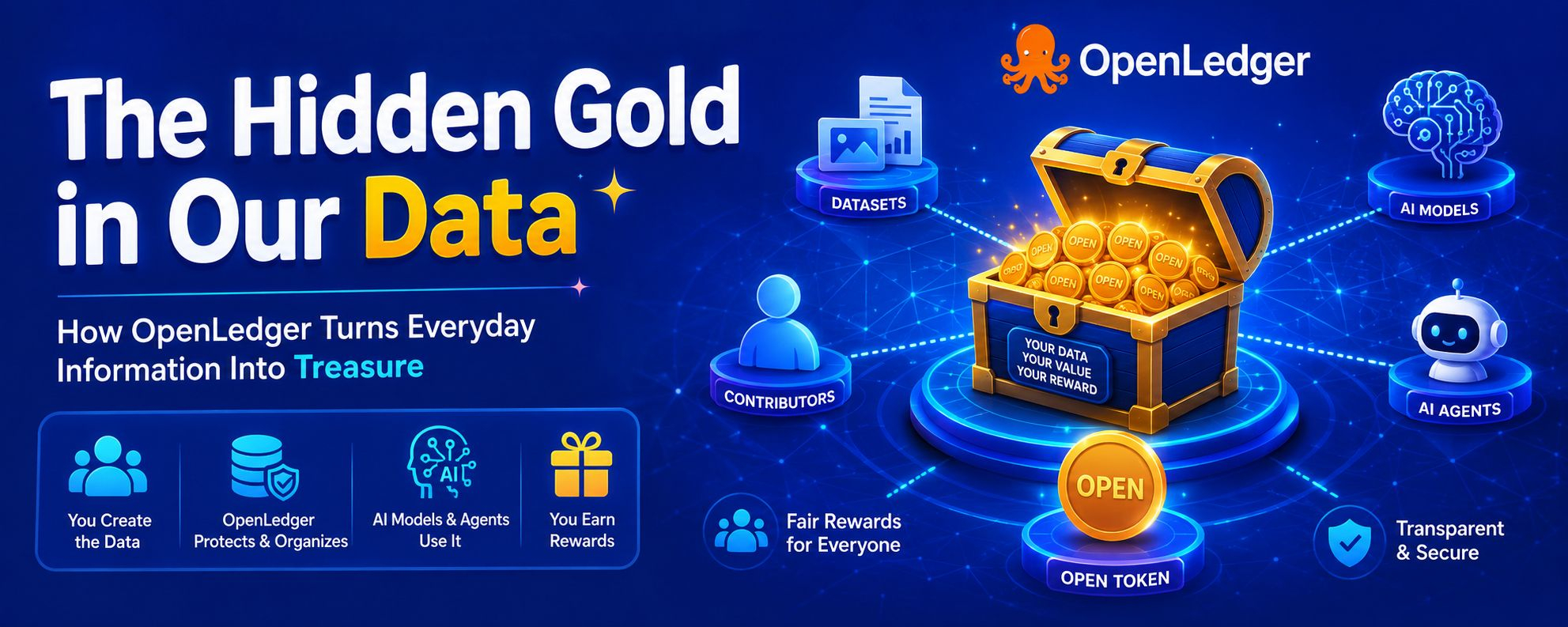
Most people use the internet every day and never think about what they are really giving away.
We type messages. We upload photos. We ask AI questions. We share ideas, habits, and knowledge. It feels normal, almost like breathing. But behind all of that, something very valuable is being created. Data.
Data is like tiny pieces of gold scattered everywhere. One piece by itself may look small. But when millions of pieces are collected together, they become more precious than people imagine.
For many years, large companies have been collecting this gold quietly. People created the value, but they rarely received anything in return. It was like farmers growing crops on their own land, only to watch someone else harvest everything and keep the profit.
That never felt fair to me.
When I first learned about @OpenLedger , it felt like hearing a simple but powerful idea.
What if the people who create data could finally earn from it.
What if the builders of AI models could be rewarded each time their work helped someone.
What if smart AI agents could work like tiny digital workers, earning money on their own.
And what if all of this happened in a system where everyone could see who helped and who deserved the reward.
That idea is what makes OpenLedger so interesting.
A World Where Nothing Is Wasted
Imagine a child collecting seeds after the harvest.
Most people walk past them without noticing. They look too small to matter. But the child knows that every seed can become a tree, and every tree can produce fruit for many years.
OpenLedger treats data in the same way.
A single document, a list of facts, a trained model, or a useful AI agent may seem small at first. But when they are placed into a system where they can be used again and again, they become something alive.
They start to grow.
And each time they help produce something valuable, the creator can earn rewards.
It is a little like planting one mango tree and receiving fruit every season.
The Big Problem No One Talks About
AI is becoming stronger every year.
It writes stories, answers questions, helps businesses, and teaches students. But AI does not appear from nowhere.
It learns from data created by real people.
Teachers, writers, researchers, farmers, doctors, and students all contribute knowledge. Yet most of them are never paid when that knowledge is used.
That feels strange.
If a baker uses your wheat to make bread every day, should you not receive some share of the bread.
OpenLedger says yes, you should.
And that simple answer could change everything.
A Fairer Way to Share Rewards
OpenLedger keeps track of who contributed useful data and tools.
When AI creates something valuable, the system tries to recognize the people and builders who helped make it possible. Then rewards can be shared through the OPEN token.
It sounds complicated at first, but the idea is actually very easy.
If you help the garden grow, you should receive some of the fruit.
That is all.
Data Becomes a Living Asset
Most people think data is boring.
Rows of numbers. Notes. Documents. Files hidden inside computers.
But on OpenLedger, data becomes something more.
It becomes an asset that can keep working long after it is uploaded.
This is why the project feels exciting. Instead of letting knowledge sit quietly in a folder, OpenLedger gives it a chance to earn over time.
A student in Nepal, a farmer in India, or a researcher in Brazil could all contribute useful information. If that information helps future AI systems, rewards may continue to come back.
Small efforts can turn into long streams of value.
Tiny Digital Workers
One of the most interesting ideas is AI agents.
These are programs that can perform tasks automatically. They can answer questions, organize information, and help users solve problems.
I like to think of them as tiny robots living inside the internet.
They do not sleep. They do not complain. They simply work.
And with OpenLedger, these little workers can become part of an economy where they create and capture value.
It sounds like science fiction, but also a bit like a storybook where wooden toys suddenly come to life.
Why This Matters for Ordinary People
Many blockchain projects feel distant and difficult to understand.
OpenLedger feels different because its main idea is very human.
If you build something useful, you deserve credit.
If your work helps others, you deserve reward.
If you plant seeds, you should be able to taste the fruit.
That message is easy to understand, even for a child.
And maybe that is why it feels powerful.
The OPEN Token
The OPEN token is the fuel of this ecosystem.
It can be used to pay for services, reward contributors, and support the network.
But the token itself is not the most interesting part.
The real story is the fairness behind it.
The token is simply the tool that helps value move to the people who created it.
Like coins passed around a village market, it helps everyone trade and share what they have built.
Looking Toward the Future
I sometimes imagine a future where knowledge becomes one of the most important forms of property.
Not just land or buildings, but ideas.
Facts.
Models.
Agents.
Digital helpers.
In that world, people who create useful information may finally receive the recognition they deserve.
OpenLedger is trying to build that world.
Maybe it will succeed. Maybe it will face many challenges. No one knows for sure.
But some of the most important inventions begin with a very simple question.
What if things were fairer.
Final Thoughts
OpenLedger is more than another crypto project.
It is a story about value hiding in places most people ignore.
It is about seeds becoming forests.
It is about children picking up small stones and discovering they are diamonds.
And it is about giving ordinary people a chance to earn from the knowledge they create every day.
Sometimes the biggest treasures are not buried underground.
Sometimes they are already in our hands, and we just did not know it yet.