
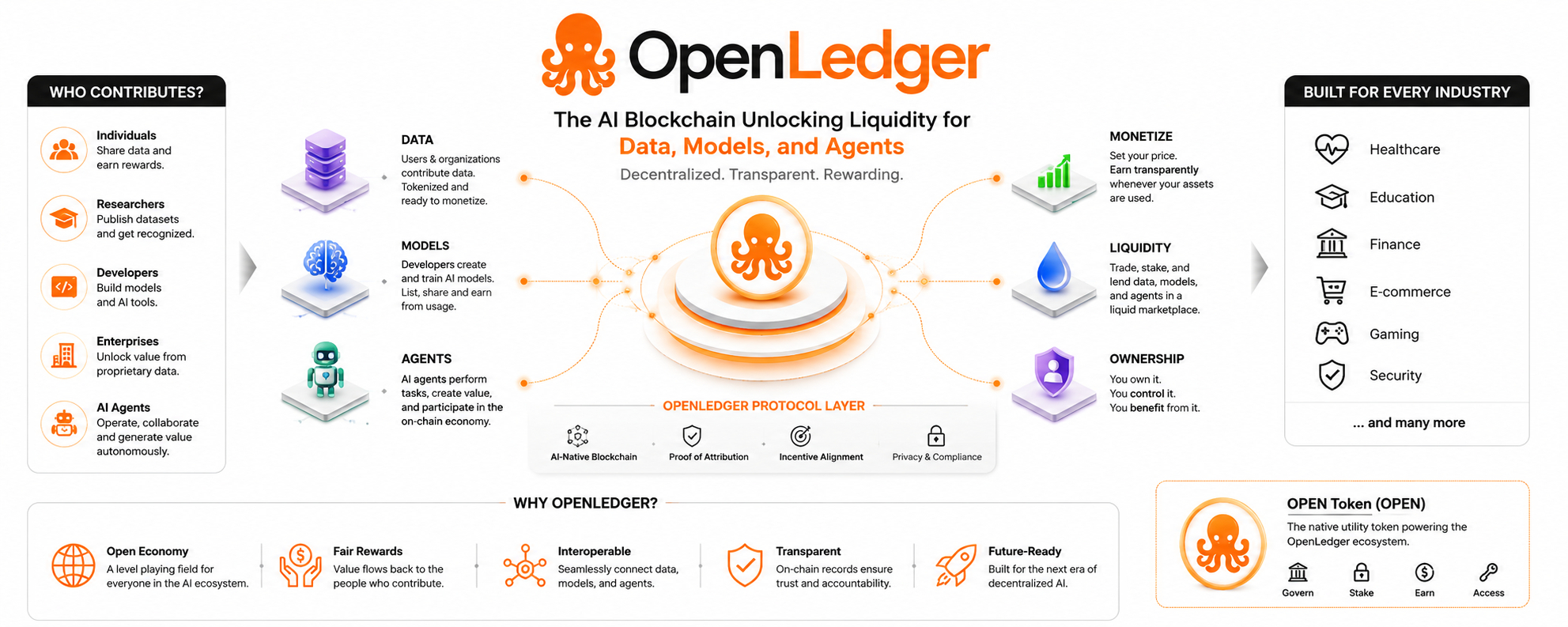
There was a time when people believed artificial intelligence would create a smarter and fairer future for everyone. The dream sounded beautiful. Machines helping humanity solve impossible problems, creators earning from their ideas, developers building without limitations, and ordinary people becoming part of a new digital economy. But as AI started growing faster, another reality quietly appeared behind the scenes.
A small number of companies began collecting everything.
They collected the data.
They controlled the models.
They owned the infrastructure.
And they captured most of the value.
Meanwhile, millions of people unknowingly continued feeding these systems every single day. Every search, every conversation, every image uploaded online, every creative thought shared publicly became part of a machine much larger than themselves. People helped train the future of artificial intelligence without ever truly owning a piece of it.
That is the world OpenLedger wants to challenge.
OpenLedger is not trying to follow temporary hype or build another ordinary blockchain project with empty promises. It feels more like an attempt to fix a growing imbalance before it becomes impossible to reverse. At its core, OpenLedger carries a very human idea — if people are contributing to the future of AI, they should also share in the value being created.
That thought alone makes the project feel different.
Most blockchain projects speak only about technology, numbers, or market performance. OpenLedger speaks about ownership in a world where ownership is slowly disappearing from ordinary people. It speaks about giving value back to contributors instead of silently extracting from them.
And honestly, that conversation matters now more than ever.
Artificial intelligence is becoming part of nearly every industry on Earth. It is changing how businesses operate, how people communicate, how content is created, how decisions are made, and even how knowledge itself is distributed. Some people see AI as a revolution. Others see it as a threat. But almost everyone agrees on one thing — the future will be deeply connected to intelligent systems.
The question is no longer whether AI will shape the world.
The real question is who will control it.
OpenLedger enters this conversation with a bold answer. It believes intelligence should not belong only to centralized corporations with massive servers and closed ecosystems. It believes data, models, and AI agents should become part of an open economy where contributors, builders, and communities can actually participate.
That vision feels powerful because it touches something personal.
People are tired of creating value for platforms that never truly reward them. Artists watch AI models learn from their work while receiving nothing in return. Developers spend years building tools only to compete against giant ecosystems with unlimited resources. Communities generate enormous amounts of online engagement, yet the financial upside usually flows upward to a handful of companies.
OpenLedger looks at this system and says maybe there is another way.
Instead of treating data like something to be harvested quietly, the project treats it like a real digital asset. Instead of locking AI models inside centralized environments, it creates pathways where models can generate value inside decentralized networks. Instead of limiting AI agents to closed systems, it imagines agents capable of interacting economically in open ecosystems.
In simple words, OpenLedger wants intelligence itself to become more accessible, more collaborative, and more rewarding for the people involved.
That idea may sound futuristic, but the deeper you think about it, the more natural it becomes.
Because human knowledge has always been collective.
No great invention was built entirely alone. Progress happens when people contribute pieces to something larger than themselves. The internet grew because millions participated. Open-source software transformed industries because developers collaborated globally. Blockchain challenged traditional finance because communities believed ownership could become decentralized.
OpenLedger seems to carry that same spirit into artificial intelligence.
And maybe that is why the project feels emotionally different from many others in the crypto space. It is not only selling technology. It is selling participation. It is telling people they should not remain invisible in the AI economy.
The OPEN token becomes part of that larger story. It is not simply about trading or speculation. It acts as a bridge connecting contributors, developers, validators, models, and intelligent agents within the ecosystem. But beyond utility, it represents something symbolic — a chance for people to become stakeholders in the growth of decentralized intelligence.
That narrative becomes even more important when you look at where the world is heading.
AI systems are becoming smarter every year. Companies are competing aggressively for data because data is now one of the most valuable resources on Earth. Entire industries are restructuring around machine learning capabilities. Governments are discussing regulations. Economies are preparing for automation. And in the middle of all this change, ordinary people are wondering whether they will benefit from the future or simply become resources inside it.
OpenLedger is trying to answer that fear with a more hopeful model.
A model where contributors are not forgotten.
A model where innovation does not require surrendering ownership.
A model where intelligence can grow without becoming completely centralized.
Of course, none of this will be easy. Building decentralized AI infrastructure is incredibly difficult. Scalability, trust, transparency, security, interoperability — every part of the system requires constant innovation. Many projects talk about changing the future, but very few attempt to solve problems this complex.
Still, history has shown that the most meaningful technologies often begin with ideas that seem impossible at first.
The internet once sounded unrealistic.
Blockchain once sounded dangerous.
Artificial intelligence once sounded like science fiction.
Now these technologies are colliding together at the same moment in history.
OpenLedger exists right in the center of that collision.
And maybe the most interesting part is that the project is not only asking technical questions. It is asking human questions too.
Who deserves to benefit from AI?
Who owns digital intelligence?
Who should control the systems shaping the future?
Will ordinary people participate in the next technological revolution, or will they simply feed it silently from the background?
Those questions are bigger than crypto markets.
They are questions about power, fairness, creativity, and the future relationship between humans and intelligent machines.
That is why OpenLedger feels larger than just another blockchain project.
It feels like part of a growing movement trying to make sure the AI era does not become another story where value concentrates into fewer and fewer hands while everyone else watches from the outside.
And maybe that is the strongest thing about OpenLedger.
It is not trying to replace humanity with machines.
It is trying to make sure humanity still has ownership in the age of machines.
