
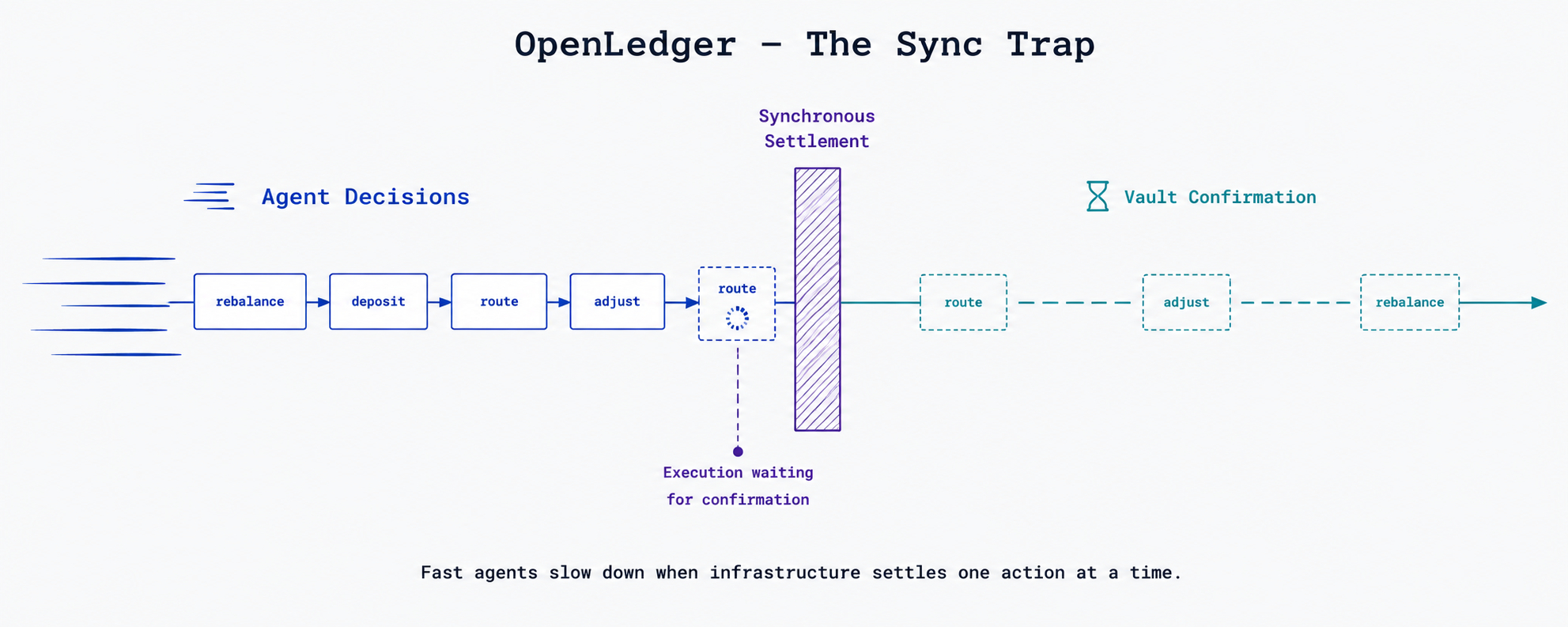


I built a rebalancing agent last year that worked perfectly in isolation.
Decision logic was clean.
Position sizing made sense.
The strategy itself held up.
Then I connected it to actual vault infrastructure and it deadlocked.
Not crashed.
Deadlocked.
The agent made a decision.
Called the deposit function.
Waited for confirmation.
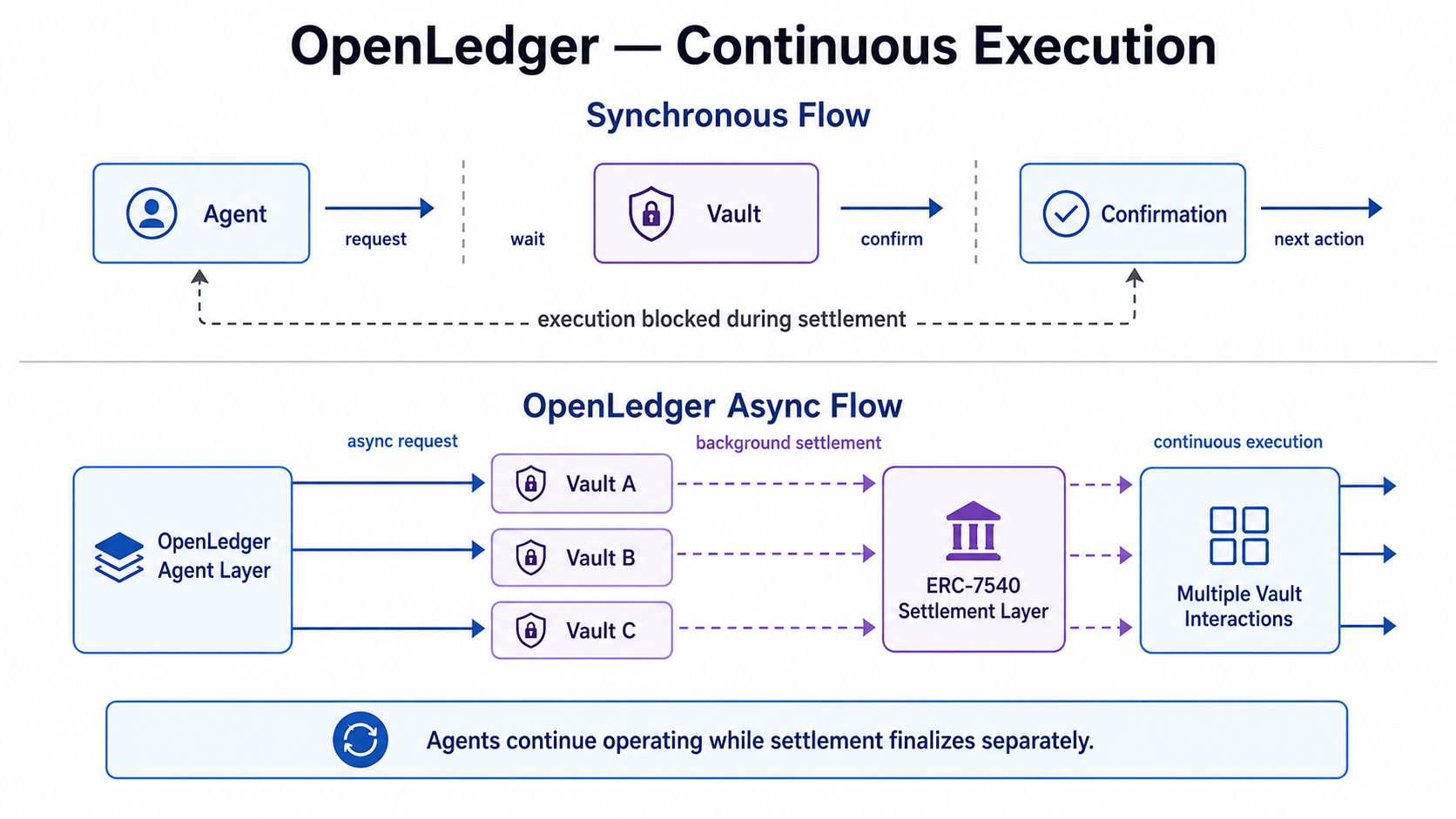
Standard ERC-4626 assumes synchronous settlement.
Deposit assets. Receive shares. Move to the next step.
The agent couldn't move until the vault confirmed the previous action.
Which meant the system wasn't operating continuously anymore.
It was operating in forced waiting periods between executions.
The decision-making was fast.
The infrastructure underneath it wasn't.
I keep thinking of that as the sync trap.
The deadlock that happens when continuous agent logic hits infrastructure designed for one-action-at-a-time human interaction.
Human users barely notice this constraint.
They deposit.
Wait.
Check the result.
Decide what to do next.
Humans are slow enough that synchronous settlement feels normal.
Agents aren't.
For an agent, every forced wait becomes a throughput constraint.
That's where things start breaking in ways most dashboards don't show clearly.
The agent can still make correct decisions.
The strategy can still technically work.
But intelligence and throughput stop scaling together.
The agent spends more time waiting than acting.
You don't end up with a bad model.
You end up with a fast decision-maker trapped on slow settlement rails.
The bottleneck stops being logic.
It becomes infrastructure timing.
That's the part that changed how I think about vault standards entirely.
Before this, I treated ERC standards mostly as compatibility layers.
Shared interfaces.
Cleaner integrations.
Lower adapter overhead.
Useful, but operationally boring.
The sync trap made me realize the interface layer quietly shapes what kinds of agent behavior are even possible.
A synchronous interface doesn't just slow execution.
It changes the structure of execution itself.
An agent forced to pause between actions behaves differently from one that can continue operating while previous requests settle asynchronously in the background.
The decisions compound differently.
The position adjustments happen on different timelines.
The reaction speed to changing market conditions changes.
The infrastructure starts influencing strategy behavior.
That's where ERC-7540 matters specifically.
Standard ERC-4626 assumes instant settlement.
ERC-7540 extends the vault interface to support asynchronous request flows.
The agent submits a request.
The vault acknowledges it.
Settlement processes separately.
The agent keeps operating while confirmation finalizes in the background.
No forced pause between every action.
No execution deadlock between decisions.
The vault and the agent stop needing to move at the same speed.
That's a deeper shift than it first sounds like.
Because once execution becomes continuous, yield stops behaving like a static strategy outcome.
It starts behaving like an emergent property of ongoing system behavior.
Not a human setting parameters and waiting.
An agent continuously repositioning across changing conditions without freezing every time infrastructure needs confirmation.
OpenLedger put that consequence directly.
Yield becomes an emergent property of continuous execution.
That line stayed with me because it describes a structural shift, not a feature upgrade.
Most DeFi infrastructure was designed around human interaction patterns.
Click.
Confirm.
Wait.
Agents don't naturally operate that way.
Continuous systems hitting synchronous infrastructure eventually create hidden bottlenecks.
The smarter the agent becomes, the more visible the bottleneck gets.
$OPEN sits inside this mechanically.
Every vault request, async settlement, rebalance, attribution event, and execution flow on OpenLedger consumes OPEN as gas.
Removing sync constraints increases execution throughput.
More throughput means more interactions.
More interactions means more OPEN consumed.
The token only becomes economically meaningful if continuous execution actually exists at scale.
Otherwise the infrastructure remains burst-based instead of persistent.
That's the part I think most people miss when they talk about agent economies.
The hard part isn't always building the intelligence.
Sometimes it's removing the waiting.
The part I'm still watching is the uncertainty window async systems create.
Synchronous settlement is slow but predictable.
Async settlement is faster, but the agent operates for a period of time before confirmation fully lands.
If conditions move hard during that window, the agent may be acting against partially settled state.
ERC-7540 defines the interface.
It doesn't define how agents should manage that uncertainty.
That's an execution problem.
Not an infrastructure one.
And it's where most agent systems still look unfinished to me.