

Most people still look at AI and blockchain as two separate conversations.
One side talks about models, agents, compute, and inference. The other side talks about liquidity, tokens, and decentralized coordination. What I’ve been noticing recently is that OpenLedger is trying to collapse those two worlds into the same economic system, and I think that’s the real reason the project has started attracting attention inside the current market cycle.
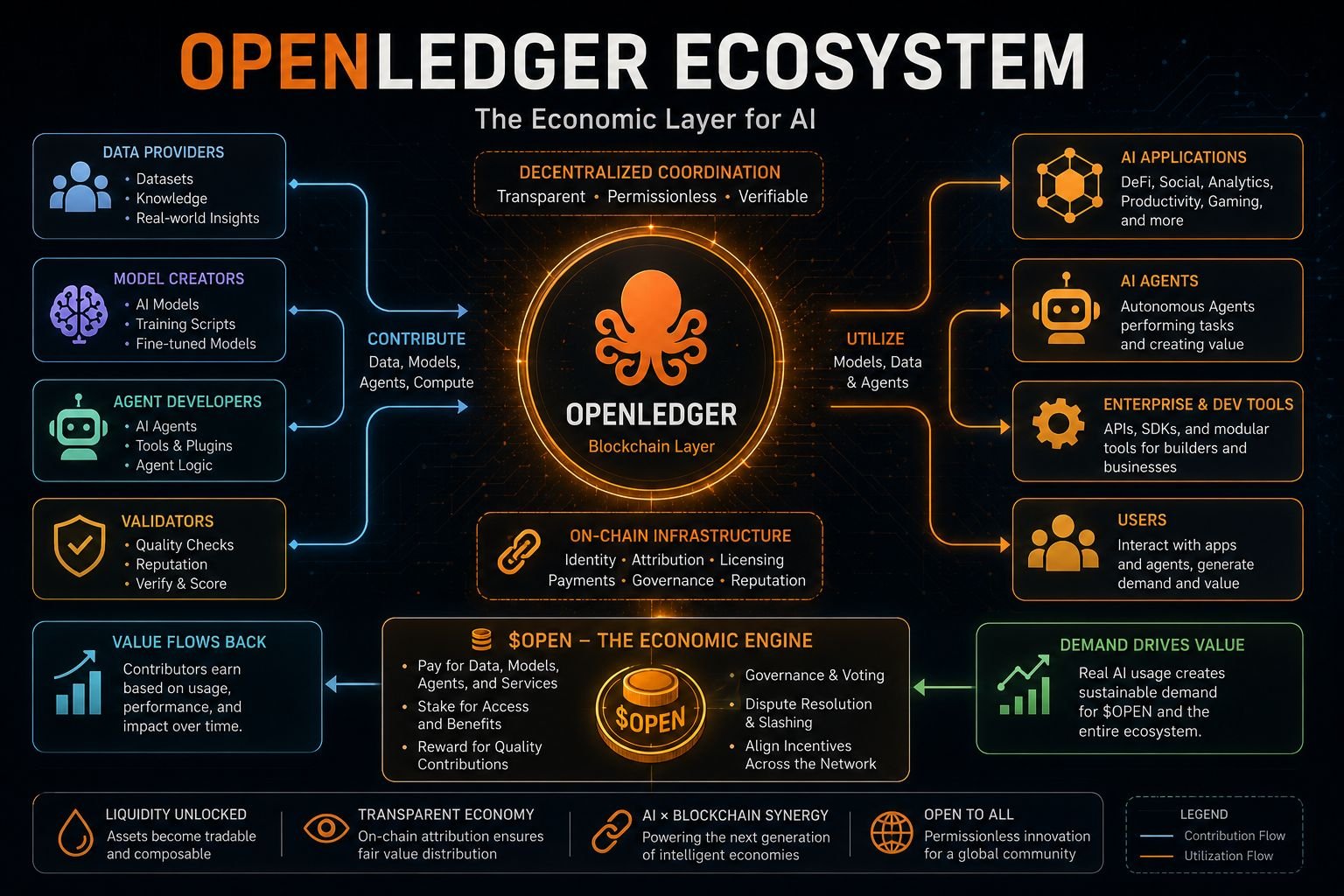
The interesting part is that OpenLedger is not positioning itself as “just another AI chain.” That category is already crowded. Every week another project appears claiming to build decentralized AI infrastructure. But when I look closely at OpenLedger, I think the more important idea is not AI itself. It’s the attempt to turn data and models into liquid economic assets that can continuously generate value instead of sitting idle.
That distinction matters more than most people realize.
Right now, almost the entire AI industry operates on a very strange imbalance. The companies training large models capture most of the value, while the people producing useful data, specialized knowledge, or smaller models rarely participate in the upside. Data gets extracted once, models get centralized, and users become consumers rather than economic participants.
OpenLedger seems to be built around changing that relationship.
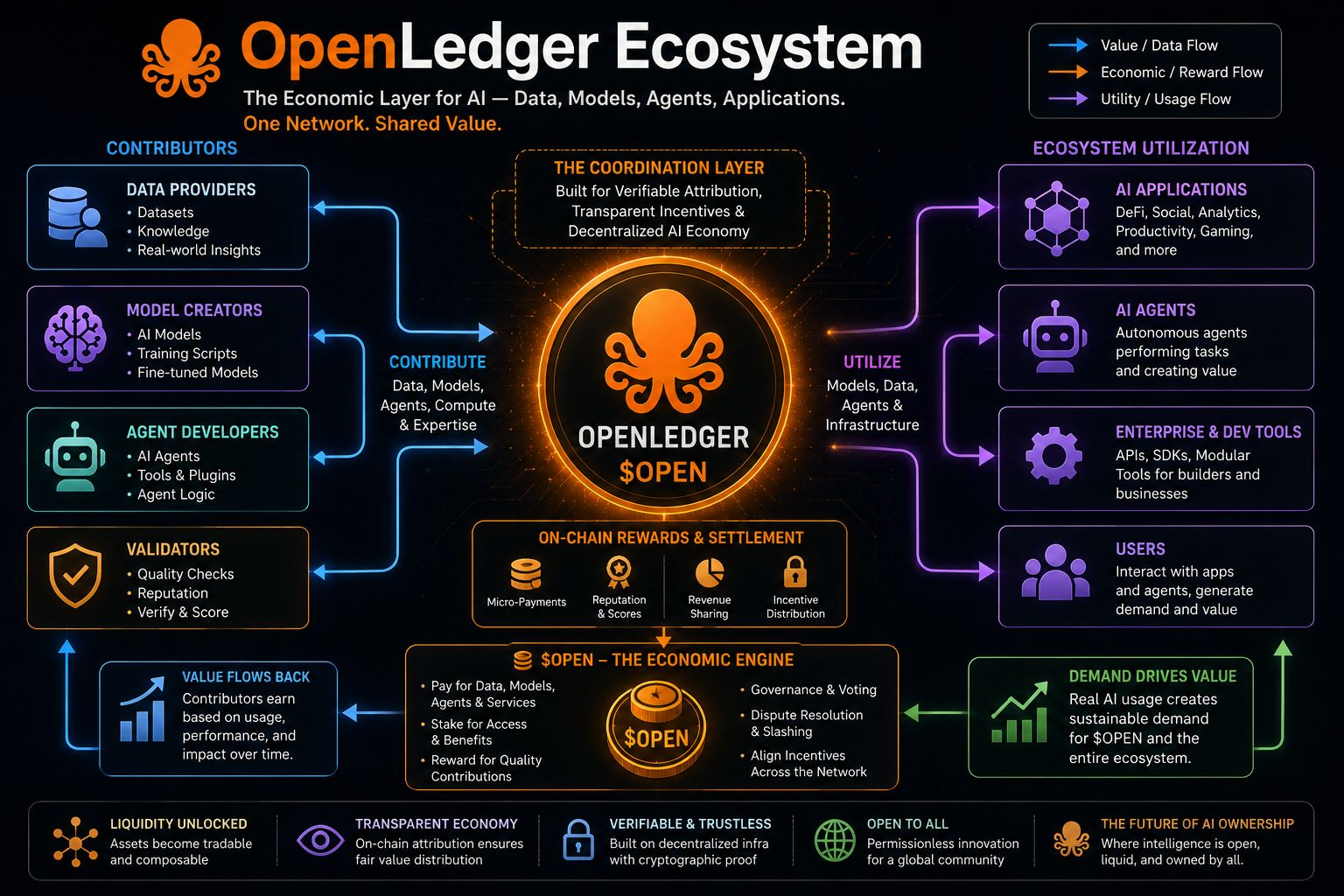
What caught my attention is the way the system treats data contributions almost like productive digital infrastructure rather than passive uploads. Instead of viewing AI datasets as static resources, the network tries to create a framework where useful data, models, and agents can continuously interact with applications while generating economic activity on-chain.
In simple terms, I think OpenLedger is trying to answer a difficult question the market has quietly ignored:
How do you create an economy around AI itself instead of just speculating on AI narratives?
That sounds abstract until you look at how AI products actually function today. Most models rely on huge amounts of constantly evolving information. The better the data quality and specialization, the more valuable the model becomes. But there has never really been a clean mechanism to reward contributors proportionally over time.
OpenLedger appears to be experimenting with exactly that layer.
The reason I find this important now is because the broader market is entering a phase where infrastructure narratives matter again. Earlier cycles rewarded attention more than utility. A token only needed momentum and community energy. But as liquidity becomes more selective, I think investors are starting to look for systems that connect directly to real computational demand or real economic coordination.
AI is obviously one of the strongest narratives in technology right now, but narratives alone eventually hit a ceiling. At some point, markets start asking where the actual value flow comes from. That’s where OpenLedger becomes more interesting to me.
The architecture itself is not especially flashy from the outside, and honestly I think that’s intentional. The project focuses more on coordination mechanisms than visual complexity. The chain acts as an economic layer where AI-related assets, contributions, and interactions can be tracked, priced, and rewarded transparently.
The easiest way I can describe it is this:
Imagine thousands of contributors feeding specialized intelligence into a shared ecosystem where models, applications, and agents continuously consume that intelligence. Instead of one centralized company owning the monetization pipeline, the network attempts to distribute economic value back through the system itself.
That sounds efficient in theory, but the difficult part is incentive alignment.
This is where most decentralized AI projects struggle.
If rewards are too easy to farm, the network fills with useless data. If participation becomes too technical, adoption slows down. If token incentives overpower real utility, the ecosystem becomes speculative instead of productive. OpenLedger still has to prove it can balance those forces over time.
And honestly, that uncertainty is probably healthy.
One thing I’ve learned from watching crypto for years is that the projects worth paying attention to are usually the ones dealing with uncomfortable coordination problems rather than easy marketing narratives. OpenLedger is entering a space where both AI economics and blockchain incentives remain largely unresolved.
That creates opportunity, but it also creates fragility.
From a market perspective, I think the token mechanics are what traders will watch most closely over the next phase. If the network genuinely succeeds in generating meaningful AI-related activity, then the token stops behaving purely like a speculative asset and starts acting more like economic infrastructure. Demand would theoretically come from actual participation inside the ecosystem rather than only secondary market excitement.
But that transition is difficult.
Crypto markets often price future expectations long before real usage arrives. So there’s always a period where valuation runs ahead of fundamentals. I suspect OpenLedger will eventually face that exact tension. Traders may push volatility aggressively around ecosystem announcements, partnerships, or AI narratives before sustainable network activity fully matures.
That doesn’t necessarily invalidate the project. It just means the market cycle around the token may look very different from the slower reality of infrastructure development.
Another thing I’m watching carefully is user behavior.
A lot of blockchain systems sound powerful architecturally but fail because normal users never meaningfully interact with them. OpenLedger’s long-term success probably depends on whether developers, data providers, and AI applications genuinely find economic advantage inside the network compared to centralized alternatives.
That’s a very high bar.
Centralized AI systems are still faster, simpler, and operationally efficient in many cases. Decentralized coordination only wins if the incentive structure becomes strong enough to justify the additional complexity. I think OpenLedger understands this challenge, which is why the project keeps emphasizing liquidity and monetization rather than ideology.
That’s actually one of the more realistic approaches I’ve seen recently.
The market also seems to be slowly shifting from “AI hype” toward “AI ownership.” Earlier conversations were mostly about which model was smartest. Now people increasingly care about who owns the data, who controls distribution, and who captures the value generated by autonomous systems.
That broader shift could become extremely important over the next few years.
Because once AI agents begin interacting economically at scale, the infrastructure governing those interactions becomes incredibly valuable. Payments, attribution, contribution tracking, and incentive distribution all become part of the same system. I think OpenLedger is positioning itself around that future before most people fully recognize where the industry is heading.
Still, I don’t think this is the type of project that should be viewed through short-term excitement alone.
The real test is whether economic activity becomes durable after the narrative attention fades. Can the ecosystem continue attracting meaningful participation when the market eventually rotates to another trend? Can the token maintain relevance beyond speculation? Can decentralized AI coordination genuinely outperform parts of centralized infrastructure?
Those are difficult questions, and I don’t think anyone honestly knows the answers yet.
But I do think OpenLedger is attempting to solve a more important problem than most projects currently being discussed. It’s not simply trying to build another chain or another AI product. It’s trying to build a market structure around intelligence itself.
And if that idea works even partially, the implications are much larger than most people currently realize.
