


Most crypto projects don't disappear because the technology failed.
They disappear because nobody became dependent on them.
That's the frame I've been using while watching @OpenLedger and $OPEN
A few cycles ago I watched an ecosystem lose momentum almost overnight after incentives slowed down.
Users left first.
Then liquidity.
Then integrations quietly stopped updating.
Nothing was technically broken.
People just realized they could leave without disrupting anything important.
That's when I started thinking differently about infrastructure.
Real infrastructure isn't defined by hype or even usage.
It's defined by dependency.
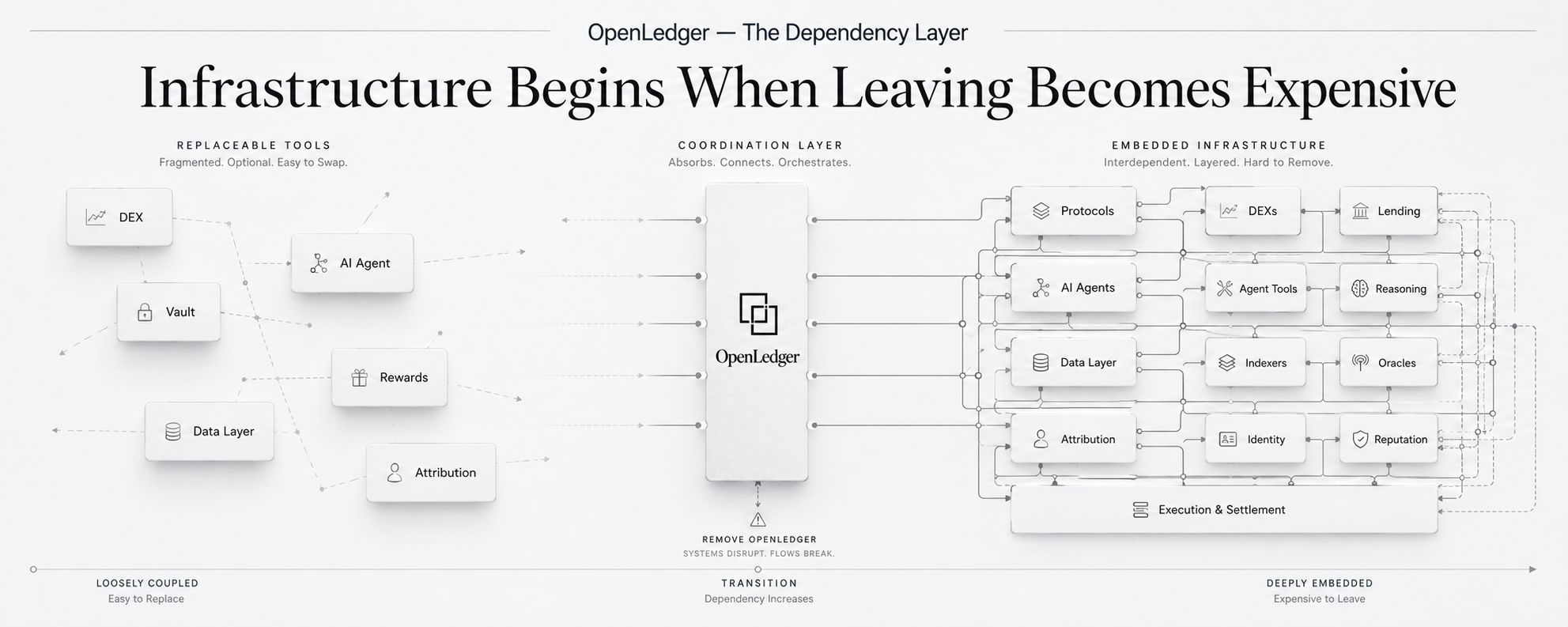
How expensive does leaving become once other systems start building on top of you?
Most crypto products never cross that line.
They're useful.
Sometimes genuinely innovative.
But still replaceable.
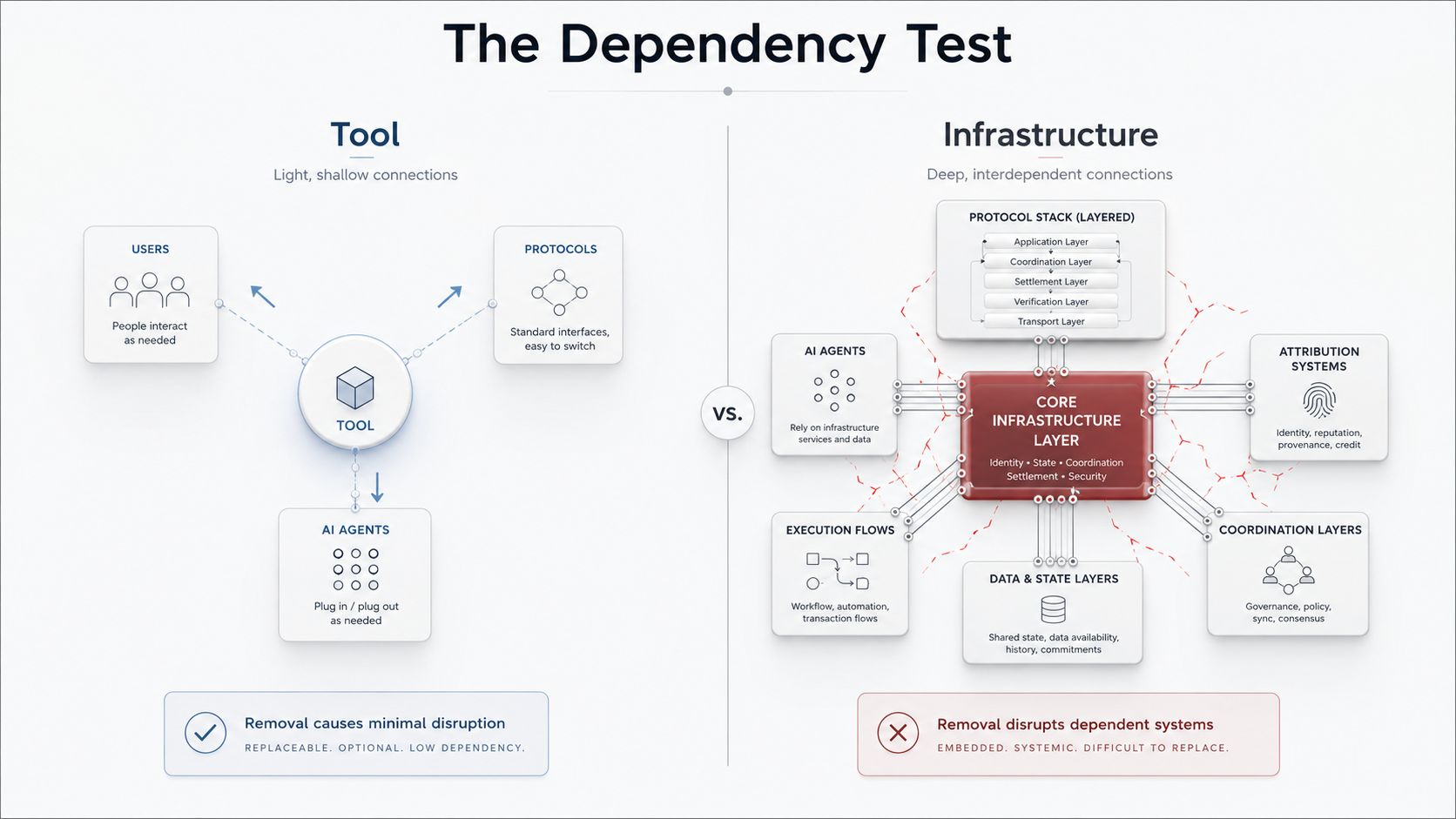
Infrastructure behaves differently.
Once protocols, agents, and applications start coordinating through a system deeply enough, removing it stops being simple.
Not because the system is perfect.
Because too many connected workflows depend on it continuing to function.
That's the part of OpenLedger I think most people still evaluate too superficially.
The surface narrative is easy:
AI agents.
Proof of Attribution.
Async execution.
Cross-chain coordination.
The more important question is whether other systems begin depending on those mechanisms deeply enough that removing them becomes operationally painful.
Because if that happens, $OPEN stops behaving like a normal speculative asset.
It starts behaving more like infrastructure fuel.
Every attribution settlement.
Every agent execution.
Every workflow routed through the network.
Every external protocol integrating OpenLedger instead of rebuilding internally.
Dependency compounds.
Infrastructure usually compounds differently than products do.
What makes this interesting is that the mechanisms already solve problems that exist right now.
Most AI systems still lose the connection between contributors and outputs once training finishes.
Most blockchain infrastructure still assumes humans tolerate waiting between actions.
Agents don't.
That difference matters more than most systems are designed for yet.
Still, none of this guarantees OpenLedger wins.
I've watched technically strong ecosystems lose before.
Sometimes another network moved faster on integrations.
Sometimes onboarding was easier.
Sometimes developers coordinated somewhere else first.
That's still the real risk.
Not failure of the technology itself.
Failure to become embedded deeply enough before another coordination layer reaches escape velocity.
So the signals I'm watching aren't announcements.
They're dependency signals.
Do protocols begin building reward systems directly around OpenLedger's attribution layer?
Do agents start coordinating across systems instead of operating alone?
Does $OPEN begin appearing inside workflows outside the immediate OpenLedger ecosystem?
That's usually how infrastructure emerges.
Quietly.
One dependency at a time.