
I was doomscrolling crypto stuff again last night when I landed on another thread about “AI infrastructure.” Same recycled excitement. Same dramatic predictions. Different token ticker. At this point, every second project claims it’s building the future of artificial intelligence on blockchain, and honestly, most of them sound like they were created inside a marketing meeting nobody wanted to attend.
Everything is “revolutionary.” Everything is “decentralized AI.” Everything is apparently going to change humanity forever.
Meanwhile half these chains can barely handle real traffic without slowing down the second users actually show up.
That’s the part people avoid talking about. Crypto projects don’t usually fail because the technology completely breaks. They fail because real humans finally arrive. Too many wallets. Too many bots. Too much speculation. Everyone chasing rewards at the same time until the system starts coughing smoke.
And somehow, in the middle of all this noise, I kept seeing OpenLedger pop up.
At first I ignored it because I’m honestly tired of AI narratives getting shoved into crypto every five minutes. Slap “AI” onto anything right now and people immediately start calling it the future. We’ve seen this before with metaverse projects, gaming chains, DeFi farms, NFTs, all of it. The cycle changes but the behavior stays exactly the same.
But OpenLedger felt slightly different when I actually looked deeper into it.
Not magical. Not perfect. Just… different enough to make me pay attention.
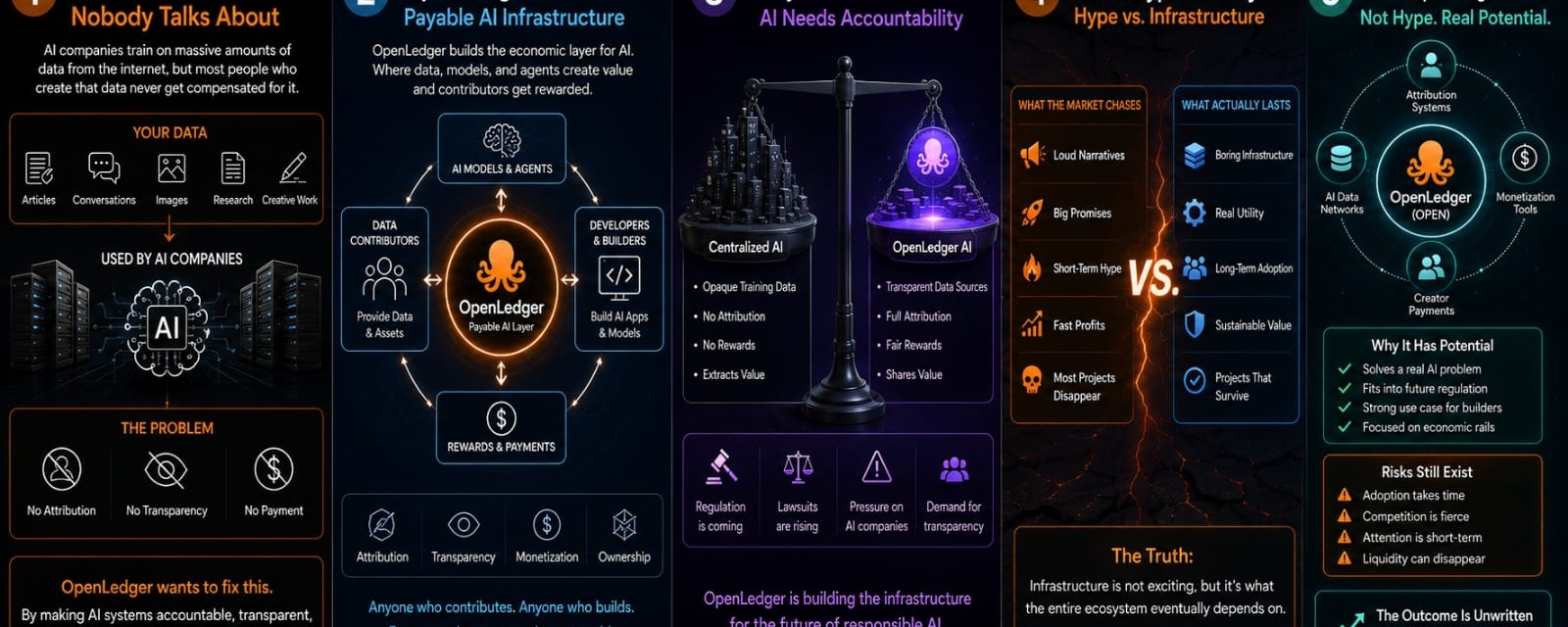
The project is basically trying to build an AI blockchain where data, models, and AI agents can actually generate value and distribute rewards back to contributors. Their whole idea revolves around something they call “Payable AI,” which sounds a little corporate at first, but the concept behind it makes sense.
AI companies are training models using massive amounts of internet data, and most people who created that data never get compensated for it. Articles, conversations, images, research, creative work — all of it gets absorbed into training systems. OpenLedger is betting that eventually people will demand transparency around where AI models get their information from and who deserves payment when those systems make money.
And honestly… that doesn’t sound crazy to me anymore.
Because AI right now feels like the wild west pretending to be organized. Everyone’s racing to build faster models, smarter agents, bigger systems, but almost nobody talks about ownership properly. Who gets rewarded? Who gets credited? Who controls the value once AI starts automating larger parts of the internet economy?
That’s where OpenLedger is trying to position itself.
Not as another chatbot. Not as the next OpenAI killer. More like the accounting layer underneath AI systems.
And weirdly enough, that might actually be smarter than trying to compete directly with massive centralized AI companies.
The crypto market loves flashy promises, but boring infrastructure usually survives longer.
That’s something I’ve learned the hard way.
The projects screaming the loudest about “changing the world” usually disappear the fastest once liquidity dries up. Meanwhile the quieter infrastructure projects sometimes stick around because they solve annoying problems nobody else wants to deal with.
Still, I’m cautious.
Crypto people have a habit of falling in love with concepts before real adoption exists. We romanticize potential like it’s already reality. And there’s a huge difference between a project sounding important and people actually using it daily.
That gap kills most ecosystems.
OpenLedger launched its OPEN Mainnet and pushed heavily into attribution systems, AI data networks, and monetization tools for models and datasets. On paper, it sounds practical. They’ve also been building partnerships around AI licensing and creator payments, which at least feels more grounded than the usual “AGI on-chain” fantasy stuff.
But here’s the uncomfortable truth nobody wants to admit: users are lazy.
Most people in crypto still care more about price action than infrastructure. They’ll talk about decentralization all day and then immediately bridge into whatever ecosystem offers the fastest profits. Attention spans here are brutal. Communities switch narratives every few months like changing clothes.
That creates a real problem for projects like OpenLedger.
Because even if the tech makes sense long term, adoption still depends on people caring enough to participate. And participation in crypto usually follows incentives before utility.
That’s why I keep going back and forth mentally about OPEN.
Part of me thinks the timing makes sense. AI regulation is increasing. Questions around training data ownership are becoming unavoidable. Governments are paying attention now. Lawsuits are piling up. Big AI companies are under pressure to explain how their models are trained.
If AI eventually needs transparent systems for attribution and payments, OpenLedger could fit naturally into that future.
But another part of me remembers how many “future infrastructure” projects already exist in crypto graveyards.
Good ideas alone don’t save ecosystems.
Liquidity matters more than people admit.
I know that sounds cynical, but after being around crypto long enough, it becomes obvious. A project can have brilliant developers, smart architecture, strong vision — none of it matters if liquidity disappears and nobody wants to stay. Once volume dies, everything starts feeling abandoned fast.
And AI crypto projects are entering a dangerous zone right now where narratives are overheating again. Every chain suddenly wants to become the AI chain. Every roadmap includes agents, automation, decentralized compute, or machine economies.
Most of these projects probably won’t survive.
Not because AI is fake. Not because blockchain is useless.
Just because hype moves faster than reality.
That’s always been crypto’s biggest problem.
People expect infrastructure to instantly create demand, but real adoption usually takes years and arrives much slower than investors want. The internet itself took decades before average people fully depended on it. Crypto still acts like every new project should dominate the world within six months.
That mindset destroys patience.
And honestly, I think OpenLedger understands this better than some competitors do. They aren’t trying to pretend they already solved AI itself. They’re focusing more on monetization rails, attribution systems, and economic coordination around AI assets.
That sounds boring compared to the louder projects.
Which weirdly makes me trust it a little more.
Still, none of this guarantees success.
Crypto history is full of technically solid projects nobody cared about. Sometimes the market rewards nonsense longer than logic. Meme coins outperform infrastructure. Random trends absorb all the attention while serious builders quietly keep working in the background hoping users eventually arrive.
It’s messy.
That’s the best word for this industry honestly. Messy.
People outside crypto think everything here is calculated and strategic, but half the time it feels like a giant emotional experiment fueled by sleep deprivation, greed, fear, and online narratives moving at unhealthy speeds.
And AI is making that chaos even more intense now.
Because underneath all the hype, there actually is something important happening. AI is changing how information, creativity, and labor work online. That part is real. The question is whether blockchain projects like OpenLedger can create systems that genuinely help manage that shift instead of just turning it into another speculative casino.
I think there’s a chance.
Not certainty. Just a chance.
Maybe OpenLedger becomes important infrastructure later because AI eventually needs transparent ownership and payment systems. Maybe OPEN finds a real role connecting data contributors, developers, and AI economies.
Or maybe people simply don’t care enough once market excitement fades.
That’s the part nobody can predict.
And honestly, after years in crypto, I’ve stopped pretending I know how these stories end. Sometimes the obvious winners disappear. Sometimes the quiet projects survive longer than expected.
Right now OpenLedger feels somewhere in the middle for me. Not overhyped garbage. Not guaranteed success either. Just a project trying to solve a real problem in an industry full of fake ones.
And in crypto these days, that alone already makes it interesting.