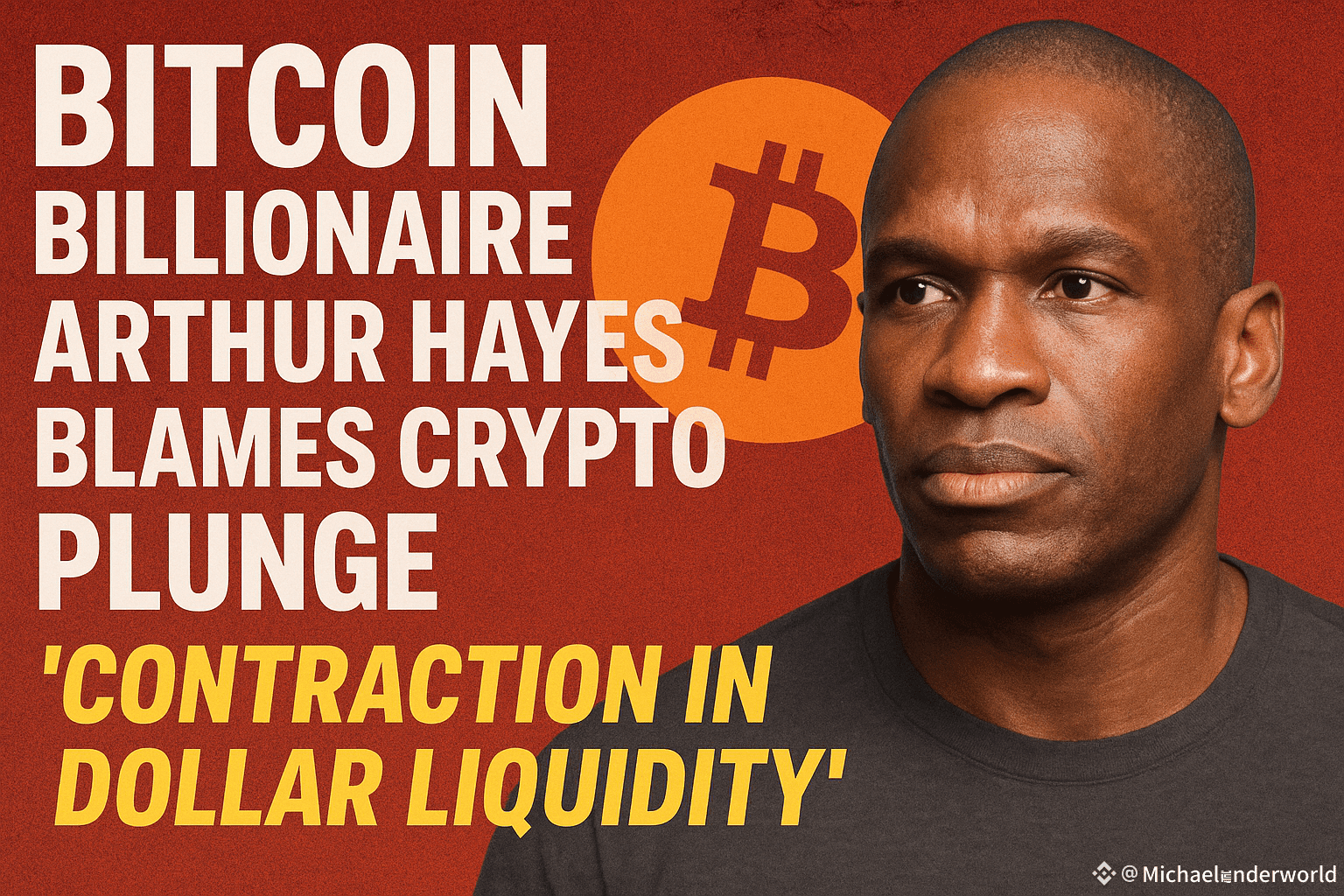
$BTC Arthur Hayes, the former BitMEX chief known for calling macro turns before they hit the mainstream, has offered a blunt explanation for Bitcoin’s sudden slide: the world is choking on a shortage of fresh U.S. dollars.
Hayes argues the drop has nothing to do with governments losing interest, ETF investors flipping bearish, or the usual headlines people rush to blame. In his view, Bitcoin is simply reacting to a shrinking pool of liquidity — the lifeblood of global markets.
“Bitcoin is the world’s truest thermometer for fiat liquidity,” Hayes wrote in his latest market note, adding that the asset prices in future money creation long before it actually happens.
---
BTC Dips Below $90K — While Stocks Pretend Nothing Is Wrong
On Tuesday, Bitcoin slipped under the $90,000 mark, its lowest level in seven months, and wiped out all of its gains for 2025. Meanwhile, major U.S. stock indices like the S&P 500 and Nasdaq 100 are still hovering near record territory.
To Hayes, this divergence isn’t random — it’s a warning.
He believes such a split often signals that a credit shock is forming beneath the surface. If stocks suddenly correct by 10–20% and interest rates remain stuck near 5%, the U.S. government would have one option: print even more dollars to rescue the system.
And that is where his bold prediction comes in.
With new liquidity, he thinks Bitcoin could catapult to $200,000–$250,000 before the year ends, especially if broader markets start unravelling and force the Federal Reserve and Treasury back into “money-printing mode.”
---
Why Bitcoin Held Up… Even While Liquidity Fell
Interestingly, Hayes points out that Bitcoin kept rising from April onward even though his preferred liquidity gauges showed the dollar supply falling.
He attributes the mismatch to two forces:
Heavy ETF inflows from institutions
Pro-Bitcoin messaging from the Trump administration
Those institutional inflows, however, have now reversed violently.
Last week, BlackRock’s flagship Bitcoin ETF, IBIT, suffered a record $463 million single-day outflow, contributing to nearly $2 billion in total crypto fund exits worldwide.
---
Institutions Aren’t “Buying Bitcoin” — They’re Running a Basis Trade
Hayes highlights a detail most retail traders completely overlook:
The biggest holders of IBIT — firms like Goldman Sachs and Jane Street — aren’t bullish Bitcoin holders at all. They’re using the ETF for a basis trade, a complex strategy where traders:
Buy the ETF
Short CME Bitcoin futures
Profit when the gap between the two prices eventually closes
As Hayes notes, these institutions are playing a spread game, not a belief game. And because brokers often let them post the ETF as collateral for their futures positions, the trade consumes far less capital.
JPMorgan estimates the total size of basis trades across markets sits around $400 billion — making it one of the largest engines of hidden market activity.
But as Bitcoin’s price falls, the basis shrinks, making the trade far less attractive. Fewer inflows follow. Institutional players unwind positions. Retail misreads the exits as “institutions dumping Bitcoin,” creating more fear… and the cycle accelerates.
---
The Feedback Loop Hayes Warns About
According to Hayes, retail investors are interpreting these outflows all wrong.
Institutions aren’t saying they dislike Bitcoin — they’re simply abandoning an arbitrage trade that’s no longer profitable.
But the misunderstanding creates a chain reaction:
1. Retail assumes institutional conviction is fading
2. Retail sells
3. Basis gets even smaller
4. Institutions unwind more $BTC ETF exposure
5. More selling follows
A self-fulfilling loop.
---
The Bottom Line
In Hayes’ view, Bitcoin didn’t crash because the world lost interest. It crashed because dollar liquidity shrank, ETFs unwound their basis trades, and the market misread those signals as a vote of no confidence.
And if he’s right, the pain may not be over: Hayes expects $BTC could dip into the low $80,000s before roaring back toward quarter-million levels — but only once the U.S. turns the liquidity taps back on.
#BTCVolatility #USJobsData #USStocksForecast2026 #CPIWatch #WriteToEarnUpgrade