
hip.
The first time I seriously looked at @OpenLedger .
My brain filed it under a familiar category:
Data marketplace.
You contribute data.
AI models get trained on it.
You receive compensation.
That’s the pitch, more or less, and honestly it’s a reasonable one.
I’ve watched enough infrastructure projects come and go to know that clean, transactional models are underrated. They work.
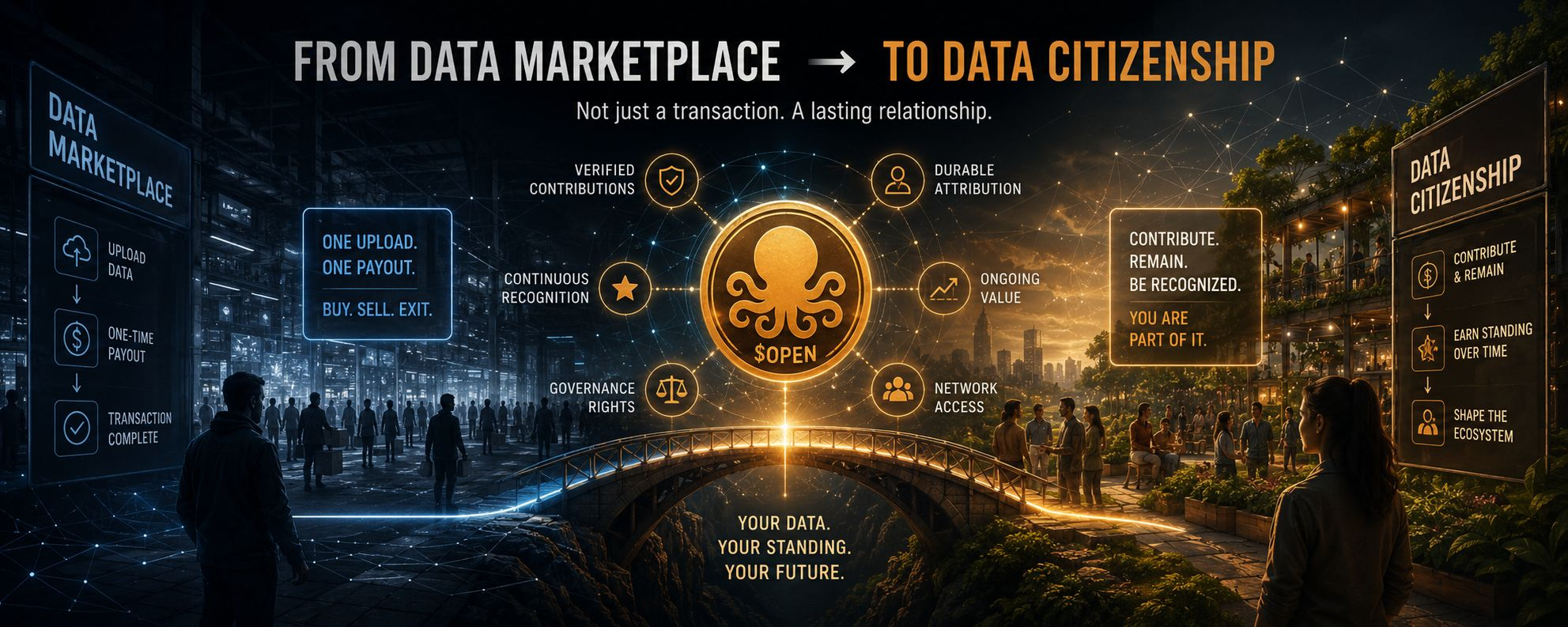
But OpenLedger isn’t just a place where data gets sold.
In plain terms, it’s a protocol designed to let people contribute data in a way that can be verified and attributed.
So models can keep learning from it over time and contributors can keep being recognized for the value they’re actually providing.
If a marketplace is “one upload, one payout,” #OpenLedger seems to be trying to make the relationship continuous.
Something kept bothering me the longer I stayed with it.
A marketplace has a straightforward logic.
Someone brings something to sell.
Someone else buys it.
The exchange completes and both parties walk away.
Whatever relationship existed was fully contained in that moment. You don’t owe each other anything after.
Most data monetization projects I’ve looked at operate exactly this way.
You’re a supplier.
The protocol is the market. The token is how you get paid.

OpenLedger doesn’t sit cleanly in that frame.
The more I read about it in the official pdf white paper that how the protocol actually functions? the more it looked like the relationship between a contributor and the network doesn’t end at the point of payout.
Data verification, attribution, ongoing model training cycles—these aren’t events that happen once and close.
They’re the point. And if that’s true, then $OPEN isn’t just “money for data.”
It may be pricing something closer to membership:
A durable kind of presence in the system.... where your contribution keeps counting because the system keeps using it.
A simple way to picture it is to stop thinking in terms of “selling a dataset” and start thinking in terms of “becoming legible to the network.”
Imagine you contribute a specialized set of information—say, annotated examples from a niche domain you actually understand.
The contribution isn’t valuable because it exists once.
It’s valuable because it can be checked, referenced, and reused whenever a model is trained again, or improved again, or evaluated again.
If the network can reliably attribute that value back to you,
Then you’re not just a one-time seller. You’re a continuing source.
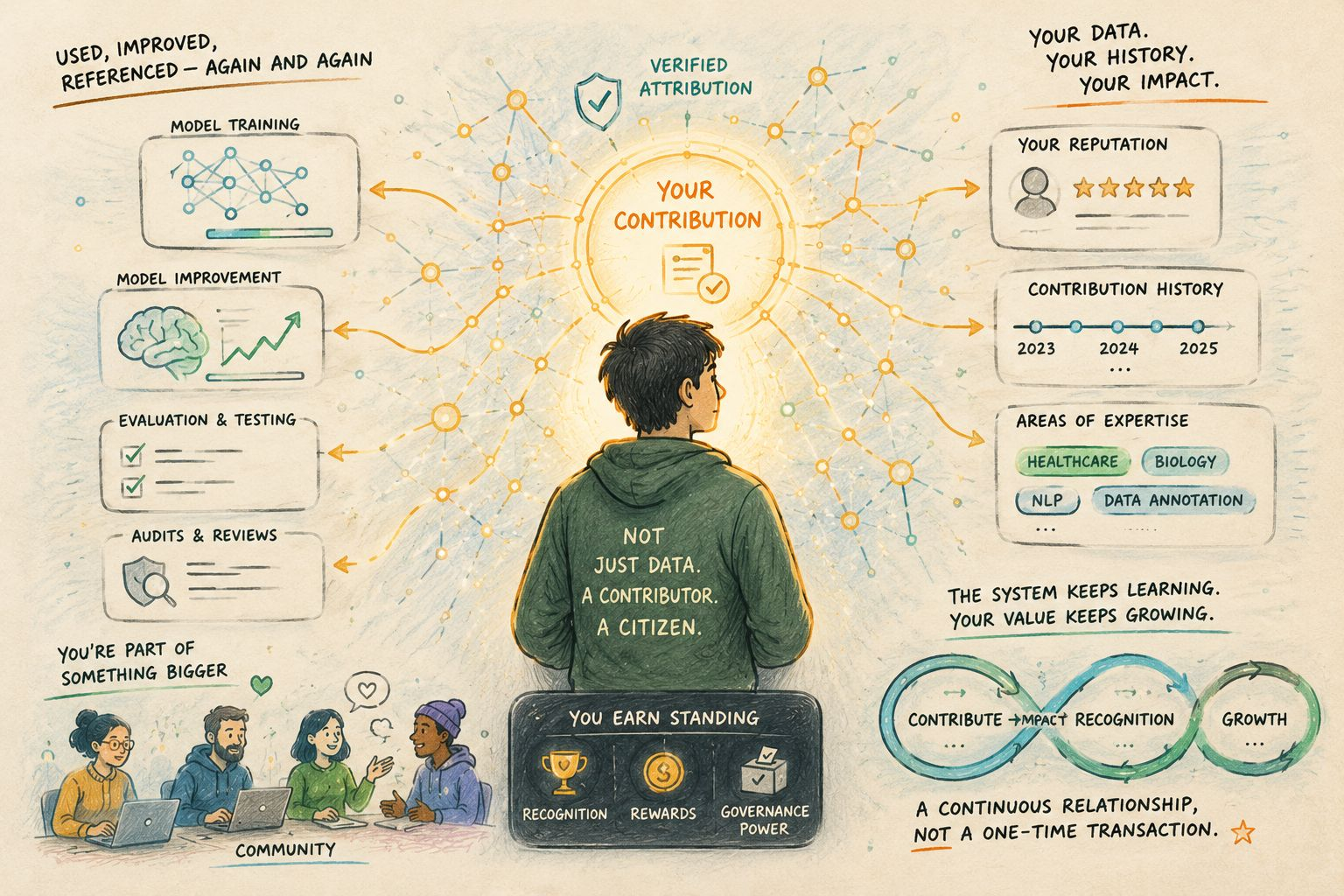
Your data has a history.
Your identity in the system has weight.
And a token that tracks access, incentives, and governance starts to feel less like a payout mechanism and more like the way that “weight” is represented.
This is when I started thinking about cooperative grocery stores.
There’s a type of grocery store, common in parts of Europe and in smaller communities, where you don’t just shop there.
You own a fraction of it.
Local farmers bring produce.
Members vote on what gets stocked.
Everyone receives a share of the surplus at the end.
It’s still commerce, obviously—things are bought and sold—but the deeper logic isn’t a one-off exchange. It’s participation in a system you have a stake in, where the health of the whole matters because you’re part of the whole.

That’s the feeling OpenLedger gave me.
Not “upload and exit,” but “contribute and remain.” Not “sell your data,” but “earn standing through verified usefulness.” If that sounds like I’m stretching, I get it.
Crypto loves to rename things and call it a breakthrough.
But the reason this frame matters is because data is not like most commodities. It compounds.
Once it’s in a model training loop, the real question is not only who got paid once, but who keeps getting acknowledged as the value keeps being extracted.
And this is the part that makes the timing feel real.
We’re walking into an era where AI systems will be trained, retrained, fine-tuned, and audited in cycles, and the social pressure around “where did this come from” is only going to increase. The old story—data gets scraped, value gets concentrated, and contributors are invisible—has run out of runway.
If OpenLedger is serious about making contribution verifiable and attribution durable, then it’s not competing with marketplaces so much as it’s challenging the default arrangement.
So when people ask what OPEN is for?
I don’t think the most interesting answer is “it pays contributors.”
Plenty of tokens can do that.
The more interesting question is whether OPEN ends up representing a kind of data citizenship: the right to be recognized, rewarded, and counted in a system that doesn’t stop learning from you just because the first transaction is over.
If you’re watching OpenLedger from the sidelines, the simplest next step is to stop trying to categorize it as a marketplace and instead ask a different question: what would it look like if contributors weren’t just vendors, but participants with ongoing rights inside the training economy?
If that question grabs you the way it grabbed me, OpenLedger is worth a closer read.

__