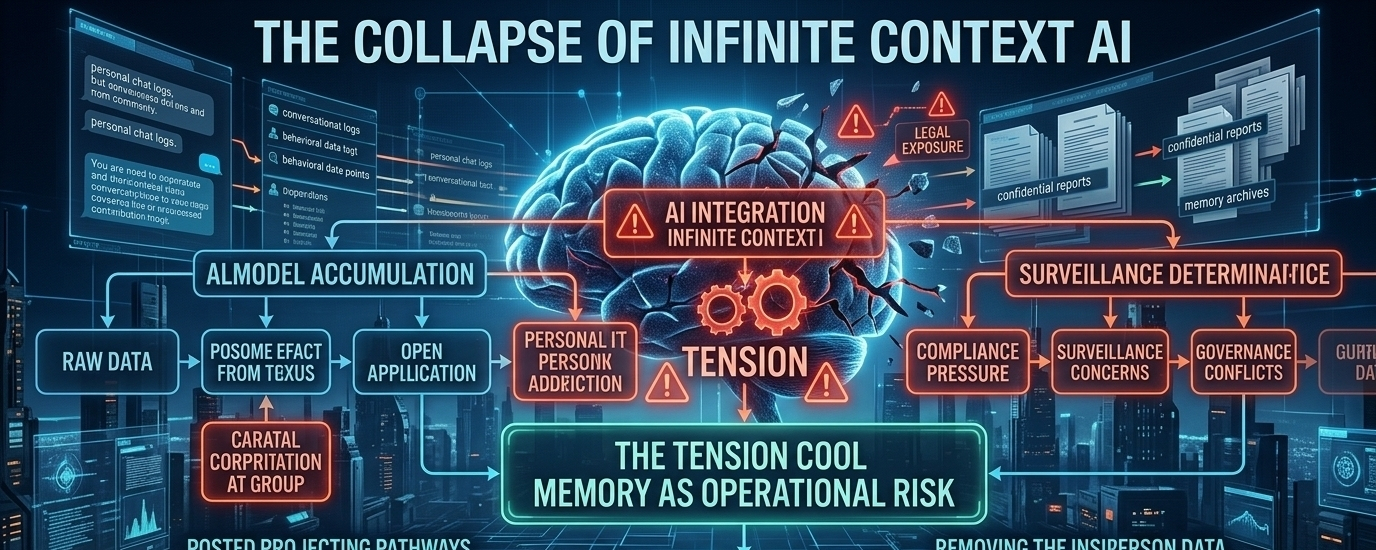

One assumption quietly dominates almost every AI product being built right now:
More context is always better.
Longer memory windows. Persistent personalization. Infinite conversation history. Continuous behavioral learning. The industry treats retained context like a universal competitive advantage, as if the ideal AI system is simply the one that remembers the most for the longest amount of time.
I think that assumption breaks eventually.
And honestly, the deeper I think about OpenLedger, the more I suspect the project may be positioned around what happens after that break occurs.
Because “infinite context” sounds brilliant in theory.
Until the context becomes dangerous.
Right now the market still views memory primarily through a performance lens. Better memory improves outputs. Better outputs improve user retention. Better retention improves monetization. Clean equation.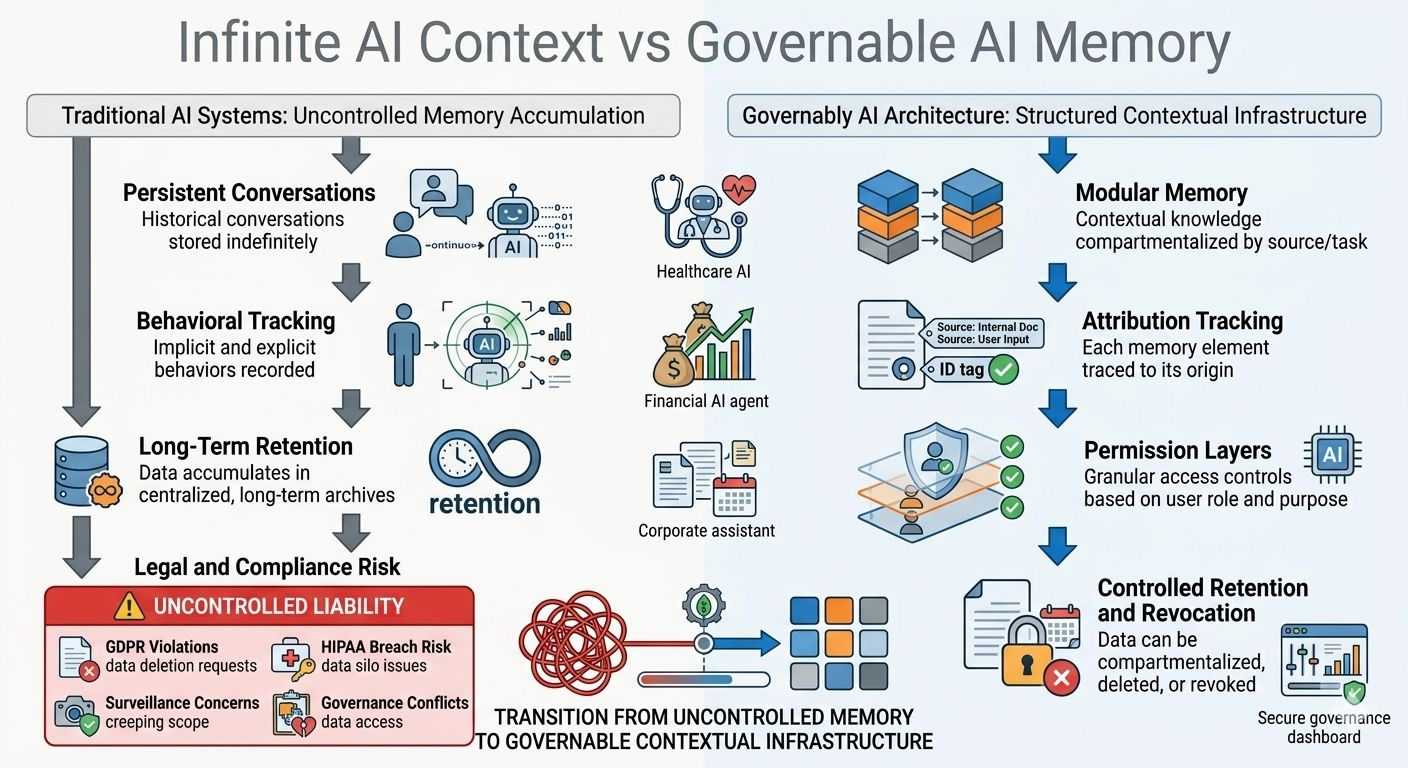
But corporations do not operate purely on performance curves. They operate inside legal systems, geopolitical systems, shareholder systems, and compliance systems. That changes how memory gets valued.
The same persistent context that makes an AI assistant useful can also become the exact thing that creates catastrophic exposure later.
A healthcare assistant remembering years of patient interactions sounds intelligent right up until a regulatory dispute emerges around consent boundaries. A corporate AI retaining internal strategic discussions feels productive until legal discovery turns that memory into a liability archive. Autonomous financial agents remembering behavioral counterparties may improve execution while simultaneously creating surveillance and compliance nightmares.
The market still prices the upside of persistent memory.
It barely prices the downside.
That is partly why OpenLedger feels structurally different to me compared to most decentralized AI narratives.
Most projects are still competing to accelerate AI accumulation. More data ingestion. More intelligence coordination. More model capability.
OpenLedger increasingly feels like infrastructure for controlling the lifecycle of intelligence itself.
That is a very different category.
Because once attribution becomes persistent through systems like Proof of Attribution and Datanets, context stops behaving like free digital exhaust. It becomes economically traceable infrastructure tied to contributors, permissions, governance structures, and operational accountability.
And the moment memory becomes traceable…
memory becomes negotiable.
That changes everything.
Suddenly AI retention is no longer just a technical design decision. It becomes an economic negotiation between operators, contributors, regulators, and institutions with completely different incentives.
A contributor may want revocation rights. An enterprise may want permanent retention. A regulator may demand partial removal. An operator may want selective persistence because retraining costs are enormous.
Those interests do not align naturally.
And honestly, I think the AI industry is heading toward this conflict much faster than most people realize.
Especially because current model architecture was never really designed for dynamic memory governance at scale. Deep learning systems absorb information diffusely. Knowledge spreads across weights, fine-tuning layers, retrieval systems, and embeddings in ways that make selective removal incredibly difficult operationally.
The industry still talks about deletion like deleting files from cloud storage.
That mental model is dangerously outdated.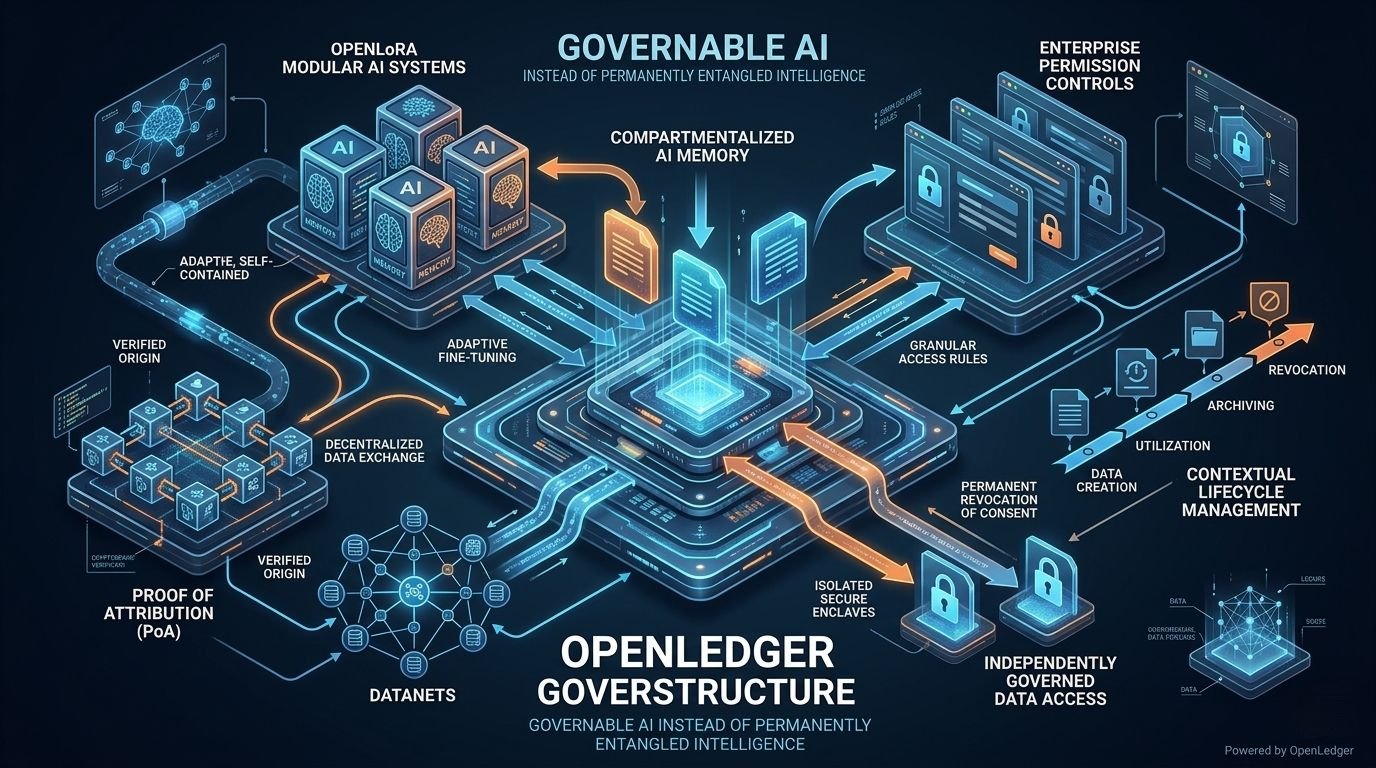
Which is why OpenLoRA keeps standing out to me as more than just an efficiency mechanism.
Most people focus on the obvious part: lightweight modular adaptations reduce compute burden and deployment costs. True. But the deeper implication is architectural compartmentalization.
Modular intelligence is easier to isolate politically.
That may become extremely important later.
Because enterprises do not actually want infinitely entangled intelligence systems long term. They want systems where operational exposure can be segmented, audited, detached, or economically deprecated without collapsing the entire model stack.
In other words, the future enterprise advantage may not come from building the smartest possible AI.
It may come from building the most governable AI.
That distinction feels massively underappreciated right now.
And it changes how I think about $OPEN itself.
The easy narrative is straightforward: AI activity expands, Datanet usage grows, inference demand rises, token utility increases.
Maybe.
But the more interesting possibility is that $OPEN becomes economically linked to the governance of contextual persistence itself. Not merely powering AI activity, but mediating the lifespan, traceability, and economic burden of retained intelligence.
That creates a completely different market dynamic than most infrastructure tokens.
Because the core economic question stops being: “How much intelligence can the network process?”
And becomes: “How much contextual risk can institutions tolerate keeping active?”
That is not a compute race.
It is a governance race.
And governance races are messy because nobody truly agrees on the optimal balance between utility, privacy, profitability, and control once AI systems become deeply embedded inside real-world operational environments.
That is the uncomfortable part most market narratives still avoid.
The AI industry keeps framing intelligence as if it naturally scales toward permanence.
I increasingly think permanence itself becomes the bottleneck.
Because eventually institutions stop asking whether systems can remember more.
And start asking whether systems can forget precisely enough to survive politically, legally, and economically over time.
That is the future OpenLedger increasingly feels aligned with beneath the surface narrative around decentralized AI infrastructure.
Not simply making AI smarter.
Making AI governable before memory itself becomes unmanageable.
#OpenLedger #openledger @OpenLedger