

There is a conversation happening right now in AI that almost never makes it to crypto Twitter.
It is not about which model is smarter. It is not about AGI timelines or token prices. It is about something much more boring and much more important. How do you actually run thousands of specialized AI models without spending a fortune on compute?
Most people building in this space do not think about this until they hit it. You fine-tune a model for a specific task medical queries, legal drafting, customer support in three languages. It works. Then you try to scale it. And you realize that every model needs its own GPU instance. Every new use case multiplies your infrastructure bill. The economics collapse before the product does.
This is the problem OpenLoRA was built to solve. And it was not built as a side feature it launched as a standalone open protocol on July 1, 2025, specifically targeting the deployment cost crisis in specialized AI.
Here is what it actually does differently. Traditional deployment preloads models into GPU memory and keeps them there. If you have twenty fine-tuned variants, you need twenty loaded instances. Memory fills up. Costs multiply. OpenLoRA does not preload anything. LoRA adapters small parameter files that represent the fine-tuning sit dormant until a request arrives. When a request comes in, the right adapter loads just-in-time, merges dynamically with the shared base model, runs the inference, and releases. The GPU holds one base model and processes adapters on demand. The published numbers from tests across multiple hardware environments: 20ms latency under high concurrency, less than 12GB of VRAM to serve thousands of adapters simultaneously, token generation more than four times faster than traditional approaches.
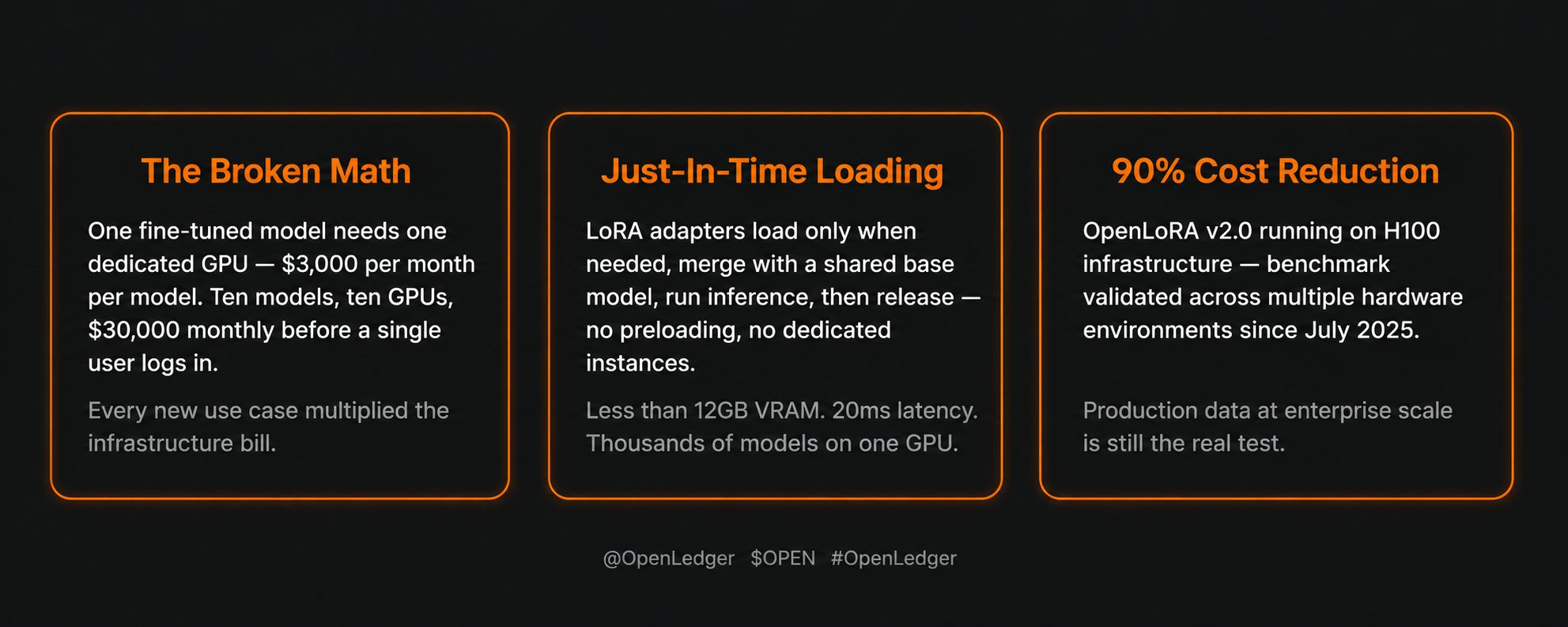
OpenLoRA v2.0 is the current version refined parallelization, tighter attribution tracking integration so every inference maintains the on-chain data trail that connects outputs back to the Datanets contributors whose data shaped the model. That integration detail matters because it means scaling with OpenLoRA does not break the attribution chain. Your deployment costs go down and the contributor reward system keeps working.
For production infrastructure OpenLedger partnered with Aethir NVIDIA H100 GPUs, up to 2TB RAM, 3.2 Tbps networking, clusters scalable to 4,096 H100s globally in under two weeks. That partnership is the difference between a benchmark and a production system.
Now here is where I genuinely do not have a clean answer yet.
Ninety percent cost reduction is a specific claim. The benchmarks support it in controlled conditions. But production performance real enterprise loads, unpredictable query patterns, concurrent users from different time zones hitting specialized models simultaneously that is a different stress test. I have not seen enough independent production data from large deployments to know whether OpenLoRA holds at the scale the marketing implies.
What I do think is clear: the underlying architecture is sound. Just-in-time adapter loading is not a new concept in ML research OpenLoRA is applying it at production scale with an on-chain attribution layer on top. That combination is new.
Whether the 90% number holds in your specific production environment that is a question worth testing before you rebuild your infrastructure around the answer.
The developer thread I saved from a few months ago is still open in my browser. The person who wrote it has not posted a follow-up about whether they solved the cost problem.
Maybe they found OpenLoRA. Maybe they just stopped building.
The math of specialized AI deployment is broken either way. At least someone is working on it.
What would you deploy first if the cost constraint disappeared?