
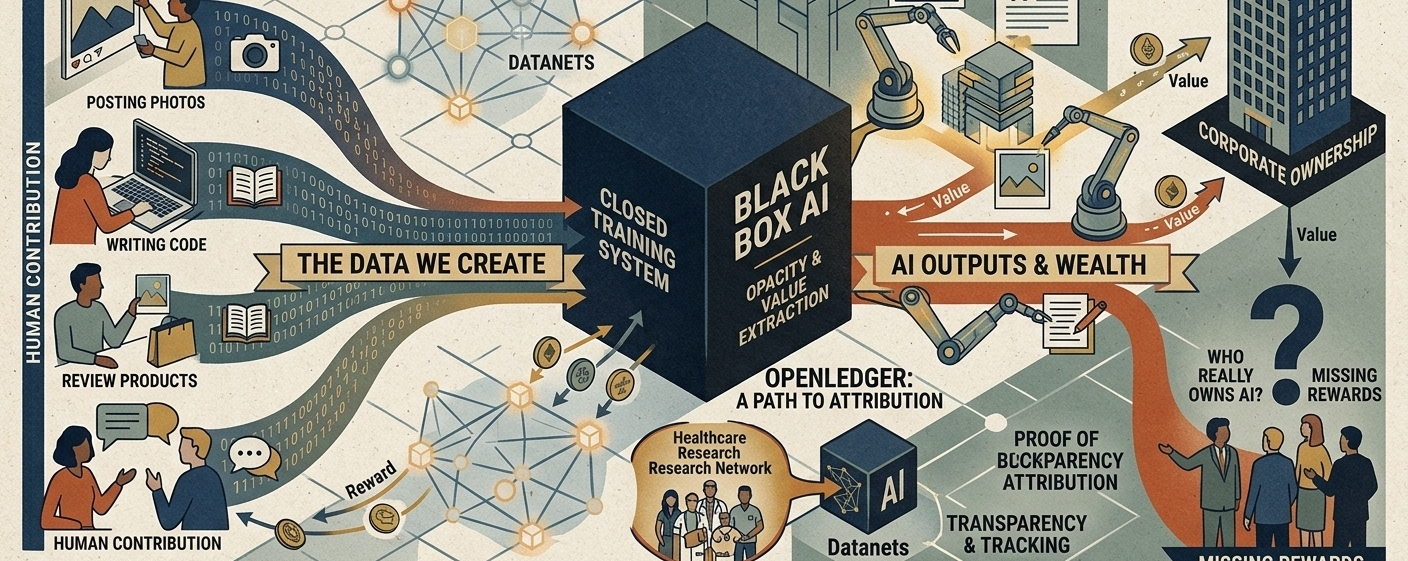
Most people never expected their everyday internet activity to become part of a global economic system. Posting photos, leaving comments, writing reviews, searching for information, or simply interacting online once felt casual and temporary. But over time, those small digital actions quietly became valuable. They helped train recommendation engines, language models, advertising systems, and now modern artificial intelligence itself. The strange part is that the people creating most of this value rarely own any piece of what is eventually built from it.
That uncomfortable reality sits behind the rise of projects like OpenLedger. OpenLedger presents itself as an AI-focused blockchain trying to create a more transparent relationship between data, AI models, and the people contributing to them. Instead of allowing information to disappear into closed systems controlled by a few companies, the project attempts to build infrastructure where contributions can be traced, verified, and rewarded through blockchain technology.
The idea comes from a problem that has existed for years but only recently started receiving serious attention. Artificial intelligence depends heavily on data. The larger the datasets, the better most systems perform. Technology companies have spent years collecting enormous amounts of information from users, businesses, websites, and public platforms. Yet once data enters the training process of an AI model, ownership becomes blurry. The people whose content shaped the system often lose visibility entirely.
That imbalance has created growing tension inside the AI industry. Writers, artists, developers, researchers, and even ordinary internet users have started questioning whether current AI models are benefiting unfairly from human-generated content without proper acknowledgment or compensation. At the same time, companies developing AI systems argue that large-scale training would become nearly impossible if every contribution required direct negotiation or licensing.
Earlier solutions never fully resolved this conflict. Some platforms attempted to build centralized data marketplaces where users could upload datasets and receive payment from buyers. In practice, many contributors still lacked transparency into how their information was used or how much value it actually generated. Open-source AI communities created more collaborative environments, but those systems often depended on volunteers contributing work without sustainable incentives.
Crypto projects also tried entering the space long before OpenLedger appeared. Decentralized compute networks, tokenized AI ecosystems, and blockchain-based model sharing became popular ideas during previous market cycles. But many of those projects struggled to move beyond ambitious language. Some lacked real adoption while others focused more on speculative token activity than solving meaningful infrastructure problems.
OpenLedger seems to approach the issue from a slightly different angle. Rather than trying to become another large-scale AI company, it focuses on attribution and coordination. One of the project’s main ideas is something called “Proof of Attribution,” which attempts to identify how specific datasets or contributors influence AI outputs. In theory, this creates a system where value can flow back toward the people or communities helping train the models.
The concept sounds attractive because it touches on a growing fear surrounding artificial intelligence: opacity. Most modern AI systems function like black boxes. Users interact with them daily without understanding where the training data came from, how outputs are shaped, or who benefits economically behind the scenes. As AI becomes more integrated into education, media, healthcare, and finance, that lack of transparency is becoming harder to ignore.
OpenLedger’s structure reflects the belief that AI systems may eventually need stronger accountability layers. The project introduces “Datanets,” specialized networks where communities contribute datasets used for training smaller domain-focused AI models. Instead of competing directly in the race toward giant universal AI systems, OpenLedger appears more interested in enabling narrower and more specialized intelligence built around specific industries, languages, or communities.
That design choice may actually be more practical than it first appears. Not every organization needs an enormous general-purpose model competing with the largest AI labs in the world. A healthcare research network, legal database, gaming ecosystem, or local business platform may only require highly focused AI trained on specific information. OpenLedger seems built around the assumption that future AI development could become more decentralized and specialized rather than controlled entirely by a handful of dominant companies.
Still, the project faces serious challenges that cannot be ignored. Attribution in machine learning is incredibly difficult. AI outputs are usually created through complex relationships between millions or billions of parameters. Tracing the exact influence of one dataset on a specific result may never become perfectly accurate. Even partial attribution systems could create disagreements about fairness and ownership.
There is also the issue of quality control. Decentralized systems often struggle with balancing openness and reliability. Financial incentives may encourage participation, but they can also encourage manipulation, spam, or low-quality contributions. Crypto history is filled with examples where reward systems unintentionally pushed users to prioritize extraction over long-term value creation.
Another important question is whether blockchain infrastructure is truly necessary for these problems. Critics of AI-crypto projects frequently argue that some systems introduce tokens and decentralization into areas where traditional databases may work faster and more efficiently. OpenLedger attempts to justify blockchain usage through transparency and traceability, but whether developers and businesses ultimately see that trade-off as worthwhile remains uncertain.
The economics behind participation may also become uneven over time. In many blockchain ecosystems, early adopters and technically skilled users accumulate disproportionate influence while ordinary participants struggle to navigate the system effectively. A network designed to reward data contributors could still end up concentrating value among validators, developers, or insiders who understand the infrastructure better than everyone else.
Regulation adds even more uncertainty. Governments worldwide are already increasing scrutiny around both artificial intelligence and digital assets independently. A platform operating at the intersection of both industries could eventually face complicated legal questions involving copyright, privacy, licensing, and accountability. The legal frameworks surrounding AI-generated content are still evolving, and decentralized systems may complicate those debates further.
Even so, OpenLedger reflects something larger happening across the technology world. People are beginning to question whether the current structure of AI development is sustainable if enormous economic value continues flowing into systems built on collective human input without meaningful participation from the contributors themselves. That conversation is no longer limited to crypto communities. It is slowly becoming part of mainstream discussions about the future of artificial intelligence.
The project also highlights a deeper divide in how people imagine the future of technology. One vision favors centralized efficiency, where a small number of powerful companies control the infrastructure needed to build increasingly advanced AI systems. The other vision favors openness, shared ownership, and decentralized coordination, even if those systems become slower or more complicated to manage.
OpenLedger exists somewhere between those competing ideas. It is trying to explore whether AI economies can become more transparent without losing functionality, and whether blockchain systems can support meaningful coordination instead of simply financial speculation. That does not guarantee success. In fact, the project may ultimately reveal how difficult those goals truly are.
For now, OpenLedger feels less like a finished solution and more like an experiment responding to a broader shift in public awareness. People are no longer just impressed by what AI can do. They are starting to ask who controls it, who profits from it, and who gets left out of the system entirely.
As artificial intelligence continues absorbing more human knowledge, creativity, and behavior into its models, the harder question may not be whether projects like OpenLedger succeed, but whether future AI systems can continue operating without eventually being forced to answer who actually owns the value created by human contribution.
