
I’ll be honest, I’ve reached the point where I automatically tune out most AI and blockchain projects the second they start talking about infrastructure. I’ve watched too many teams throw around words like coordination, scalability, decentralization, and automation while the actual product underneath feels stitched together with dashboards, disconnected APIs, and vague promises about the future. After a while, skepticism stops being a mindset and just becomes muscle memory.
That was more or less my reaction when I first started looking into OpenLedger. Another AI chain. Another ecosystem claiming it will connect models, agents, liquidity, and execution into one unified environment. At first glance, it sounded familiar in the same way a lot of these projects sound familiar now. Clean branding. Ambitious positioning. Big architectural claims.
But the more time I spent observing how the system was actually structured, the more I realized the interesting part wasn’t the branding around AI. It was the operational thinking underneath it.
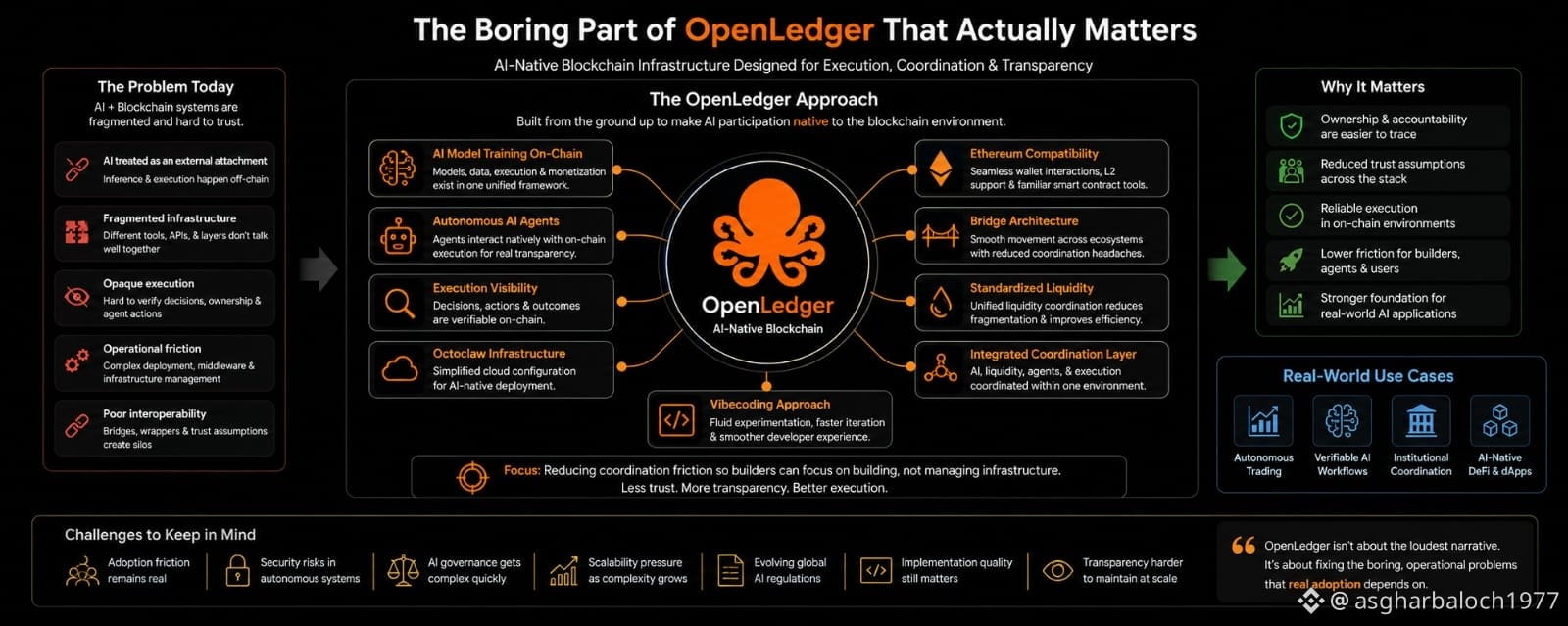
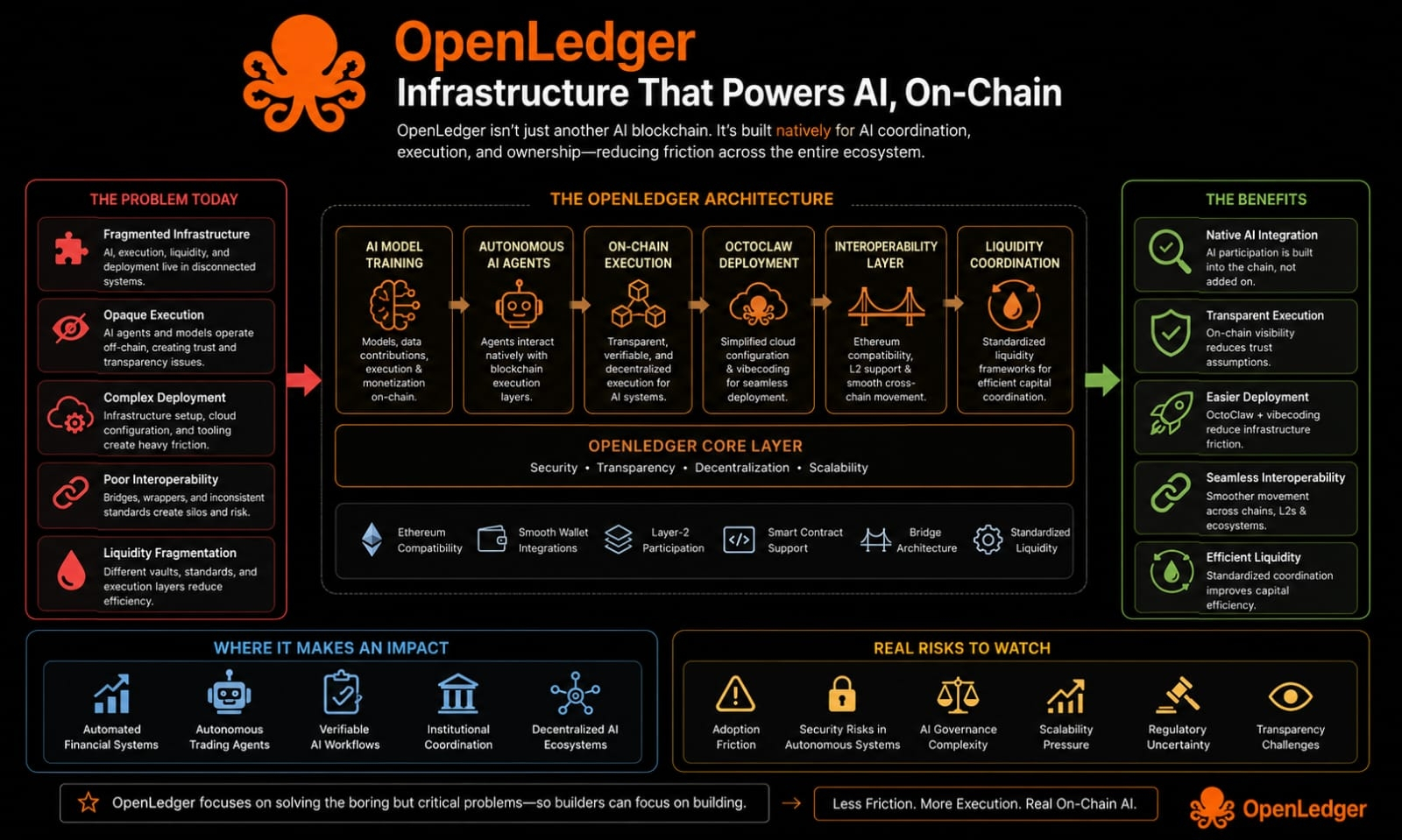
Most blockchain systems still treat AI like an external attachment. The chain handles transactions, and then somewhere off to the side there’s an AI service, a centralized inference layer, or some off-chain execution engine quietly doing the real work. The result usually feels fragmented. Ownership gets messy. Verification becomes difficult. Users end up trusting invisible infrastructure while the chain mostly acts as a record keeper after the fact.
What caught my attention with OpenLedger was that it seemed to approach the problem from the opposite direction. Instead of asking how AI could be added onto existing blockchain systems, the architecture looked designed around the assumption that AI participation itself would become native to the environment.
That distinction sounds small until you start looking at how execution actually works in practice.
I started noticing it while digging through the way the ecosystem handles AI model training, autonomous agent deployment, and execution coordination. Most systems today still rely heavily on middleware layers that create operational friction everywhere. One tool handles inference, another handles orchestration, another manages liquidity, another manages deployment, and somewhere in between users are expected to trust that everything is functioning correctly.
That fragmentation creates a surprising amount of hidden complexity. Developers spend more time managing infrastructure than building systems. AI agents lose transparency once execution moves off-chain. Trading systems become difficult to verify. Even basic interoperability between environments often turns into a patchwork of bridges, wrappers, and trust assumptions.
OpenLedger didn’t completely eliminate those problems, obviously, but I started seeing a consistent pattern where the infrastructure itself was trying to absorb more of that coordination burden directly into the chain environment.
The AI model training side was one example that stood out to me. Instead of treating models like detached external products, the ecosystem appears built around the idea that models, data contributions, execution, and monetization should exist inside the same operational framework. That matters because ownership and accountability become easier to trace when the workflow itself isn’t constantly jumping between disconnected systems.
The same thing applies to autonomous AI agents.
I’ve spent enough time around trading agents and automated execution systems to know how quickly they become opaque once real capital and live environments get involved. Most AI agent systems today still feel experimental in a messy way. You often can’t tell where execution is happening, how decisions are verified, or what assumptions users are expected to trust behind the scenes.
What made OpenLedger more interesting over time was seeing how much attention seemed to go toward execution visibility and coordination rather than just the agent narrative itself.
The integration of trading agents directly into on chain environments felt more practical than performative. Instead of agents existing as isolated bots loosely connected to crypto infrastructure, the system looked designed for agents to interact with blockchain execution layers more natively. That reduces a lot of the awkward friction that usually appears between AI systems and decentralized environments.
I also found the Octoclaw infrastructure surprisingly important, even though it’s probably one of the least exciting things to talk about publicly.
Deployment complexity is one of those boring problems that quietly kills adoption. A lot of AI tooling still assumes users are comfortable juggling cloud environments, infrastructure configuration, container management, dependency handling, and scattered orchestration systems. In reality, most people simply want reliable execution without turning every deployment into an engineering project.
The cloud configuration approach inside OpenLedger seemed designed around reducing that friction. Not eliminating complexity entirely, but making AI native deployment workflows feel more operationally manageable. The vibecoding approach especially caught my attention because it reflects something I’ve noticed across AI development lately. Builders increasingly want fluid experimentation rather than rigid infrastructure management. They want systems that let them move quickly between testing, deployment, coordination, and execution without constantly rebuilding the environment around them.
That becomes even more important once interoperability enters the picture.
One of the most frustrating parts of crypto infrastructure today is how often ecosystems claim compatibility while still creating painful operational silos. Wallet integrations break. Bridges introduce risk. Liquidity becomes fragmented. Smart contract environments behave inconsistently across chains.
OpenLedger’s Ethereum compatibility felt less like a marketing checkbox and more like an acknowledgment of reality. Most users and developers already exist inside Ethereum adjacent environments. Supporting smoother wallet interactions, Layer-2 participation, and familiar smart contract tooling lowers onboarding friction in ways that actually matter operationally.
The bridge architecture also started making more sense the deeper I looked into it. Interoperability is usually discussed in abstract terms, but in practice it’s mostly about reducing coordination headaches. If AI agents, execution systems, liquidity environments, and smart contracts cannot move smoothly across ecosystems, the entire idea of decentralized AI coordination becomes fragile very quickly.
The standardized liquidity coordination approach was another detail I appreciated because liquidity systems across crypto still feel unnecessarily inconsistent. Different vault structures, fragmented execution standards, and incompatible coordination layers create operational inefficiencies everywhere. Standardized frameworks reduce some of that friction quietly in the background, even if most users never notice it directly.
And honestly, that’s probably the main reason OpenLedger gradually became more interesting to me.
The project doesn’t feel centered around creating the loudest narrative possible. It feels centered around reducing coordination friction between AI systems, blockchain execution, liquidity, interoperability, and deployment itself.
That may sound boring compared to the usual AI hype cycle, but infrastructure only becomes valuable when people stop thinking about the infrastructure and simply use the system because it works consistently.
At the same time, I don’t think any of this guarantees success.
There are still real concerns that come with trying to build AI-native blockchain infrastructure at scale. Adoption friction is real. Autonomous systems create security risks. AI governance becomes complicated quickly once incentives and coordination enter the picture. Scalability pressure increases as execution complexity grows. Regulation around AI systems is still evolving globally, and decentralized environments introduce additional uncertainty. Even well-designed infrastructure can break down if developers implement weak applications on top of it.
And transparency itself becomes harder to maintain as systems scale outward.
So I’m not looking at OpenLedger as some perfect solution that suddenly fixes decentralized AI coordination overnight. That would be unrealistic. But I do think the project is trying to address the right operational problems instead of simply layering AI terminology onto existing blockchain structures.
That difference matters more than people think.
The environments where this kind of infrastructure actually makes sense are probably the environments where execution quality matters more than branding. Automated financial systems. Verifiable AI workflows. Autonomous trading environments. Institutional coordination systems where accountability and transparency matter operationally, not just philosophically.
Those systems need infrastructure that reduces trust assumptions instead of quietly increasing them.
That’s also why I’ve been paying more attention to usability than announcements while watching the ecosystem develop. I care more about whether wallet interactions remain smooth under real conditions, whether interoperability actually works consistently across environments, whether AI workflows execute reliably on-chain, and whether coordination remains manageable as complexity increases.
Marketing narratives are easy to manufacture. Operational consistency is harder.
The longer I spend around crypto and AI infrastructure, the more I think real adoption usually happens quietly. Not through dramatic promises or oversized narratives, but through systems that remove friction so effectively that people gradually stop noticing the complexity underneath.
That’s probably the part of OpenLedger that stayed with me the most.
Not the AI branding. Not the blockchain positioning. Not even the autonomous agent narrative.
Just the feeling that someone behind the architecture spent time thinking seriously about execution problems that most projects still treat like somebody else’s responsibility.