
AI doesn’t feel like magic anymore. A year or two ago, it was impressive just seeing it write an essay or generate an image from a prompt.
Now it’s part of everyday work summarizing research, answering questions, building content, and quietly influencing decisions at scale.
But the more I use it, the more one question keeps coming back:
where does all this “intelligence” actually come from?
Because the truth is simple.
AI isn’t creating from nothing.
It’s built on human data our writing, conversations, code, art, and behavior.
Yet once that data enters centralized systems, the connection to its origin disappears.
The value gets concentrated, while the contributors stay invisible.
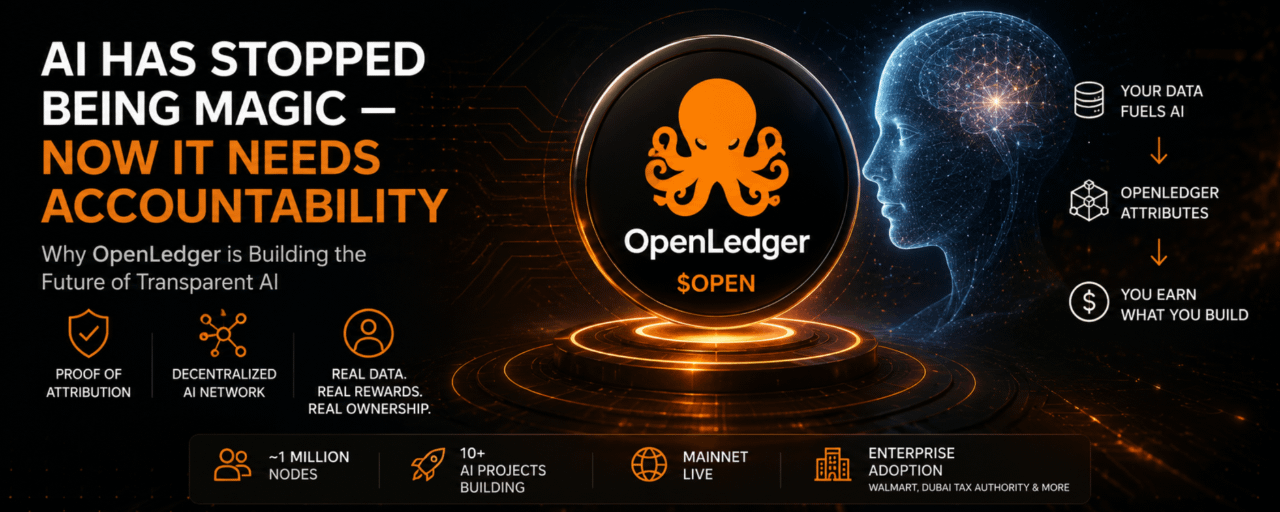
That’s why @OpenLedger feels like an important shift in direction.
Instead of treating data as something abstract and disposable, it focuses on tracking how data actually contributes to AI outputs.
The idea of Proof of Attribution changes the usual model value isn’t just locked in tokens or speculation, but linked to real usage and real contribution.
With $OPEN , the goal isn’t passive holding.
It’s participation in an AI ecosystem where agents, data, and outputs are all connected.
Tools like OctoClaw and frameworks such as ModelFactory and OpenLoRA point toward a system where AI development becomes more transparent, scalable, and traceable.
Of course, the real test isn’t the idea it’s execution.
Most users don’t care about complexity; they care about simplicity.
If this system becomes too technical, it won’t matter how innovative it is.
Still, the direction is hard to ignore.
As AI grows into a massive global industry, accountability is becoming just as important as capability. And projects like @OpenLedger are trying to answer a question the industry has mostly avoided.
If human data is what powers AI, why shouldn’t humans have a clear stake in the value it creates?
Explore here: OpenLedger Profile $OPEN | #OpenLedger
