
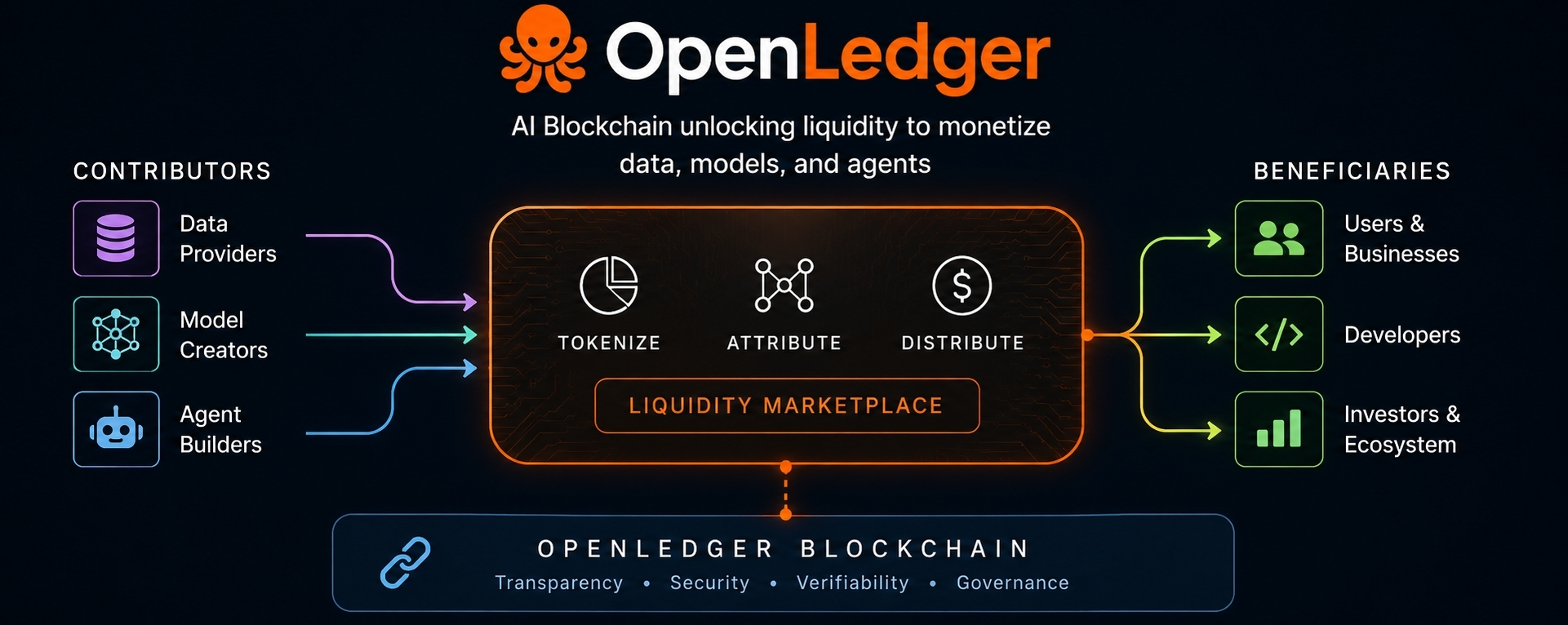
OpenLedger has been sitting in the back of my mind for a while now, and not for the usual reasons. It is not because the project is loud or because people constantly force it into every conversation around AI and crypto. If anything, it feels quieter than most of the narratives surrounding this space. But sometimes the quieter projects become harder to ignore because they leave behind questions that do not fully disappear.
The more I look at OpenLedger, the less I think about it as just another blockchain connected to AI. What keeps pulling my attention back is the idea underneath it. The attempt to build an economy around data, models, and AI agents without everything collapsing into the hands of a few centralized companies. That sounds simple when written down, but it becomes far more complicated the longer you sit with it.
Right now, most people interact with AI like consumers standing outside a giant machine they do not control. The models improve, the companies grow stronger, the systems absorb more data, and users mostly adapt to whatever structure is already being built around them. OpenLedger seems to challenge that direction by trying to turn contributors into participants instead of raw inputs feeding someone else’s ecosystem.
But I keep wondering whether participation actually changes power or just changes the appearance of power.
Crypto has always believed that incentives can organize human behavior better than institutions can. Sometimes that belief works surprisingly well. Other times it creates systems where everyone is technically included while real influence slowly concentrates somewhere else. I think that possibility matters more in AI infrastructure than people want to admit.
Because AI systems are naturally difficult to verify socially. Most users will never fully understand how data is sourced, how models evolve, or how value moves through the network. They will trust interfaces, reputation, and outcomes more than the actual mechanics underneath. That creates a strange environment where decentralization can exist technically while coordination quietly narrows around a smaller group of operators, developers, validators, or large contributors.
Not through corruption necessarily. Mostly through convenience.
That is usually how these shifts happen. A small group becomes important because they are more capable, more active, or simply more available during critical moments. Over time, the network starts depending on them more heavily. Governance remains open in theory, but fewer people have the time, knowledge, or energy to participate meaningfully. Eventually the structure still looks decentralized from the outside even though practical influence becomes harder to separate from a handful of participants.
I do not think OpenLedger is uniquely vulnerable to that. If anything, I think almost every ambitious crypto infrastructure project drifts toward this pressure eventually. But AI may intensify it because the systems themselves are becoming more abstract and harder for ordinary people to evaluate.
And then there is the economic side of it, which honestly feels even less certain.
The idea of monetizing data, models, and agents sounds attractive because it promises a more open AI economy. But markets have a habit of rewarding what is measurable instead of what is meaningful. The internet already went through this transformation once. Engagement became more important than quality because engagement was easier to track. Visibility became more important than depth because algorithms could quantify clicks faster than substance.
I sometimes wonder if AI infrastructure risks moving toward the same pattern.
If OpenLedger successfully creates liquidity around AI contributions, what eventually becomes the dominant behavior inside the network? Genuine usefulness? Careful development? Long-term integrity? Or simply activity optimized to extract rewards from the system as efficiently as possible?
That question matters because economic systems slowly shape culture whether they intend to or not.
People often assume decentralization protects networks from becoming exploitative, but decentralization alone does not remove human incentives. It only redistributes them across different layers. Over time, contributors adapt to whatever behavior the network rewards most consistently. If low-quality synthetic outputs become profitable, the system eventually has to defend itself against its own incentives. And defending against that usually requires stronger coordination, stronger filtering, or stronger gatekeeping.
Which creates another contradiction.
The more open the network becomes, the harder it may be to maintain quality. But the more aggressively quality is controlled, the easier it becomes for influence to consolidate around whoever controls those standards.
I do not think there is a clean solution to that tension. Maybe there never will be.
Still, I cannot dismiss OpenLedger entirely because the problem it circles around feels real. AI is becoming too important economically and culturally for people to remain comfortable with complete concentration forever. At some point, there will probably be pressure for systems where ownership, contribution, and value creation feel more distributed.
The difficult part is that distributed systems are not automatically resilient systems.
Everything feels sustainable during periods of growth. Activity hides structural weaknesses. Optimism smooths over contradictions. But difficult environments reveal what networks are actually built on. What happens when incentives weaken? What happens when contributors become less ideological and more transactional? What happens when attention disappears and the network has to survive without constant excitement carrying it forward?
I think about that more than the technology itself.
Because the real test for OpenLedger probably does not happen while AI remains one of the strongest narratives in the market. The real test comes later, when growth slows down, when coordination becomes harder, and when the network has to decide whether openness still matters once maintaining openness becomes expensive.
And honestly, I do not know what the answer looks like yet.
Part of me thinks projects like this could quietly matter years from now because they are trying to solve a problem that will only become more visible over time. Another part of me thinks human systems eventually drift toward concentration no matter how decentralized they appear in the beginning.
Maybe both things can be true at the same time.
That is probably why OpenLedger keeps resurfacing in my mind. Not because I am convinced it succeeds, but because I am not fully convinced the current direction of AI survives comfortably either.