
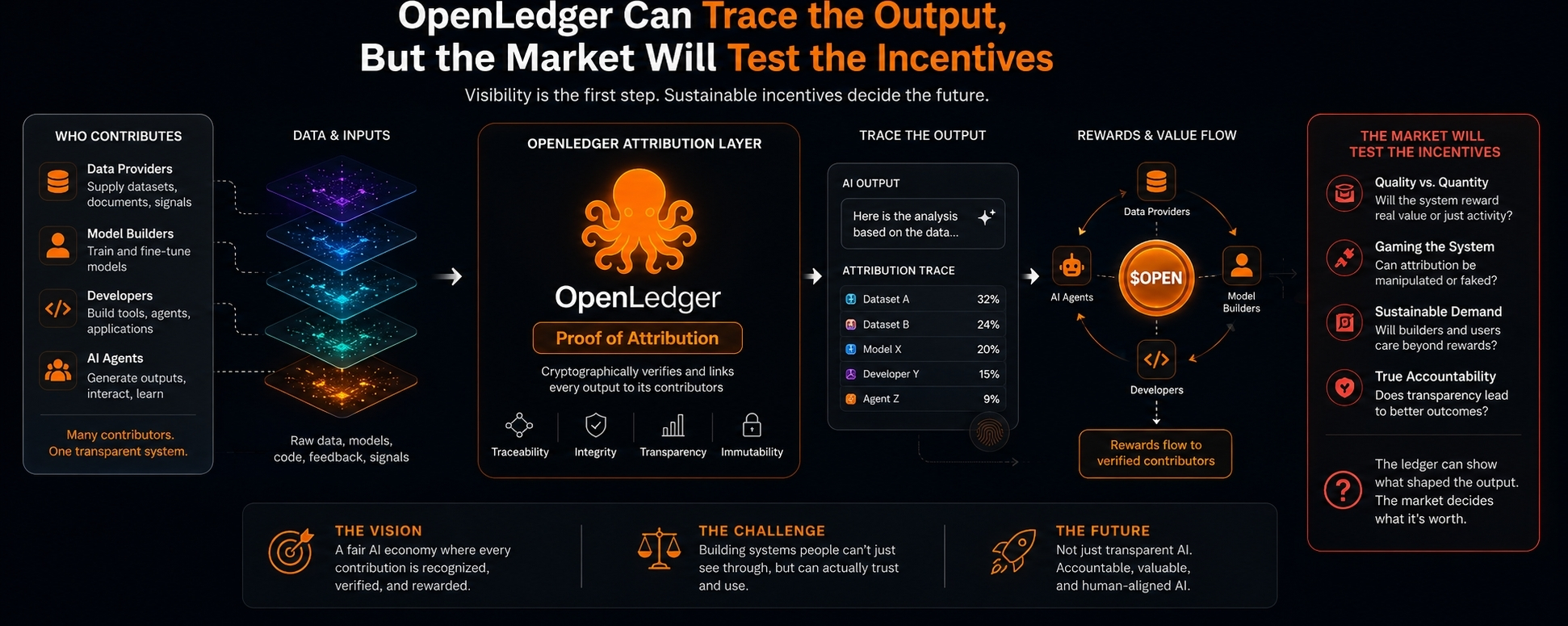
OpenLedger with interest, but not the kind of interest that turns into belief too quickly. The project sits in one of those places where crypto and AI both promise clarity, while the actual market underneath them remains messy, tired, and full of incentives that can bend even good ideas out of shape. OpenLedger is trying to make AI outputs more traceable, to show what data shaped a result and who may have contributed value along the way. That is a serious idea. It is also not something I can take at face value just because the language around it sounds clean.
What makes OpenLedger worth studying is not that it has attached itself to AI. Plenty of projects have done that. Most of them feel like they are borrowing the narrative rather than building through the problem. OpenLedger feels more specific. It is looking at the invisible layer behind AI: the datasets, the contributors, the signals, the knowledge that gets absorbed into a model and then disappears once an answer is produced. That disappearance has always bothered me. The model gets the attention. The people and data behind it become background noise.
OpenLedger is trying to make that background visible.
That is where the project becomes interesting, but also where the pressure begins. Visibility sounds simple until money is attached to it. Once attribution becomes part of a reward system, people do not just contribute. They optimize. They look for patterns. They test the edges. They try to understand what the system values and then give it more of that, even if more is not always better. Crypto has seen this many times. A good incentive design can attract useful behavior. A weak one can attract activity that looks productive from far away and hollow up close.
This is the part I keep coming back to with OpenLedger. The project is not only building around AI attribution. It is building around human behavior. That is harder. It has to deal with the fact that contributors may not always be honest, users may not always be patient, and the market may not wait long enough to separate real usage from rewarded motion. A system can show what shaped an output, but it still has to prove that the shaping was valuable.
That proof will not come from the narrative.
OpenLedger’s core idea has a natural pull because AI is becoming harder to trust at the exact moment people are using it more. Outputs appear instantly, but the path behind them is often hidden. Where did this answer come from? Which data mattered? Who helped create the knowledge being used? Was the model leaning on strong material or just repeating patterns with confidence? These questions are not abstract anymore. They sit behind every AI product that wants to be taken seriously.
So OpenLedger is aiming at a real gap.
But aiming at a real gap does not remove execution risk. In some ways, it increases it. The more important the problem, the less forgiving the market becomes once the first wave of curiosity fades. OpenLedger has to do more than prove that attribution can be recorded. It has to prove that attribution can be useful. It has to make developers, contributors, and users feel that the system improves decisions, not just documentation. A ledger of influence is only valuable if people act differently because of it.
That is where many projects lose their shape.
Crypto often confuses recorded activity with meaningful activity. A dashboard can look alive while the underlying demand is weak. A reward program can create movement without creating loyalty. A community can talk about ownership while behaving like short-term liquidity. OpenLedger has to fight that gravity. If the project becomes mainly a place where people contribute because they expect rewards, then the quality question becomes unavoidable. Are they making the network smarter, or just feeding it what they think it wants?
That question matters more than the branding.
I like that OpenLedger is not trying to sell a vague dream of AI ownership without a mechanism behind it. There is a real attempt here to connect data, models, attribution, and reward. That gives the project more substance than the usual surface-level AI crypto pitch. But substance still has to survive use. It has to survive bad actors. It has to survive low-quality data. It has to survive users who do not care about the philosophy and only care whether the system gives them something better than what already exists.
Most systems sound clean before users arrive.
The market will probably not judge OpenLedger patiently. It rarely does. It may overprice the story before the execution is proven, then punish the project later for not matching the fantasy the market created around it. That is not unique to OpenLedger. That is crypto’s usual rhythm. But it means the project has to be careful with its own narrative. The more it promises, the more fragile it becomes. The strongest version of OpenLedger may be the one that stays focused on solving a narrow, difficult problem instead of trying to become the symbol of an entire AI economy.
There is something quietly valuable in that restraint.
The project’s real test is whether it can make attribution feel less like a concept and more like infrastructure people rely on. Not because it sounds fair. Not because it fits the AI cycle. Because it helps identify better data, reward better contribution, and reduce the fog around how outputs are formed. If OpenLedger can do that, it has a reason to exist beyond the narrative. If it cannot, then it risks becoming another well-framed idea that the market understood faster than the product matured.
Execution is where narratives go to die.
I keep thinking about what happens after the excitement settles. That is usually when the truth becomes easier to see. Are contributors still showing up when rewards are less exciting? Are builders still integrating when attention moves elsewhere? Are users actually learning something from attribution, or is it just another layer they ignore? Does OpenLedger make AI systems feel more accountable, or only more explainable?
Those are different things.
And maybe that is the tension that makes OpenLedger worth watching. The project is trying to bring memory, ownership, and reward into a part of AI that has been too invisible for too long. That deserves attention. But it also has to prove that showing what shaped an output can change how people build, contribute, and trust. Until then, I can respect the direction without surrendering to the story.