
I went into OpenLedger carrying the same skepticism I now automatically bring to almost every AI and blockchain project I come across.
After a while, they all start sounding strangely similar.
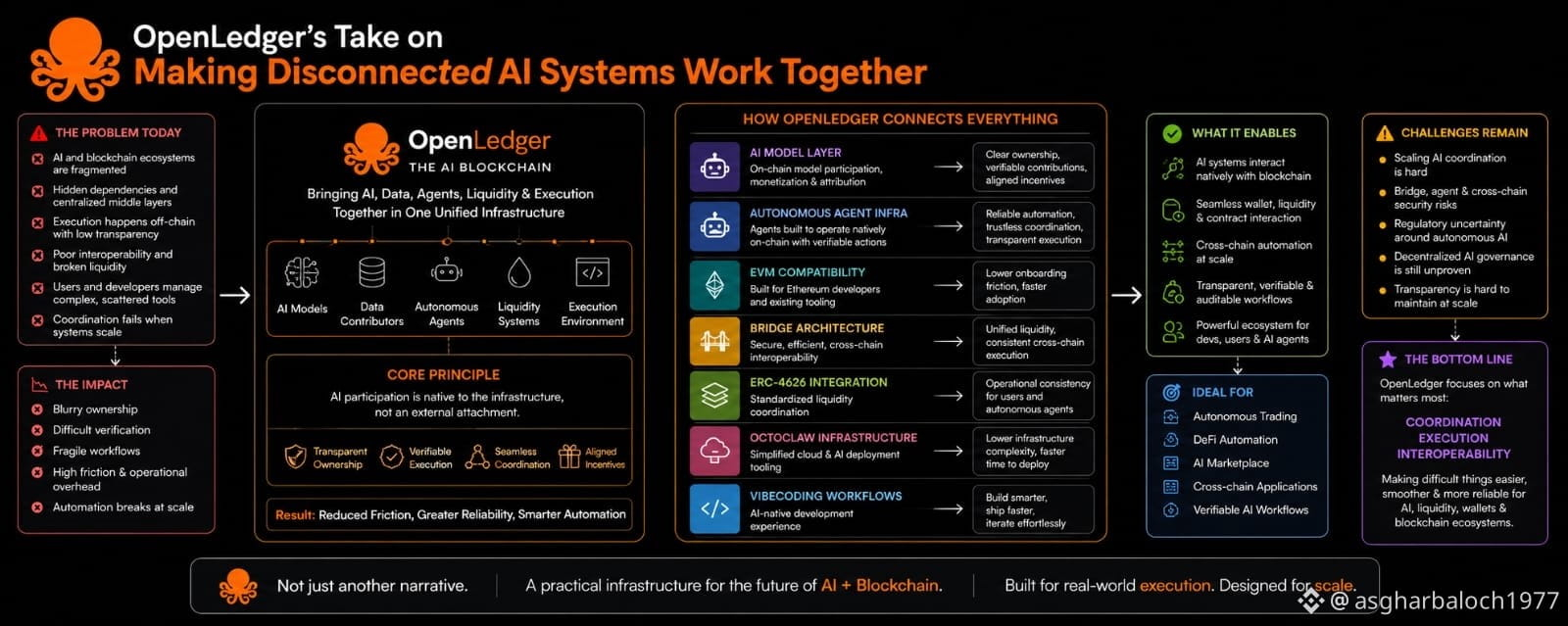
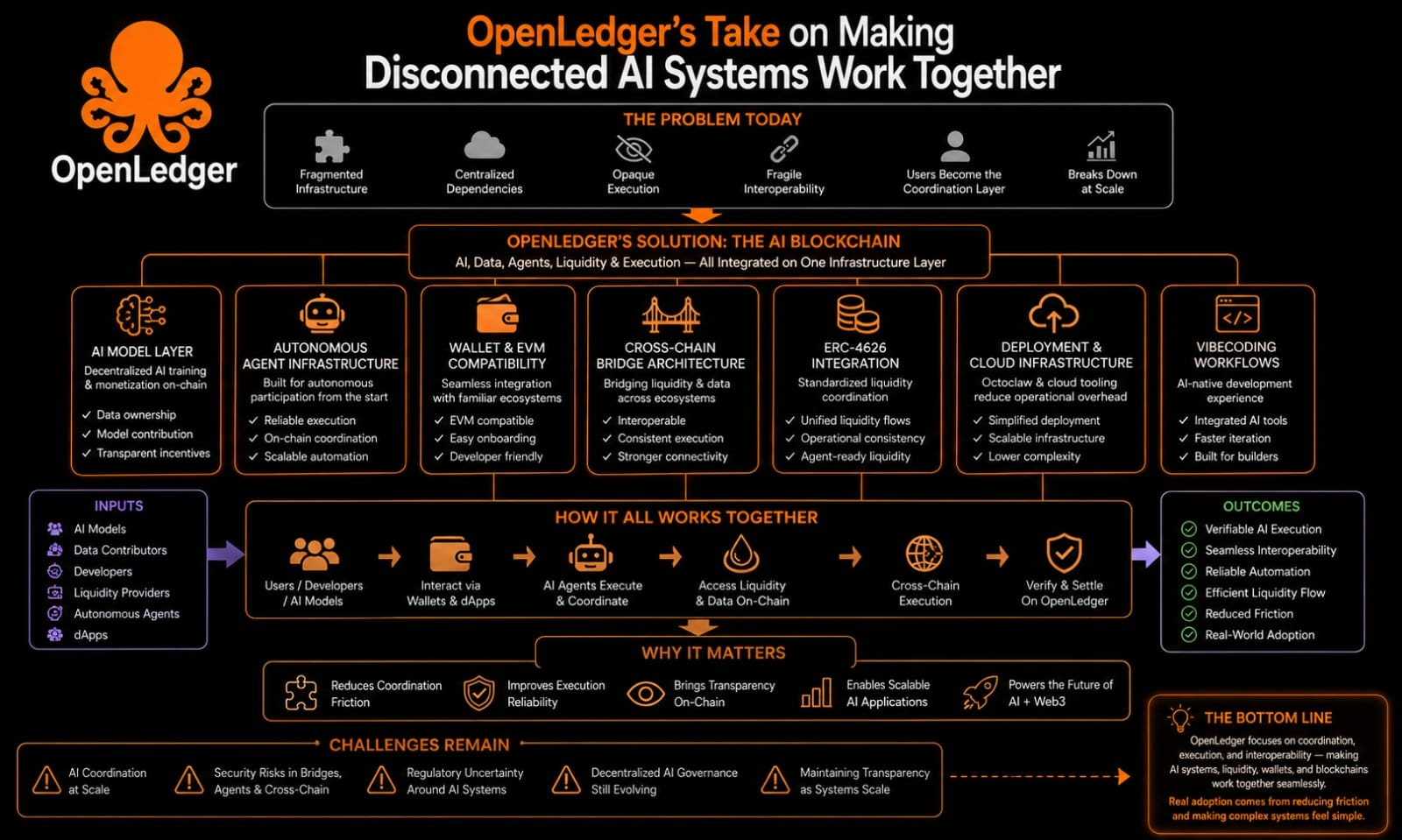
Every team claims they’re building infrastructure for autonomous agents, decentralized intelligence, AI coordination, or some entirely new digital economy. But once you spend enough time digging beneath the surface, the same problems usually show up underneath the branding. There’s almost always some hidden dependency in the middle of the system. Centralized APIs. Opaque execution layers. Fragile interoperability. Or workflows so messy that the user quietly becomes the real coordination layer holding everything together.
That’s honestly where my head was when I started looking into OpenLedger.
At this point, I’ve developed a pretty automatic suspicion toward anything combining AI narratives with token ecosystems. The space has become crowded with projects that talk endlessly about the future while still relying on fragmented infrastructure behind the scenes.
So initially, I assumed this would be more of the same.
What slowly changed my perspective wasn’t marketing or hype. It was spending time looking at how the system appears to approach coordination itself.
The deeper I looked, the more it felt like OpenLedger was trying to solve operational problems instead of simply describing futuristic possibilities.
That distinction matters more than people realize.
A lot of blockchain ecosystems today still treat AI like an external attachment rather than something native to the infrastructure itself. The blockchain handles settlement, while the actual intelligence, execution, training, orchestration, and coordination happen somewhere else entirely. Usually through cloud systems, middleware layers, third-party APIs, or services users are simply expected to trust without much visibility.
Everything technically works together, but it often feels stitched together rather than truly integrated.
That fragmentation becomes obvious very quickly once real activity starts scaling.
What made OpenLedger feel different to me was that the architecture appears designed around AI participation directly inside the ecosystem rather than forcing AI systems to operate externally and connect afterward as an afterthought.
At first, even the phrase “The AI Blockchain” sounded like pure marketing language to me. Honestly, I almost ignored it because of that. But operationally, the system seems built around the idea that AI models, data contributors, autonomous agents, liquidity systems, and execution environments should all interact inside the same infrastructure layer instead of constantly jumping across disconnected systems.
The longer I thought about that, the more important it started to feel.
Because one of the biggest problems in both AI and Web3 right now is coordination friction.
Ownership becomes blurry. Verification gets difficult. Execution moves off-chain where users lose visibility. Liquidity systems don’t communicate properly. Bridges introduce fragility. Developers end up managing scattered infrastructure manually across multiple environments. And despite all the decentralization rhetoric, many ecosystems still rely heavily on centralized coordination somewhere in the middle.
Most people don’t notice those weaknesses immediately because everything looks functional during low-scale usage.
But once autonomous systems begin interacting continuously with wallets, liquidity, contracts, data, and cross-chain environments, fragmentation becomes painfully obvious.
That’s one of the areas where OpenLedger started holding my attention longer than I expected.
The AI model side was probably the first thing that genuinely stood out to me. A lot of projects talk abstractly about decentralized AI training, but OpenLedger appears to tie model participation and monetization directly into blockchain operations themselves. Instead of separating data ownership, model contribution, execution, and incentives into isolated systems, the infrastructure seems designed to bring those relationships on-chain where interaction becomes more transparent and verifiable.
Conceptually, that sounds simple.
Operationally, though, it changes workflow design quite a bit.
Normally, AI systems involve scattered tooling everywhere. One environment handles storage. Another manages compute. Another handles payments. Wallet integration feels secondary. Verification becomes difficult. Users often have very little visibility into how outputs are coordinated once multiple systems start interacting together.
OpenLedger seems to be trying to reduce that fragmentation by making AI participation itself part of the core environment instead of something sitting outside of it.
That became more interesting to me over time.
The autonomous agent infrastructure also caught my attention the longer I observed it. Most AI agent systems I’ve looked at still feel partially detached from blockchain environments. They execute externally, depend on centralized orchestration, or struggle once interoperability becomes necessary across multiple ecosystems.
Here, the infrastructure appears designed with autonomous participation in mind from the beginning.
That matters because automated systems break very quickly when coordination starts failing underneath them.
Trading agents especially make infrastructure weaknesses impossible to hide. Once AI systems begin interacting directly with liquidity, wallets, bridges, and contracts, execution quality becomes far more important than branding. Routing reliability matters. Verification matters. Cross-chain consistency matters. Wallet coordination matters.
Fragmented infrastructure gets exposed immediately in those environments.
What made OpenLedger feel more practical to me was seeing how wallet integrations, EVM compatibility, Layer-2 connectivity, and bridge architecture seem connected operationally instead of existing as isolated product announcements.
The Ethereum compatibility especially feels smarter than some projects realize.
A lot of ecosystems try reinventing everything from scratch and accidentally create massive onboarding friction in the process. OpenLedger appears to lean more toward interoperability rather than isolation, which realistically makes adoption easier for developers already building inside EVM ecosystems.
The bridge architecture started making more sense to me in that context too.
Most blockchain ecosystems still struggle heavily with fragmented liquidity and inconsistent cross-chain execution. Interoperability often sounds better in theory than it works in practice. And AI systems especially can’t function efficiently if infrastructure layers constantly fail to communicate properly with each other.
Coordination complexity scales extremely fast.
I also found the ERC-4626 integration more important than I expected initially. Standardization around liquidity coordination doesn’t sound exciting on the surface, but operational consistency matters a lot once autonomous systems begin interacting directly with capital flows.
In fragmented ecosystems, every protocol handles liquidity differently. That creates unnecessary friction not only for users but also for automated agents trying to execute reliably across multiple environments.
The more standardized those interactions become, the more stable automated coordination becomes too.
Another thing I kept coming back to was deployment complexity.
This is where a lot of supposedly advanced AI infrastructure quietly falls apart.
Building AI-native workflows today usually means managing far too many moving parts across disconnected systems. Developers spend huge amounts of time coordinating infrastructure instead of actually building functionality.
That’s part of why the Octoclaw infrastructure and cloud configuration tooling became interesting to me.
Not because they sounded flashy, but because they appeared focused on reducing operational overhead directly.
The ecosystem seems designed to reduce how much manual coordination developers need between cloud infrastructure, AI deployment, wallets, execution environments, and blockchain participation itself.
That may sound like a small thing until you’ve actually worked around complex multi-layer systems long enough to see how fragile they become under real usage pressure.
The vibecoding workflows also stood out to me more than I expected.
A lot of development environments still treat AI like an external utility rather than something naturally integrated into the workflow itself. OpenLedger appears to be moving toward a more AI-native development experience where interaction with intelligent systems feels embedded directly into the infrastructure rather than bolted onto the side afterward.
That subtle difference becomes noticeable over time.
What kept my attention overall wasn’t any single feature though.
It was the broader architectural direction.
Most ecosystems today still leave major coordination problems unresolved while expecting users to tolerate the complexity manually. Execution remains fragmented. Verification becomes inconsistent. AI workflows operate behind opaque infrastructure users cannot fully inspect.
OpenLedger at least appears to be trying to bring execution, interoperability, liquidity coordination, AI participation, and infrastructure reliability into the same operational environment instead of scattering everything across disconnected services.
Of course, none of that automatically guarantees success.
And honestly, I think pretending otherwise makes analysis less credible.
Infrastructure alone doesn’t solve adoption. AI coordination at scale becomes extremely difficult very quickly. Weak implementations can still create unreliable systems even on strong infrastructure. Security risks around bridges, agents, and cross-chain execution remain very real. Regulatory uncertainty around autonomous AI systems isn’t going away anytime soon either.
And decentralized AI governance is still largely unproven territory long term.
Even maintaining transparency becomes harder once systems scale aggressively across multiple environments and ecosystems.
It’s one thing to design clean architecture.
It’s another thing entirely to maintain reliability once real-world usage pressure starts exposing weak points.
Still, I can understand why infrastructure like this makes sense in serious operational environments.
Especially in systems involving automated financial coordination, verifiable AI execution, interoperable applications, and autonomous trading environments where execution reliability matters far more than narrative momentum.
Once AI agents begin interacting directly with capital, liquidity, and smart contracts, infrastructure quality stops being theoretical very quickly.
That’s honestly how I ended up evaluating OpenLedger in the end.
Not through slogans.
Not through token narratives.
Just through observation.
Watching how wallet interactions behave. Looking at interoperability across ecosystems. Paying attention to whether AI workflows actually feel coordinated or whether users still end up quietly managing invisible infrastructure complexity behind the scenes themselves.
Because eventually the marketing layer fades away.
The systems that survive usually do so quietly.
Not because they generate the loudest narratives, but because they reduce friction enough that people continue using them without constantly thinking about the infrastructure underneath anymore.
And that’s probably the biggest thing that changed my perspective here.
I originally assumed OpenLedger would be another AI narrative attached to fragmented tooling and abstract decentralization language.
Instead, the longer I looked, the more it seemed focused on something much more practical:
Coordination.
Execution.
Interoperability.
Reducing friction between AI systems, liquidity, wallets, models, and blockchain environments in ways that actually matter operationally.
Maybe that ends up becoming more important than most people realize right now.
Because adoption rarely arrives through promises alone.
Most of the time, it arrives quietly through systems that simply make difficult things feel easier, smoother, and more reliable over time.