
I used to think the biggest problem in AI was intelligence.
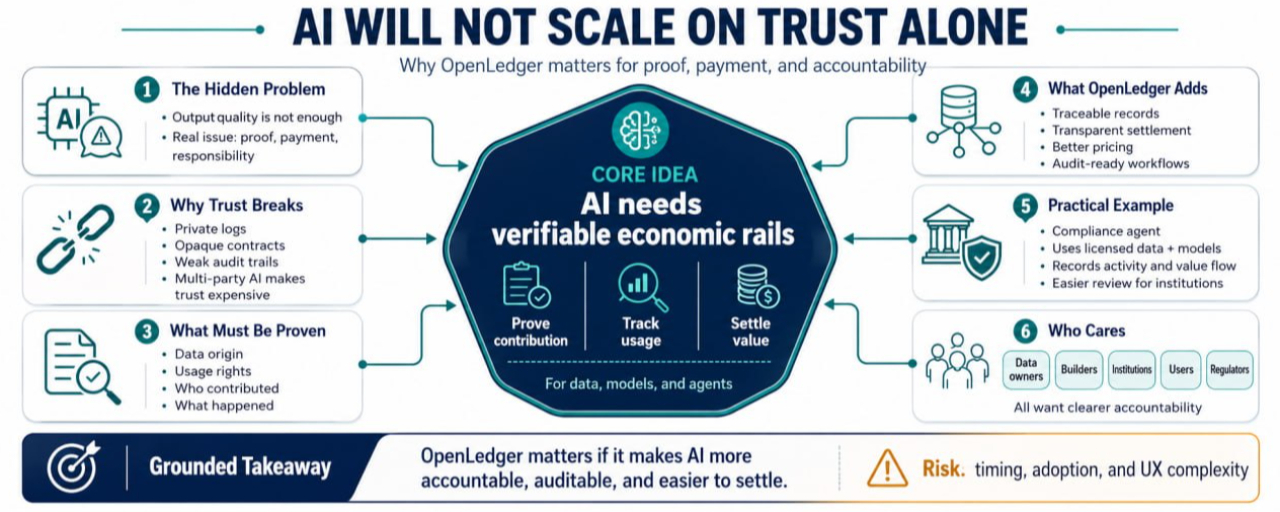
Better models, better agents, better automation. That seemed like the obvious direction. But the more I look at how AI might actually enter real businesses, the more I think the harder problem may be much less exciting: who gets paid, who is responsible, and who can prove what happened?
That is where OpenLedger starts to become interesting to me. Not because it makes AI sound futuristic, but because it focuses on the boring infrastructure that AI systems may eventually need if they are going to be trusted outside controlled demos.
The Hidden Problem Behind AI Usage
Most people talk about AI as if the main question is output quality.
Can the model write? Can the agent trade? Can it summarize documents? Can it complete a workflow?
Those things matter, but they are not enough for users, builders, institutions, or regulators. In the real world, every useful AI action creates secondary questions.
What data trained this model?
Who owned that data?
Was the model allowed to use it?
Who receives value when that model produces revenue?
What happens if the output causes harm?
Can the process be audited later?
Centralized AI infrastructure often handles these questions internally. A company may keep private logs, private contracts, private licensing terms, and private settlement systems. That can work for closed products, but it becomes fragile when many independent data owners, model builders, agents, users, and institutions interact across the same network.
The moment AI becomes multi-party, trust becomes expensive. $PLAY
Why Settlement Matters More Than It Sounds
Settlement is not a glamorous word, but it is one of the main reasons financial markets, payment networks, and enterprise systems function.
If someone contributes value, there has to be a way to record it, verify it, and distribute compensation. If someone disputes a transaction, there has to be a reference point. If regulators ask how a system made a decision or moved value, there has to be something more durable than “trust us.”
This matters even more for AI because AI outputs are often created from layered inputs. A useful agent may rely on datasets, fine-tuned models, external tools, previous user behavior, and automated decisions. Value is not produced by one actor. It is produced by a stack.
Without clear settlement logic, the AI economy risks becoming unfair at the edges. Data providers may be underpaid. Builders may struggle to prove contribution. Institutions may hesitate because the compliance trail is weak. Users may not know whether the system they are using is accountable.
This is the gap @OpenLedger appears to be targeting.
OpenLedger as Infrastructure, Not a Promise Machine
OpenLedger describes itself as an AI Blockchain focused on unlocking liquidity to monetize data, models, and agents. The important part, to me, is not just monetization. It is the idea that AI assets need traceable economic rails.
If data, models, and agents can be represented, tracked, and settled more transparently, then AI systems can become easier to price, audit, and integrate into real workflows.
That does not mean everything needs to be public in a reckless way. Institutions care about privacy. Regulators care about compliance. Builders care about costs and usability. Users care about whether the product actually works.
But the underlying need is clear: AI systems may need verifiable records of contribution and value flow. $OPEN becomes relevant in that context as part of the OpenLedger ecosystem, not as a shortcut to adoption, but as a coordination layer around the network’s economic activity.
A Practical Example
Imagine a compliance research agent used by a financial firm.
The agent summarizes regulatory changes, checks internal policies, and flags risky client activity. To do this, it may depend on licensed legal datasets, specialized compliance models, and smaller agents built by independent developers.
In a centralized setup, the firm has to trust the vendor’s internal reporting. It may not know exactly which components contributed to which result. The data owners may not receive dynamic compensation. The builders may depend on opaque revenue-sharing agreements. Regulators may ask for audit trails that are difficult to reconstruct.
With infrastructure like OpenLedger, the workflow could become more structured. Data contribution, model usage, agent activity, and value distribution could be recorded in a more verifiable way. Builders could design agents that plug into a broader economy. Institutions could demand clearer auditability before adopting AI. Regulators could examine settlement and provenance instead of relying only on promises.
That does not solve every legal issue. But it gives the system a better starting point.
The Human Side of AI Compliance
Technology usually fails when it ignores human behavior.
Data owners want upside. Builders want distribution. Institutions want lower risk. Users want convenience. Regulators want accountability. These groups do not naturally trust one another, especially when money and liability are involved.
OpenLedger could matter because it tries to align these groups around measurable contribution. If the system can show who provided what, how it was used, and how value moved, then cooperation becomes easier.
The real question is whether the infrastructure can stay simple enough for people to use. Compliance teams do not want complexity for its own sake. Builders will not adopt tools that slow them down. Users will not care about provenance unless it improves trust, cost, or access.
The Risk: Good Infrastructure Can Still Be Too Early
The biggest risk for OpenLedger is not that the idea is irrelevant. The risk is timing and adoption.
Many AI teams are still focused on speed. Many companies are experimenting without mature governance. Some users may not care where model outputs come from. Some builders may prefer closed platforms because distribution is easier. Institutions may agree that verifiable AI settlement matters, but still delay adoption due to integration costs, legal uncertainty, or internal bureaucracy. $ALT
There is also the challenge of making blockchain infrastructure feel invisible. If the user experience is too technical, the market may admire the idea without using it.
Grounded Takeaway
The people most likely to use OpenLedger are not casual AI users chasing novelty. They are builders who need better ways to monetize models and agents, data providers who want fairer attribution, and institutions that cannot deploy AI seriously without auditability and settlement logic.
It might work because AI is becoming too economically complex for informal trust systems.
It could fail if the market stays comfortable with centralized opacity, if compliance demand grows slower than expected, or if the tools are too difficult for normal teams to integrate.
For me, the case for #OpenLedger is not that it makes AI louder. It is that it may make AI more accountable.
Not financial advice.
What do you think matters more for AI adoption: better model performance, or better proof of ownership, compliance, and settlement?