
XDC Network Masternodes are the validator backbone of the XDC Network. They validate transactions, produce blocks, participate in consensus, support governance, and help secure an enterprise-ready Layer 1 blockchain built for trade finance, cross-border settlement, and real-world asset tokenization.
Since June 1, 2019, XDC has operated as an enterprise-grade delegated Proof-of-Stake network, making it one of the longest-running PoS-based Layer 1 blockchains in production and a network that pre-dates Ethereum’s Proof-of-Stake transition by more than three years. XDC’s masternode architecture has been battle-tested through years of mainnet operation, securing a blockchain purpose-built for trade finance, real-world asset tokenization, cross-border payments, and enterprise settlement.
How XDC Masternodes differ from other nodes
XDC Network has several types of nodes, but they do not all perform the same function.
A Full Node can be set up by anyone. It does not require staking and does not earn rewards. Its main role is to fetch data from the blockchain, making it useful for developers, explorers, and applications that need access to the latest blockchain state.
An Archive Node goes a step further. It stores the full historical blockchain data, which makes it valuable for analytics platforms, explorers, and applications that need deep historical reference points. Like a Full Node, it is not mandatory for standard users and does not play the same role as a validator.
A Masternode is the critical validator node. It requires a minimum contribution of 10 million XDC, validates transactions, mines blocks, participates in consensus and governance voting, helps secure the network, and earns rewards for active participation.
Why the validator count can look different
Like many blockchain networks, XDC’s validator numbers can look different depending on what is being counted.
XDC’s masternode page lists 108 Masternodes / Core Validators in its illustrative validator stats. It also lists 138 Protector Nodes, while Observer Nodes are described as unlimited.
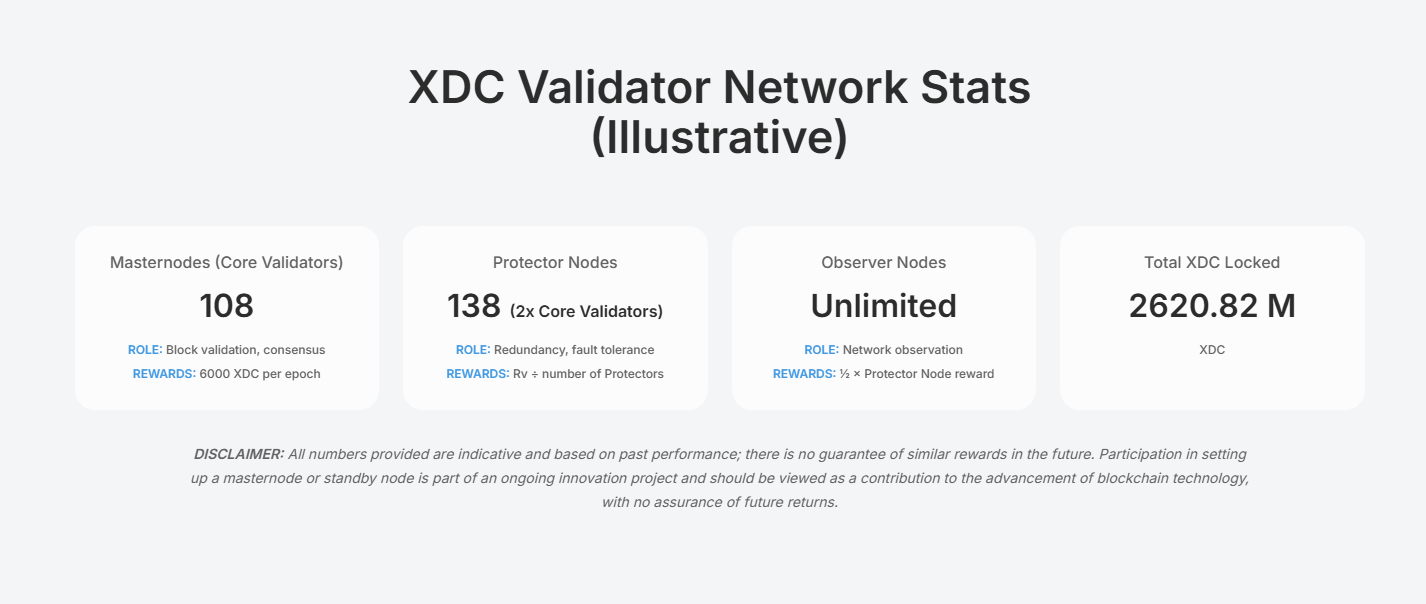
So, when people ask how many validators XDC has, the better answer is: it depends on whether they mean only Core Validators, or the broader node architecture that includes Protector and Observer roles.
What Masternodes actually do?
XDC Masternodes perform the work that keeps the network live and secure.
They validate and approve transactions, support near-instant confirmations, participate in governance, and help maintain the security and stability of the chain. Masternodes are the pillars of blockchain performance, supporting high-speed validation, network security, and decentralized governance.
XDC 2.0 further builds on this by using three pillars: masternode election, a HotStuff Byzantine Fault Tolerant state machine replication consensus engine, and a reward mechanism to incentivize nodes to join and maintain the network.
Who can run an XDC Masternode?
Running an XDC Masternode is easy and setup takes less than 10 minutes; find this step by step guide to setup XDC Network masternode.
A Masternode requires a minimum contribution of 10 million XDC, no upper limit, and 100% uptime on dedicated or cloud infrastructure. Protector Nodes and Observer Nodes also require a minimum contribution of 10 million XDC, although their responsibilities differ from Core Validators.
XDC Network Masternode setup is easy; just a single bootstrap command to run the XDC Network masternode. Whether you're running CentOS, RedHat Enterprise Linux, or Ubuntu, this guide has got all covered. There are a number of third-party services and volunteers to provide the top-notch support and services for people with zero tech knowledge. 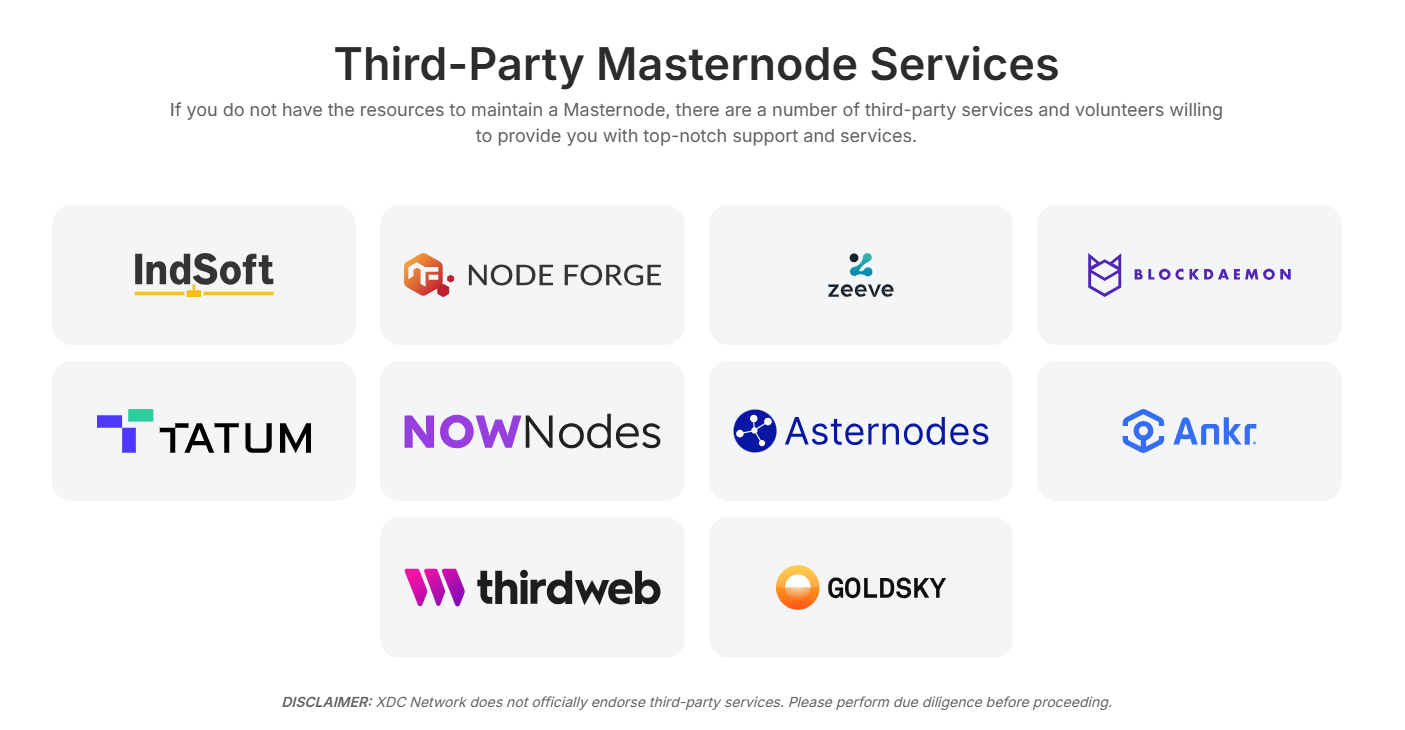
Masternode rewards are distributed after each epoch, with one epoch consisting of 900 blocks and taking approximately 50 minutes. Resigning from a Masternode requires a 30 days cooling period before the 10 million XDC can be retrieved.
Top companies supporting the XDC validator ecosystem
XDC’s masternode page highlights several leading infrastructure operators and trusted institutions connected to the network, including SBI VC Japan, Cumberland, Deutsche Telekom, GSR Markets, HashKey Cloud, Republic, UOB Venture Management, Animoca Brands, Clearpool, and Bitrue.

Animoca Brands recently joined XDC Network as a strategic validator, operating masternodes and joining a validator base that includes Deutsche Telekom, HashKeyCloud, Republic, SBI Holdings, and UOB Venture Management. The announcement positioned the move as part of XDC’s institutional validator program, supporting infrastructure for trade finance, cross-border settlement, and real-world asset tokenization.
Built for the Multi-Trillion-Dollar Shift
XDC’s masternode model answers a vital question for institutional adoption: can this infrastructure actually support the future of global finance?
With the massive boom in stablecoin settlement and a multi-trillion-dollar wave of real-world assets (RWAs) heading to the blockchain, network quality isn't optional. To handle this kind of volume, XDC delivers what enterprises demand:
Enterprise-Grade Scale: Built to handle high-volume stablecoin settlements and massive RWA transactions.
Uncompromising Speed: Instant, low-cost validation without the bottlenecks.
Rock-Solid Reliability: Nearly 100% uptime since 7 years, even before ethereum shifted to PoS and active governance that institutions can legally trust.
Lowest Gas Fees: The gas fee of XDC is extremely less compared to other blockchains.
That is the magic of XDC’s validator model. These masternodes are the active economic drivers and security providers built specifically to handle global financial infrastructure at a multi-trillion-dollar scale.
As institutional operators continue to join, XDC is cementing its position as the ultimate, open-source powerhouse optimized for international trade and international financial settlement.
Reference Links on XDC Node
https://xinfin.org/setup-masternode
https://xinfin.org/docker-setup
https://www.xdc.dev/xinfin_xdc_network/how-to-host-an-xdc-masternode-using-fireblocks-via-walletconnect-step-by-step-guide-4gpf
https://www.xdc.dev/vinn_9686/standard-guide-how-to-host-an-xdc-masternode-2n4h
https://github.com/XinFinOrg/XinFin-Node
Disclaimer
This article is for educational and informational purposes only. It should not be considered financial, investment, staking, or legal advice. Running a masternode or participating in any blockchain network involves technical, operational, and market risks. Readers should conduct their own research before making any decision.