
I keep noticing the same contradiction across the AI industry. Everyone says data is the new oil, yet most people who actually create useful data rarely benefit from it. Researchers label datasets for years, small developers train niche models, and communities generate endless streams of valuable information online, but the economic rewards usually collect around a few centralized platforms. The people feeding the system often remain invisible once the system becomes profitable.
This imbalance is not new. The internet has always struggled to define ownership around digital contributions. Social platforms monetized user attention. Streaming services monetized creators. AI companies now monetize training data, human feedback, and model outputs. Yet the infrastructure connecting contributors to value creation still feels incomplete. I think this is partly why projects like OpenLedger (OPEN) are starting to attract attention inside blockchain and AI circles.
The broader issue is liquidity around AI resources. Data, models, and AI agents exist everywhere, but most of them are difficult to monetize independently. A small medical dataset might be extremely useful for training a specialized model, but there is no simple system for proving ownership, verifying quality, distributing access, and rewarding contributors fairly. The same problem appears with open-source models and autonomous AI agents. Useful tools exist, but turning them into sustainable economic assets remains complicated.
Before projects like OpenLedger appeared, several attempts tried to solve this problem from different angles. Traditional cloud marketplaces allowed companies to buy datasets and APIs, but these systems were highly centralized. Control remained with large intermediaries, and smaller contributors often lacked visibility or bargaining power. On the blockchain side, some earlier projects experimented with decentralized data markets, but many struggled with scalability, verification, or actual adoption. In practice, it was difficult to guarantee that uploaded data was authentic, legally usable, or valuable enough for AI training.
I think one reason previous systems fell short is because they treated data as a static product rather than part of a living AI ecosystem. AI development moves continuously. Models evolve, datasets change, and agents interact dynamically. A marketplace alone cannot solve coordination problems between contributors, developers, validators, and users. There also needs to be trust around attribution and ongoing usage.
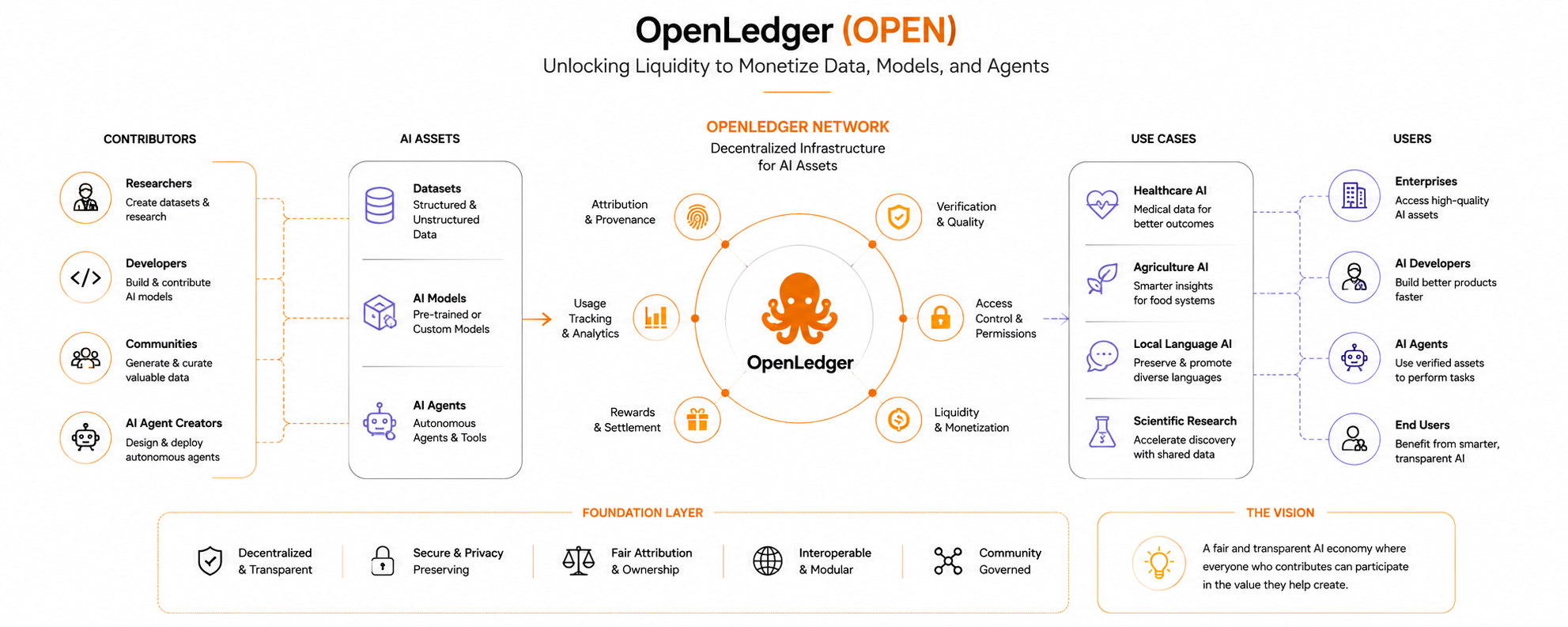
OpenLedger seems to position itself as one possible infrastructure layer for this challenge. Instead of focusing only on token transfers or speculative trading activity, the project talks about creating liquidity around AI-related assets themselves. That includes datasets, models, and autonomous agents that can potentially generate value over time.
What interests me is the attempt to connect blockchain verification with AI contribution tracking. In simple terms, the idea appears to revolve around recording who contributed what, how those resources are used, and how rewards might flow back through the network. If it works as intended, it could create a more transparent system for AI collaboration compared to the closed environments dominating the industry today.
I also notice that OpenLedger leans heavily into modularity. Rather than presenting one giant AI model, it seems designed as infrastructure where different participants contribute pieces of the ecosystem. A developer could provide a model, another participant could contribute specialized data, while agents operate on top of that structure. Conceptually, this resembles how decentralized finance tried to create interoperable financial layers, except applied to AI resources instead of lending protocols.
Still, I think there are difficult questions underneath the vision.
The first issue is verification. AI systems depend heavily on data quality, but verifying quality in decentralized environments is extremely hard. A blockchain can record ownership or transactions, but it cannot automatically determine whether a dataset is accurate, biased, outdated, or legally safe to use. Human oversight still matters, and that introduces complexity that technology alone may not eliminate.
Another concern is concentration. Decentralization sounds appealing in theory, but large players often retain advantages regardless of infrastructure design. Organizations with better computational resources, stronger distribution channels, and larger proprietary datasets may still dominate participation. Smaller contributors could gain more visibility than before, but visibility does not always translate into bargaining power.
There is also the question of incentives. When financial rewards become attached to AI contributions, participants may prioritize quantity over quality. We already see similar dynamics across parts of the internet where engagement metrics distort behavior. If decentralized AI economies expand, systems will need strong mechanisms to discourage spam, manipulation, and low-quality data generation.
Regulation is another unresolved layer. AI governance remains uncertain globally, while blockchain regulation varies dramatically between jurisdictions. Combining both industries creates overlapping legal ambiguity. Questions around intellectual property, consent, privacy, and liability could become more complicated rather than simpler.
I think the people who benefit most from a project like OpenLedger could be smaller AI developers and niche communities that currently lack monetization channels. Specialized datasets in healthcare, agriculture, local languages, or scientific research might gain new economic relevance if infrastructure genuinely supports fair attribution. Independent builders could potentially access markets that were previously controlled by large platforms.
At the same time, participation may still exclude people without technical knowledge, computational access, or legal clarity around their data ownership. Decentralization does not automatically create equal opportunity. Sometimes it simply redistributes complexity onto users.
The deeper question, at least for me, is whether blockchain-based AI infrastructure can truly create healthier digital economies, or whether it risks rebuilding familiar power structures under new terminology. OpenLedger represents an interesting attempt to address real problems around ownership and value distribution in AI, but the harder challenge may not be technical architecture alone. It may be whether human incentives inside these systems can remain aligned over time.
As AI becomes more dependent on collective human input, who should actually own the value created from that intelligence?