
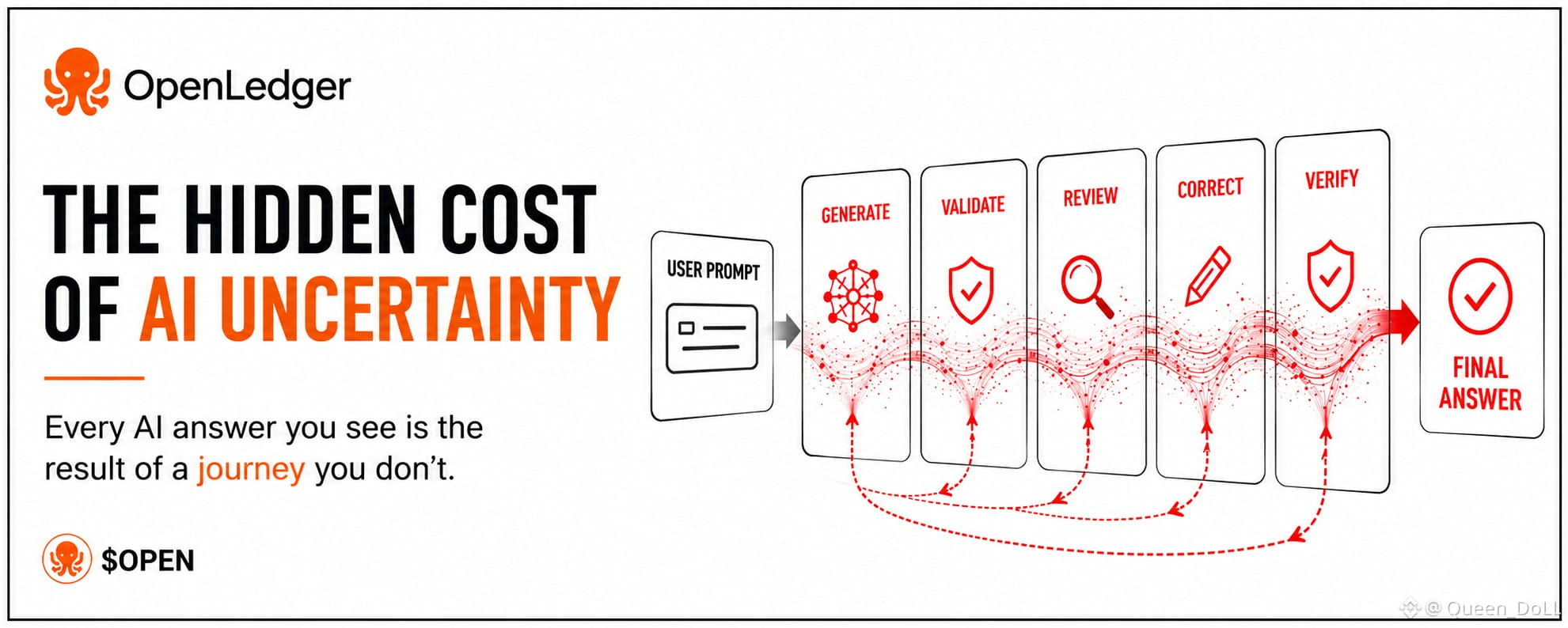
The more time I spent exploring OpenLedger, the more I found myself thinking about something most people rarely notice when they interact with AI.
What Happens Before The Final Answer
From the outside, an AI request feels incredibly simple.
You type a prompt, wait a few seconds, and receive a response.
Everything appears smooth.
But the deeper I looked into systems where AI outputs carry economic value, the more I realized the process behind that response can be far more complicated.
Sometimes an output gets validated immediately.
Sometimes it doesn't.
A response might be reviewed, checked, corrected, and sent through additional verification before it is finally accepted.
The user never sees any of that.
They only see the final answer.
The network sees every attempt.
And honestly, that distinction feels more important than I initially realized.
Because once AI-generated work becomes something that can be rewarded economically, the conversation changes.
The challenge is no longer just generating an output.
The challenge becomes figuring out how the system handles uncertainty.
That thought stayed with me while learning more about OpenLedger.
At first, I assumed the focus was simply on enabling AI participation within a decentralized network.
A lot of projects talk about that.
But the deeper idea seems more interesting.
What happens when two participants contribute to the same workflow, yet one consistently produces outputs that pass validation immediately while another regularly requires multiple correction cycles before reaching the same result?
From a user's perspective, both workflows may look identical.
The final answer arrives either way.
But internally, the cost of getting there can be very different.
Additional validation requires additional resources.
More compute gets consumed.
More routing decisions get made.
More time gets spent reaching certainty.
And that made me wonder whether the real value being measured isn't just intelligence itself.
Maybe it's reliability.
Because over time, networks naturally begin responding to performance.
Participants that create fewer complications become easier to work with.
Participants that generate more uncertainty require additional resources to support.
No dramatic penalties are necessary.
No centralized authority needs to intervene.
Economic incentives gradually shape behavior on their own.
And that's where OPEN started making more sense to me.
Not simply as a reward mechanism.
But as a framework that helps quantify the hidden cost of uncertainty inside AI workflows.
The interesting part is that uncertainty is often invisible from the outside.
A workflow that succeeds immediately and a workflow that succeeds after several retries can produce exactly the same final result.
Yet internally, they represent very different levels of efficiency.
That difference may not seem significant during quiet periods.
But when demand increases and resources become more constrained, those hidden costs start becoming much easier to notice.
Some requests move smoothly through the system.
Others spend longer navigating validation and verification layers.
And those moments reveal what the network values most.
Consistency.
Reliability.
Predictability.
Of course, this raises another question that I still find difficult to answer.
Does this kind of system create stronger coordination for decentralized AI?
Or does it gradually build a reputation dynamic that naturally favors participants with established performance histories?
Maybe both outcomes emerge at the same time.
I genuinely don't know yet.
But one thing feels increasingly clear.
The more I study payable AI systems, the less I think the challenge is generating intelligence itself.
The harder problem seems to be deciding how uncertainty gets absorbed when intelligence remains probabilistic but economic settlement requires confidence.
That coordination layer is what keeps pulling my attention back.
And it's also the layer where OpenLedger starts becoming much more interesting to me.
