

$OPEN When I think about where AI economies are heading, I feel we are still stuck in a very early accounting mindset. We measure everything in simplified units like API calls, tokens, or model subscriptions, but none of these really capture what is actually happening inside modern AI systems. What we are missing is a way to treat compute time as an economic layer, not just a utility cost.
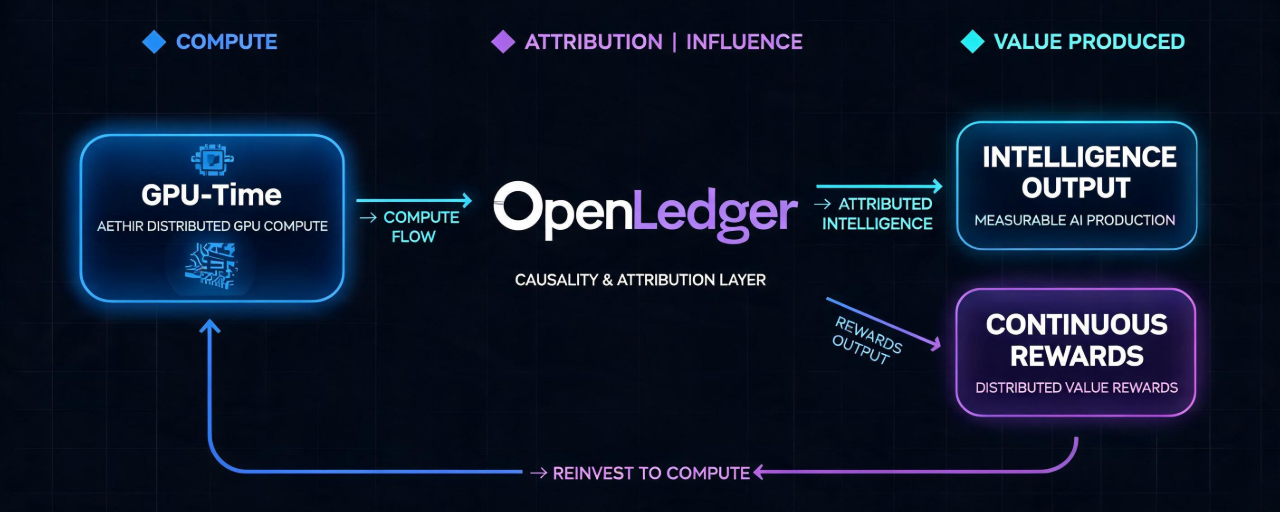
In my view, Aethir represents the physical backbone of this new economy. It distributes raw computational power across the world, turning GPU capacity into something fluid and globally accessible. But what makes this interesting is not just the availability of compute it is the possibility that every unit of compute can become traceable economic activity.
On the other side, @OpenLedger introduces something even more important: attribution. Not just who paid for compute, but who shaped the intelligence produced inside that compute. This distinction matters because AI outputs are not created by hardware alone they are shaped by layers of invisible influence.
I keep coming back to a simple idea: every GPU cycle is not just execution. It is a moment where intelligence is being formed. Something is being refined, corrected, predicted, or generated. Yet today, we treat that entire process as economically blind. We pay for the electricity, not the intelligence formation happening inside it.
If we combine these two systems distributed compute from Aethir and attribution intelligence from OpenLedger we can start imagining GPU-time as something more like a financialized production unit of intelligence. Not just “time rented,” but “value produced per millisecond of cognition.”
In this model, GPU-time stops being passive infrastructure and becomes an active economic instrument. Every second of compute carries metadata: what data influenced it, which prompts shaped it, which models were used, and which feedback loops refined the output. Suddenly, compute is no longer anonymous.
What excites me most is that this reframes the entire concept of AI labor. Today, AI labor is hidden behind systems data labeling, fine-tuning, prompt engineering, inference optimization but none of it is continuously rewarded in proportion to its actual long-term impact. Once attribution enters GPU-time, labor becomes continuous instead of one-time.
I imagine a system where every GPU-hour is split into two components: execution cost and influence weight. Execution cost is simple how much compute was used. But influence weight is more complex it measures how much human or data contribution shaped the final intelligence output.
This is where OpenLedger becomes critical. It acts like a “causality ledger,” mapping which inputs actually mattered. Not all data is equal. Not all prompts are equal. Some inputs silently reshape model behavior over time, while others have no meaningful impact. Attribution systems can finally make that difference visible.
Meanwhile, Aethir provides the scale needed to make this real. Without abundant and decentralized GPU infrastructure, attribution would remain theoretical. But once compute becomes distributed and elastic, every inference and training run can be recorded, measured, and economically indexed in real time.
From this combination, I start to see a new kind of market emerging: AI labor markets priced by GPU-time × influence score. This is very different from today’s SaaS pricing or even DeFi yield systems. It is closer to a living labor economy where intelligence production is continuously valued.
In such a system, a single GPU-hour might not be equal to another GPU-hour. One hour of compute running on high-impact datasets could generate far more economic value than ten hours of low-impact or redundant computation. This breaks the traditional assumption that compute is homogeneous.
That leads to a deeper shift: we move from “compute efficiency” to “influence efficiency.” The question is no longer just how fast or cheap AI runs, but how meaningfully each compute cycle contributes to collective intelligence growth.
I also think this introduces a new class of participants in AI economies. Not just developers or companies, but influence contributors people who shape outputs indirectly through data, corrections, feedback, and interaction patterns. These contributors are currently invisible, but in a GPU-time primitive system, they become continuously rewarded.
Another interesting implication is that AI outputs themselves begin to behave like financial assets. If every output carries attribution history, then it becomes possible to price outputs based on the quality and rarity of influence behind them. A model response is no longer just text it becomes a compressed record of distributed intellectual labor.
Over time, this could even lead to what I call “compute-backed royalties.” Instead of paying once for a dataset or model, the system could continuously distribute value as that dataset influences future GPU computations across the network. Value becomes recursive, not static.
There is also a governance angle here. If AI systems are powered by distributed compute and distributed attribution, then trust no longer depends on central institutions. It depends on verifiable computational history. Every output can be traced back through GPU execution paths and influence graphs.
What I find most transformative about this idea is not the technology itself, but the shift in how we define economic participation. In traditional systems, you either own capital or sell labor. In a GPU-time economy, you contribute influence, and that influence compounds over time across computational systems.
Eventually, I think this could lead to a new abstraction layer for global AI systems: intelligence as a fully auditable economy. Every inference, every training step, every correction becomes part of a living financial graph that reflects not just what was computed, but who shaped what was computed.
And in that world, GPU-time is no longer just infrastructure billing. It becomes the foundational currency of machine intelligence production a unit where compute, influence, and attribution converge into a single measurable economic reality.