
What I keep asking myself when looking at the future of AI + Web3 is this: how will the system survive when market risks, technical failures, and data manipulation become more frequent and more complex?
From my perspective, @OpenLedger is trying to answer exactly that question — not by avoiding risk, but by designing systems that can respond to it.
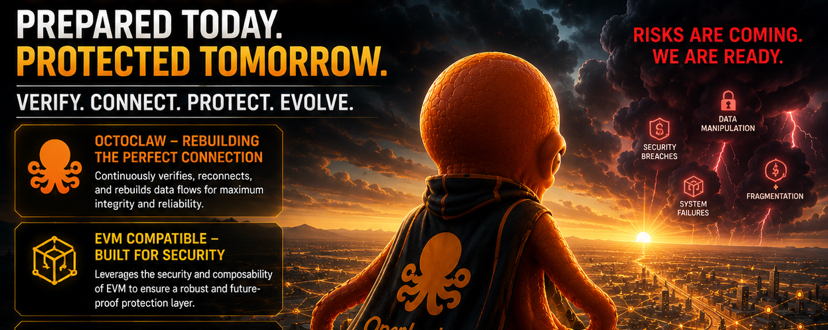
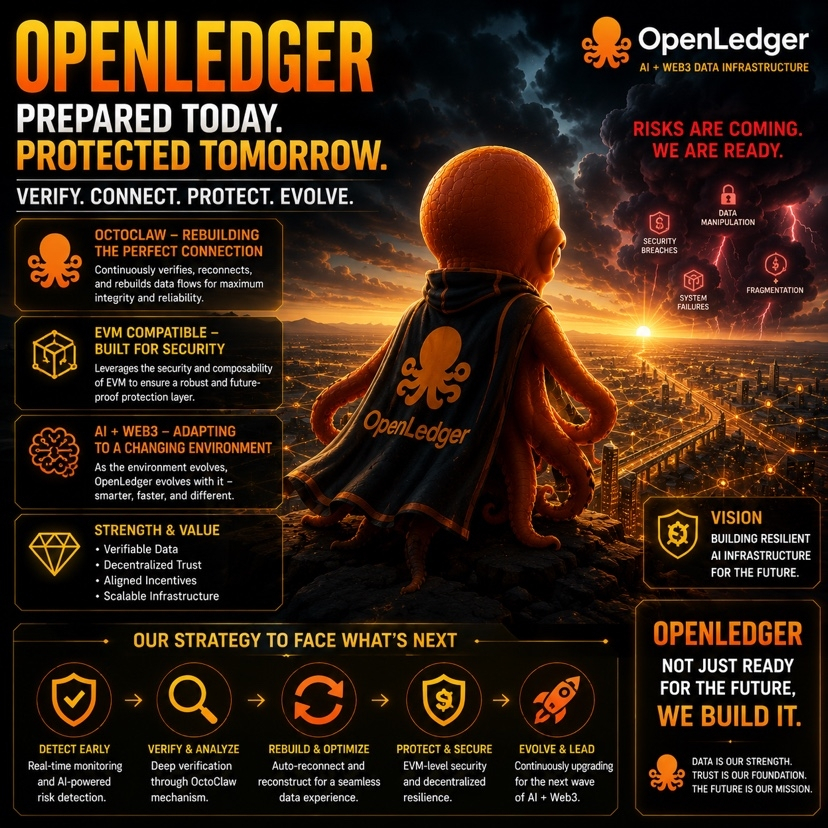
When I study the structure of the project, one of the most interesting elements is OctoClaw. Rather than seeing it as just a component, I interpret OctoClaw as a verification and reconstruction layer — a mechanism that continuously checks, reconnects, and rebuilds data flows to ensure that the system remains coherent even under fragmented or unstable conditions.
In a future where AI systems are heavily dependent on external data sources, this kind of self-correcting structure becomes extremely important. It is not only about performance, but about resilience.
Another key aspect is EVM compatibility. In my view, this is not just a technical feature — it is a strategic decision. By aligning with the EVM ecosystem, #OpenLedger positions itself inside one of the most secure and widely adopted infrastructures in Web3. This increases its ability to integrate, expand, and survive across multiple environments, which is essential when considering long-term risk exposure.
✨✨ - As AI + Web3 continues to evolve, I believe the environment itself will become more volatile — not less. Data integrity issues, incentive misalignment, and system fragmentation will become more visible as adoption grows. This is where OpenLedger’s approach becomes more meaningful.
Instead of ignoring these risks, the project appears to design around them: building verification layers, aligning incentives, and structuring data flows so that errors and inconsistencies can be minimized over time.
Of course, I still remain critical. The biggest question is whether such a complex system can scale without introducing friction for developers and users. Can OctoClaw maintain efficiency while handling large-scale AI data interactions? And will EVM integration be enough to ensure long-term resilience in an increasingly multi-chain world?
🐙🐙 - These are real challenges, not theoretical ones.
But despite these questions, my overall view remains positive. OpenLedger is not positioning itself as a short-term narrative project. Instead, it is building toward a scenario where AI systems must coexist with uncertainty — and still function reliably.
So when I think about its long-term role, I don’t just see a project reacting to market risks. I see a system attempting to design a framework where those risks are expected, managed, and structurally absorbed.
And in my opinion, that is where its real value begins to form.
