Not the output.
The trail.
The data that shaped it.
The model that interpreted it.
The agent that acted on it.
The system that carried the result somewhere else.
Most AI conversations still focus on the visible part. The text on the screen. The image that gets generated. The trade that gets placed. The app that appears after a few prompts.
That makes sense. It is the part people can see.
But the more useful question may be what happened before that moment.
Where did the intelligence come from?
What did it depend on?
Who contributed to it?
And when it creates value, where does that value go?
That is the angle that makes OpenLedger feel different to me.
Not because it is simply combining AI and blockchain. That phrase has become too easy to say. It almost hides the real point now.
The more interesting part is that OpenLedger seems to care about the record behind AI activity.
Data, models, and agents are not just tools floating around separately. They are connected. A dataset can shape a model. A model can guide an agent. An agent can create an outcome. That outcome may create value.
But in most systems, the path between these pieces is blurry.
You see the result, but not the chain behind it.
OpenLedger feels like an attempt to make that chain easier to use, easier to track, and maybe easier to reward over time.
That matters because AI is becoming less passive.
Earlier AI tools mostly waited for instructions. Ask a question, get an answer. Give a prompt, get a result. Simple enough.
Now agents are entering the picture.
Agents are different because they do not just respond. They can move through workflows. They can observe, decide, execute, and adjust. Once that happens, the question becomes more serious.
If an agent acts, what is it acting on?
That is where Octoclaw becomes an important part of the OpenLedger story.
The Octoclaw launch gives the ecosystem a clearer agent-facing direction. It points toward a future where agents are not just small demos or chat-based assistants, but active parts of a larger network. They can sit closer to data, tools, liquidity, and user intent.
That may sound like a small change at first.
But it changes the responsibility around agents.
When an agent only gives suggestions, the system around it can be loose. When an agent begins doing things, the system needs more structure. It needs better memory. Better access control. Better ways to understand what happened and why.
OpenLedger’s focus on data, models, and agents starts to make more sense in that context.
The trading agent is a good example.
Most people will look at a trading agent and immediately think about performance. Did it win? Did it lose? Is it better than a human trader?
Those are normal questions, but they are not the only ones.
A more interesting question is this:
Can the agent’s activity be understood?
What signals did it use?
What strategy shaped the action?
What data mattered?
What part of the system produced the value, if any?
A trading agent without context is just a black box with a balance.
A trading agent with a traceable environment becomes something else. It becomes a small example of how AI decisions might operate in open markets, where data and models are not hidden completely behind the curtain. $STAR
That does not make it perfect.
Markets are still uncertain. AI still makes mistakes. Agents still need limits.
But the structure around the agent starts to matter as much as the agent itself.
That is the part OpenLedger seems to be moving toward.
Vibecoding with OpenLedger adds another layer to this idea.
At first, vibecoding sounds like a casual builder trend. People prompt, build, adjust, test, and keep going. It is less formal than traditional development. Sometimes it is messy. Sometimes it works better than expected.
But there is something deeper happening there.
Vibecoding changes who can build.
More people can turn an idea into a rough product. More people can test an agent concept. More people can connect data to an interface, or create a small workflow that would have taken much longer before.
That is useful.
But it also creates a new question.
If many more people are building with AI, how do their creations become part of a shared system instead of scattered experiments?
OpenLedger may give those experiments a place to land.
A builder could create an agent. Another could bring data. Someone else could improve a model. Another person could connect it to liquidity. Over time, the line between contribution and product becomes less fixed.
That is where a ledger matters.
Not just as a database. More as a shared record of who added what, what was used, and where value moved.
ERC-4626 also fits this slower story.
On paper, it is a vault standard. It sounds technical, almost boring. But boring standards are often what make new systems easier to trust.
If AI-related assets are going to have liquidity, they need familiar containers. They need structures that other developers and protocols can understand without starting from zero each time.
ERC-4626 can help create that kind of common language.
It gives a cleaner way to think about deposits, shares, and yield-bearing structures. In OpenLedger’s case, that could support new forms of AI-linked value. Not in a forced way. More like giving the ecosystem a standard route when something does become productive.
The EVM bridge plays a similar role, but at the network level.
It is easy to underestimate bridges because they feel like infrastructure plumbing. But plumbing decides where things can flow.
If OpenLedger wants data, models, agents, and liquidity to interact with wider crypto markets, it cannot stay isolated. The EVM world already has users, developers, tools, and capital moving through it. Connecting to that environment makes OpenLedger easier to approach.
Not everyone wants to learn a new system from scratch.
Sometimes people just need a bridge before they are willing to experiment.
So when I look at these updates together, I do not see them as separate announcements.
Octoclaw is about agents.
The trading agent is about AI action in markets.
Vibecoding is about letting more people build.
ERC-4626 is about giving value a standard shape.
The EVM bridge is about letting that value move outward.
The shared thread is not hype.
It is traceability. $LAB
AI is starting to make decisions, create assets, and affect markets. That means the hidden path behind AI activity matters more than before. The data matters. The model matters. The agent matters. The environment matters.
OpenLedger seems to be building around that hidden path.
Slowly, and still early.
But the direction is worth noticing.
Because as AI becomes more active, people may care less about a single output and more about the system that produced it.
And that is probably where the next conversation begins.

Статья
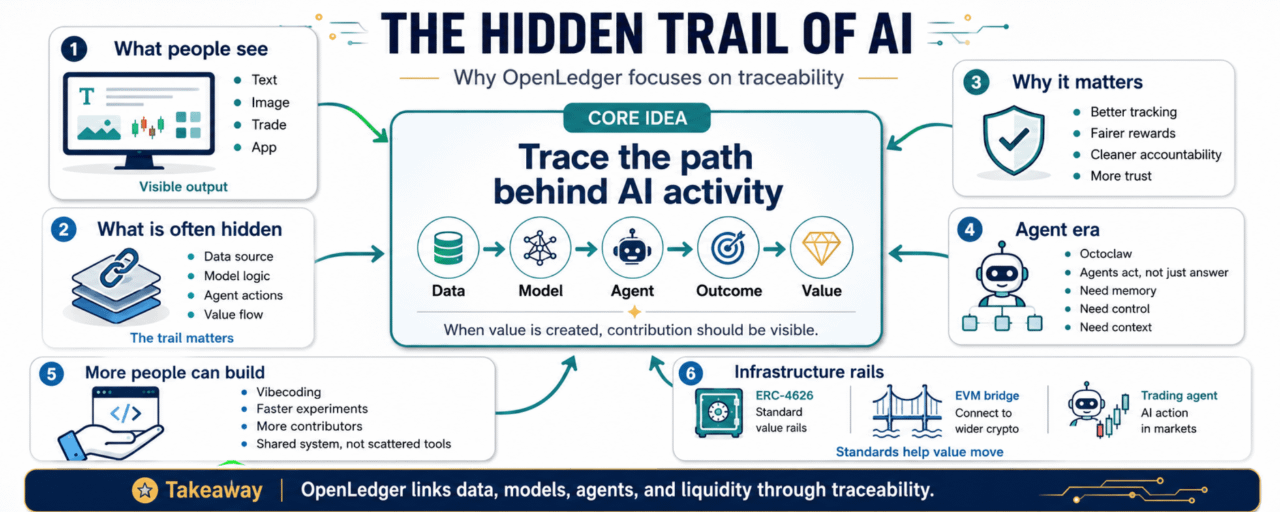
One thing people do not talk about enough with AI is the trail it leaves behind.
Отказ от ответственности: на платформе опубликованы материалы и мнения третьих лиц. Не является финансовой рекомендацией. Может содержать спонсируемый контент. См. Правила и условия.