


I almost ignored the announcement when I first saw it. @OpenLedger had open sourced its vibe coded platform, and my first reaction was that it would probably follow the same path as countless AI releases before it. A burst of excitement, a few impressive demos, and then attention would drift somewhere else. Crypto has become very good at turning technology into narratives, often before the technology has had time to prove itself. So I didn't think much about it initially. But over the following days, I kept seeing builders experiment with the platform, and the more I watched, the more I felt like the software itself wasn't actually the most important part of the story.
What caught my attention was the type of activity emerging around it. People weren't launching polished startups or preparing fundraising decks. They were building trading assistants, research copilots, workflow automations, niche AI agents, and highly specialized tools designed for very specific use cases. Most of these projects will never become billion dollar companies. Many will probably disappear within months. Yet strangely, that didn't seem to matter. Every experiment was creating something useful, even if only for a small group of people. The value wasn't coming from scale. It was coming from participation.
That's when I started looking back at #OpenLedger 's broader vision. The protocol has always felt different from projects that simply combine AI and blockchain because the narrative sounds attractive. The whitepaper keeps returning to a simple idea: intelligence is not created by a single model. It emerges from contributors, datasets, applications, workflows, users, and feedback loops interacting together. The problem is that most AI ecosystems don't recognize those contributions economically. Value is generated collectively but captured centrally. The people helping intelligence improve often become invisible the moment the system succeeds.
Then it hit me. $OPEN isn't trying to turn everyone into a developer. It's trying to make every builder economically visible.
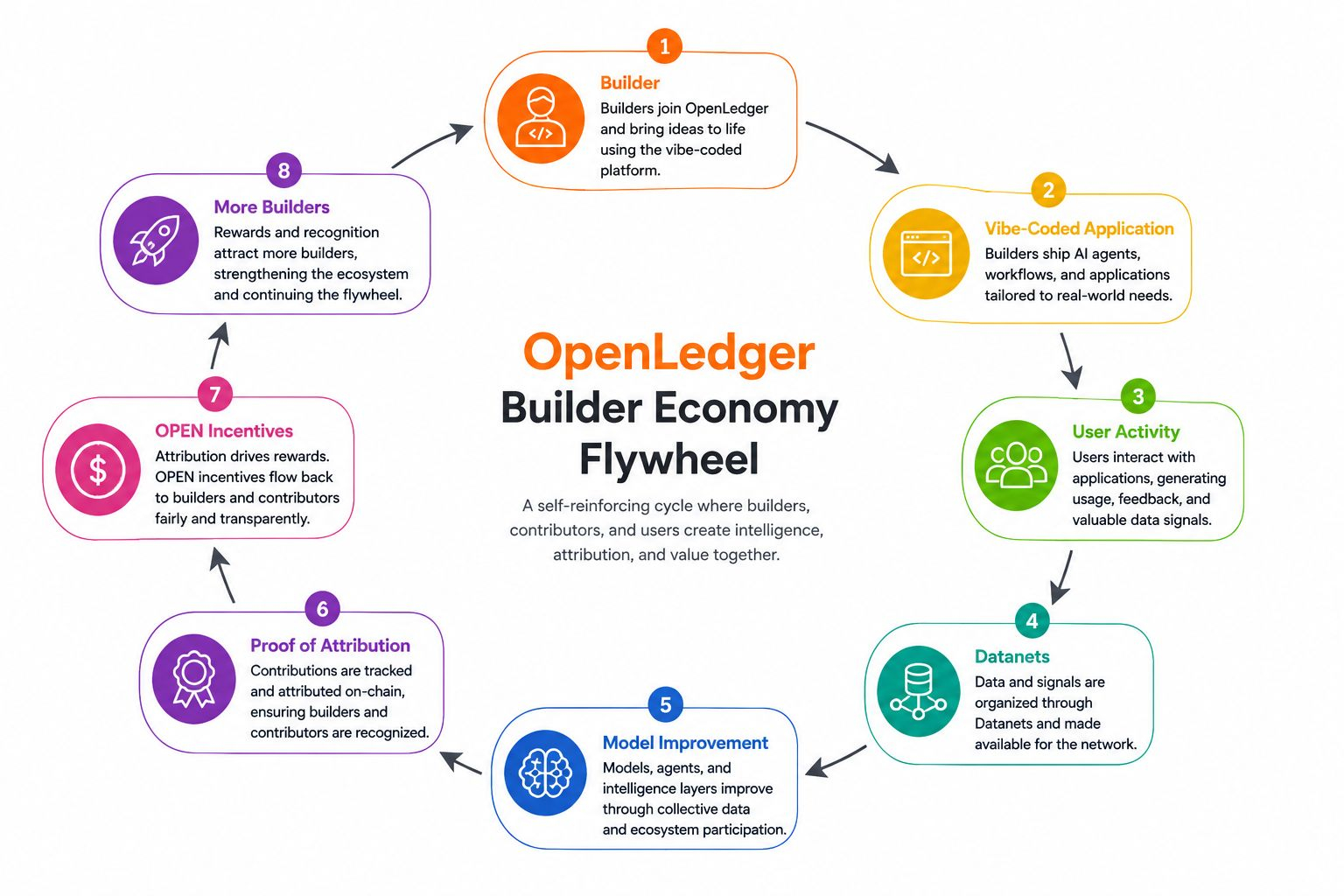
The more I thought about that idea, the more the vibe coded platform started making sense. What looked like a builder tool suddenly felt like infrastructure for participation. Every workflow, agent, and application built on the platform introduces new activity into the network. Users interact with those tools. New data is generated. New behaviors emerge. New feedback loops appear. Instead of treating those contributions as disposable activity, OpenLedger's architecture is designed to recognize them as inputs into a larger intelligence economy. The platform isn't simply helping people build faster. It's helping them become part of the system that creates value.
The more I sat with that realization, the more I felt the real product wasn't the platform at all. A builder creates a niche application, maybe a research copilot for crypto markets or an AI workflow that automates repetitive tasks. Users begin interacting with it and generate activity, signals, and feedback. Through Datanets, those signals can contribute to broader intelligence layers across the ecosystem. Models improve. Applications become more useful. Proof of Attribution works to identify where contributions originated, ensuring builders don't disappear behind the infrastructure they help strengthen. Incentives can then flow back through the network, encouraging further experimentation. What begins as one small project gradually becomes part of a self-reinforcing cycle of intelligence creation. The platform starts the process, but the ecosystem is what compounds it.
That flywheel feels especially relevant right now because AI has fundamentally changed who gets to build software. The number of potential builders is expanding faster than most crypto ecosystems were designed for. One person can now create products that previously required teams. Innovation is becoming smaller, faster, and more distributed. Yet many platforms still behave as if value creation comes primarily from a handful of large organizations. OpenLedger seems to be making a different bet. It appears to believe the next wave of innovation will come from thousands of contributors building highly specialized tools rather than a small number of dominant applications.
That's also why components like Datanets, OpenLoRA, and ModelFactory matter more than they might initially appear. They aren't isolated features sitting beside one another. Together they form a framework for collaborative intelligence creation. Datanets organize decentralized data contributions. OpenLoRA allows models to evolve through community customization. ModelFactory provides infrastructure for building and deploying AI systems within the ecosystem. The vibe coded platform acts as the entry point connecting everyday builders to those deeper layers. Instead of asking contributors to understand complex AI infrastructure, OpenLedger lowers the barrier to participation and lets experimentation become the onboarding process.
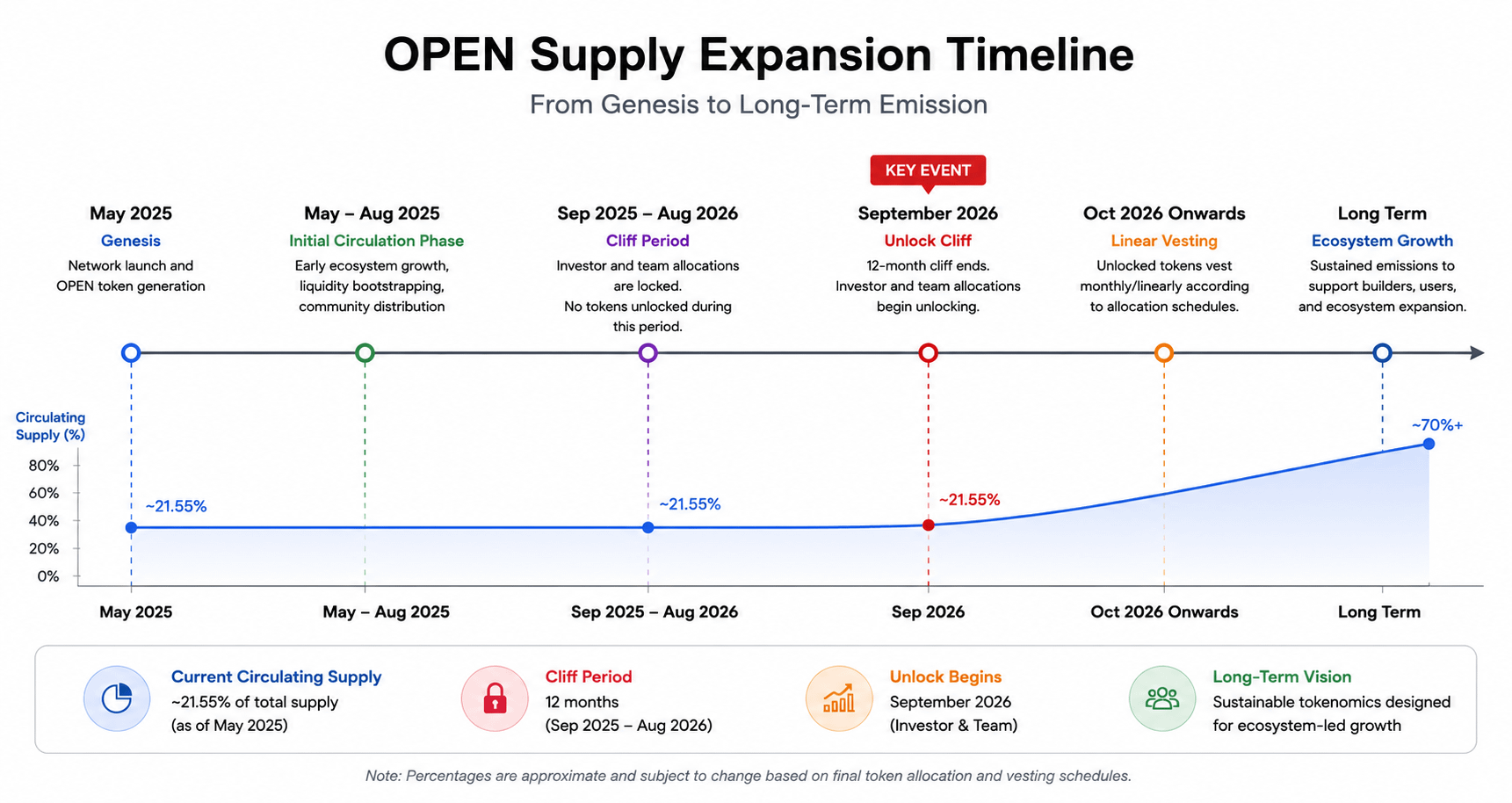
Even the tokenomics started looking different once I viewed the protocol through that lens. OPEN has a fixed supply of 1 billion tokens, with roughly 21.55% currently circulating and more than 61% allocated toward community and ecosystem growth. Normally I focus heavily on vesting schedules, unlocks, and dilution risk, and those factors still matter here. In fact, one of the biggest discussions happening around OpenLedger today centers on the September 2026 unlock cliff, when investor and team allocations begin unlocking after their 12-month cliff period. Many analysts are watching closely because monthly circulating supply could increase significantly after that point.
But what makes the discussion interesting is that it isn't only about supply. It's about whether ecosystem growth can keep pace with it. If more builders continue entering the network, more applications are deployed, and more activity flows through OpenLedger's attribution systems, then demand may grow alongside distribution. The coming unlock cycle could become one of the first real tests of whether participation driven economics can scale as effectively as the protocol expects.
Of course, there are real risks. Open source ecosystems are messy by nature. AI infrastructure is becoming increasingly competitive. Future token unlocks will continue increasing supply over time. None of those challenges disappear because a protocol has a compelling vision. But I think those risks are easier to understand than the opportunity quietly forming underneath them. The bigger question is whether AI can evolve into an economy where contributors remain connected to the value they help create. That's ultimately what OpenLedger is testing, and it's a much more interesting question than whether a single application succeeds or fails.
The projects that define the next cycle may not be the ones with the largest communities or the loudest narratives. They may be the ones that make contributors impossible to ignore. The longer I watch OpenLedger's vibe coded platform evolve, the less it feels like a tool for building applications and the more it feels like infrastructure for building participation. Every builder who creates something useful strengthens the attribution layer. Every workflow expands the intelligence network. Every contribution adds another piece to the ecosystem's economic engine. Most projects launch products and hope users arrive later. OpenLedger appears to be building something different: a system where builders arrive first, contributors remain visible, and value grows through participation itself. If that model works, the next crypto builder wave won't be defined by who owns the models. It will be defined by who gets recognized for helping create the intelligence behind them.