
A few years ago, I asked someone why they spent so much money on a watch when their phone already told time perfectly.
Their answer stayed with me longer than I expected.They said the watch was never really about time.
It was about knowing what went into it.The craftsmanship. The engineering. The reputation built over decades. The confidence that every tiny component had a place and a purpose.
At the time, it felt like an observation about luxury.Lately, though, I keep wondering if it might also become an observation about AI.
Most people still look at artificial intelligence through the lens of capability.Which model is smarter?Which model writes better?Which model processes information faster?
That makes sense. We are still in the phase where performance improvements feel obvious and measurable.But technology has a habit of changing the conversation once it matures.
The things that attract attention early are not always the things that create lasting value later.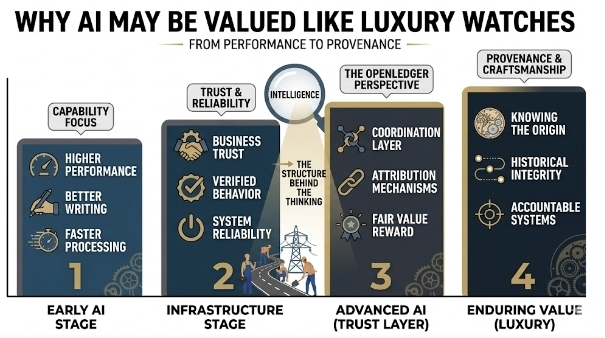
The internet wasn't valuable because websites existed. It became valuable because people trusted it enough to build businesses on top of it.
Banking systems aren't important because money moves. They're important because people assume money will still move tomorrow.That changes the meaning of infrastructure.And I think something similar may eventually happen with AI.
The strange thing is that intelligence itself may become abundant.Not identical. Not free. But abundant enough that access alone stops being the primary differentiator.
When that happens, attention naturally shifts elsewhere.People begin asking different questions.Where did the intelligence come from?Who contributed to it?
Can its outputs be traced?Can its behavior be verified?Can the system remain reliable when millions of users begin depending on it simultaneously?
Those questions sound less exciting than model benchmarks.But over time, they become much more important.Because once systems become persistent, reliability starts carrying economic value of its own.
That is where I found myself thinking about @OpenLedger.Not because it promises bigger intelligence
And honestly, I think that's the wrong lens to use anyway.What started standing out to me was the infrastructure layer underneath intelligence itself.
The coordination layer.The attribution layer.The mechanisms that attempt to answer questions most AI discussions still treat as secondary.
Who creates value?Who owns value?
Who should be rewarded when intelligence is generated from distributed contributions?The deeper layer may actually be trust.Not trust in a company.Trust in a process.There is a difference.
Luxury watches became valuable partly because people trusted the process behind their creation. Every component carried a history. Every movement reflected an ecosystem of expertise built over time.
The object became a symbol of the system that produced it.AI could be heading toward something surprisingly similar.Not because people will admire algorithms the way they admire watchmakers.But because they may eventually care about provenance as much as performance.
Once autonomous systems become integrated into businesses, applications, research, and financial infrastructure, understanding where intelligence originated stops being an academic question.
It becomes an operational requirement.And the difficult part is no longer generating intelligence.The difficult part is maintaining accountability around it.
Over time, that pressure compounds.Every new layer creates another dependency.Every dependency increases the importance of transparency.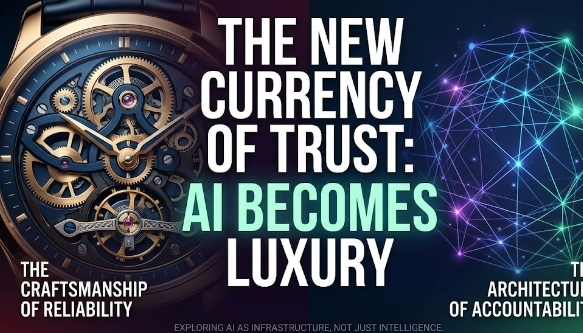
Every increase in transparency creates demand for stronger attribution systems.That's where things start shifting quietly.The conversation slowly moves away from what AI can do and toward how AI is organized.
How it is coordinated.How it is sustained.How contributors are recognized inside systems that become larger than any individual participant.
When I look at $OPEN through that perspective, it feels less like a technology story and more like an infrastructure story.
The kind of story markets often underestimate at first because infrastructure rarely feels exciting while it's being built.
Roads are boring until traffic depends on them.Power grids are boring until they fail.The same may eventually be true for AI coordination layers.
Maybe the future value of artificial intelligence won't come entirely from intelligence itself.
Maybe part of that value will come from knowing where that intelligence came from, who helped create it, and why the system behind it can continue operating under pressure.
And if that turns out to be true, AI might end up becoming valuable for a surprisingly familiar reason.Not because it thinks.But because people trust the structure behind the thinking.
