
Most people interact with artificial intelligence every day without giving much thought to what powers it behind the scenes.
A student asks an AI tool for help with homework. A business owner uses AI to write product descriptions. A designer generates images in seconds. It all feels effortless. Yet beneath every response, image, prediction, and recommendation sits something incredibly valuable: data.
For years, data has quietly fueled the growth of AI. Massive companies have collected it, stored it, trained models with it, and built billion-dollar products around it. Meanwhile, many of the people who created, contributed, or owned that data never saw much value returned to them.
This is where OpenLedger (OPEN) enters the conversation with a different idea.
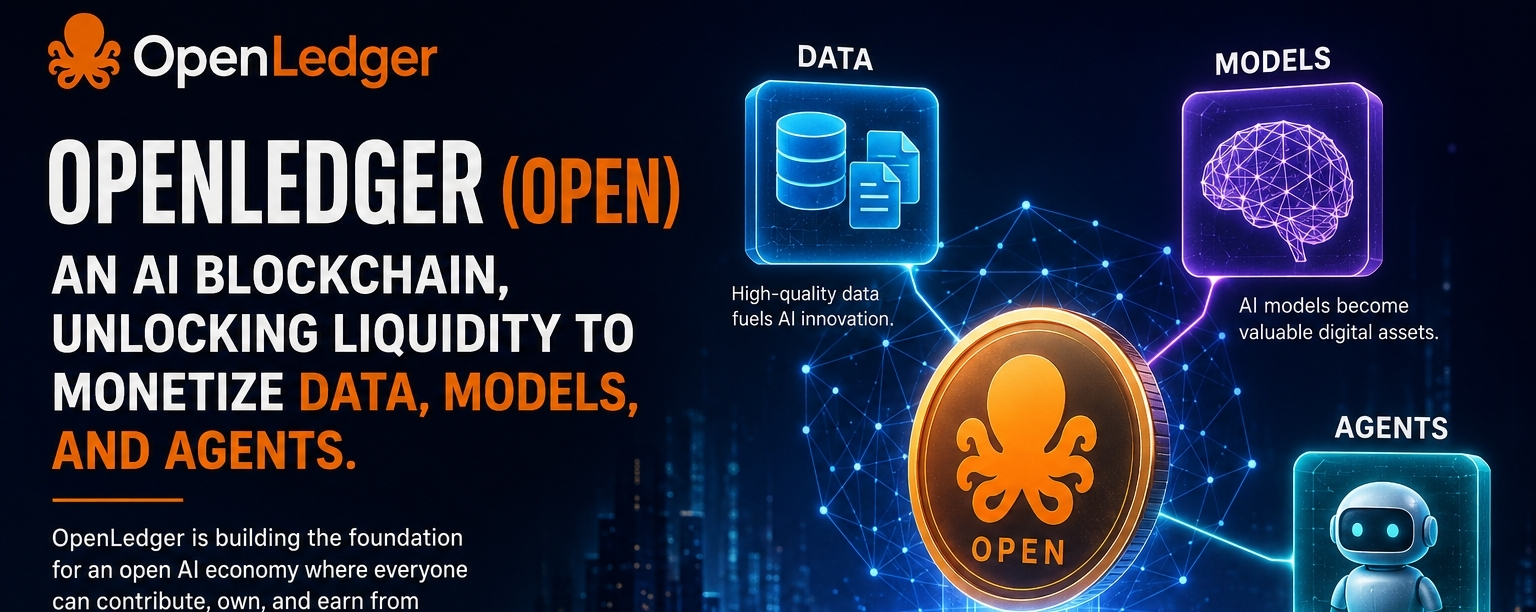
Instead of treating data as something that disappears into giant systems, OpenLedger aims to create an environment where data, AI models, and intelligent agents can become liquid assets that people can own, trade, and monetize.
That simple idea has the potential to change how value moves through the AI economy.
The Hidden Economy Behind Artificial Intelligence
Every AI system depends on information.
Without quality data, even the most advanced AI model becomes far less useful. The same is true for specialized AI models and digital agents designed to perform tasks automatically.
The strange reality is that while these resources create enormous value, there has never been a simple and transparent way for contributors to capture a fair share of it.
Imagine a researcher who spends years collecting industry-specific information.
Imagine a developer who creates a highly effective AI model.
Imagine a business that builds an intelligent agent capable of handling customer support twenty-four hours a day.
All of these assets have value, yet converting that value into ongoing income has often been complicated.
OpenLedger is built around solving this problem.
Giving Data a Life Beyond Storage
Most data spends its life sitting in databases.
It is collected, stored, and occasionally analyzed. The people who own it rarely have easy ways to earn from it unless they sell access directly or build products around it themselves.
OpenLedger introduces a different perspective.
Instead of seeing data as something static, the network treats it as a resource that can actively participate in an economy.
When data can be verified, tracked, and connected to usage, it becomes possible to create reward systems around it. Contributors can potentially benefit when their data helps power AI applications, models, or services.
This creates a stronger incentive for people to contribute high-quality information rather than simply generating massive amounts of low-value content.
Quality becomes more important than quantity.
AI Models Are Becoming Assets of Their Own
The race to build AI models has become one of the biggest trends in technology.
Companies invest millions training systems capable of understanding language, analyzing information, generating content, and solving problems.
But what happens after a model is created?
Traditionally, developers must build businesses around their models to generate revenue. That often requires infrastructure, marketing, customer acquisition, and ongoing operational costs.
OpenLedger explores a more direct path.
By creating infrastructure that supports ownership and monetization, AI models can potentially function as independent assets within a blockchain ecosystem.
Developers gain opportunities to make their work accessible while maintaining clearer connections between usage and rewards.
For smaller creators and independent builders, this could open doors that were previously reserved for large organizations with extensive resources.
The Rise of Intelligent Agents
One of the most interesting developments in AI is the emergence of agents.
Unlike traditional software that waits for instructions, agents can perform tasks, make decisions within defined parameters, and interact with other systems.
Think of a digital assistant that manages appointments.
Or an agent that monitors market information and generates reports.
Or a recharcher ustomer service assistant that handles thousands of conversations every day.
These agents are becoming productive digital workers.
As their capabilities grow, questions naturally arise.
Who owns them?
How is their value measured?
How can creators earn from their performance?
OpenLedger seeks to provide an environment where agents are not merely software tools but economic participants within a broader ecosystem.
That concept introduces entirely new possibilities for ownership and value creation.
Why Liquidity Matters
Liquidity is a word often associated with financial markets, but the idea is simple.
An asset becomes more useful when it can move freely between participants.
A house may be valuable, but selling it can take months.
Cash is valuable because it can be exchanged immediately.
Many AI-related assets exist somewhere between those extremes. They have value, but turning that value into income is often slow, difficult, or limited to a small group of buyers.
OpenLedger focuses on making data, models, and agents more accessible within a digital marketplace.
When assets become easier to exchange, license, or utilize, new opportunities emerge for creators, businesses, and users alike.
Value no longer remains trapped.
It begins to circulate.
Creating Incentives for Better AI
One challenge facing the AI industry is the growing demand for reliable information.
Poor-quality data produces poor-quality outcomes.
Biased data creates biased systems.
Outdated information leads to inaccurate results.
If contributors are rewarded based on the usefulness and quality of what they provide, the entire ecosystem gains a reason to improve.
This creates an interesting dynamic.
Instead of simply competing to generate more content, participants are encouraged to create better content, more accurate datasets, and more effective models.
In the long run, stronger incentives can help improve the quality of AI systems that millions of people depend on.
Connecting Blockchain and AI in a Practical Way
Many projects combine blockchain and artificial intelligence, but not all of them address real problems.
OpenLedger's approach stands out because it focuses on ownership, attribution, and economic participation.
Rather than using blockchain as a marketing label, the network attempts to solve questions that become increasingly important as AI adoption expands.
Who contributed the data?
Who built the model?
Who created the agent?
How should rewards be distributed?
These questions become easier to answer when transparency and verifiable records are built into the system itself.
Looking Ahead
Artificial intelligence continues to grow at a remarkable pace. New models appear almost every week. Digital agents are becoming more capable. Data is being generated faster than ever before.
Yet one issue remains largely unresolved: how the value created by these resources should be shared.
OpenLedger (OPEN) is exploring a future where data contributors, model developers, and agent creators can participate more directly in the economic activity they help generate.
Whether that vision reaches its full potential remains to be seen, but the direction is clear.
The AI economy is expanding rapidly, and ownership is becoming just as important as innovation. Projects that can connect creativity, intelligence, and fair value distribution may play an important role in shaping what comes next.
In that future, data is no longer just information, models are more than software, and agents become more than automated tools. They evolve into assets that can create, exchange, and generate value in ways that were difficult to imagine only a few years ago.
