
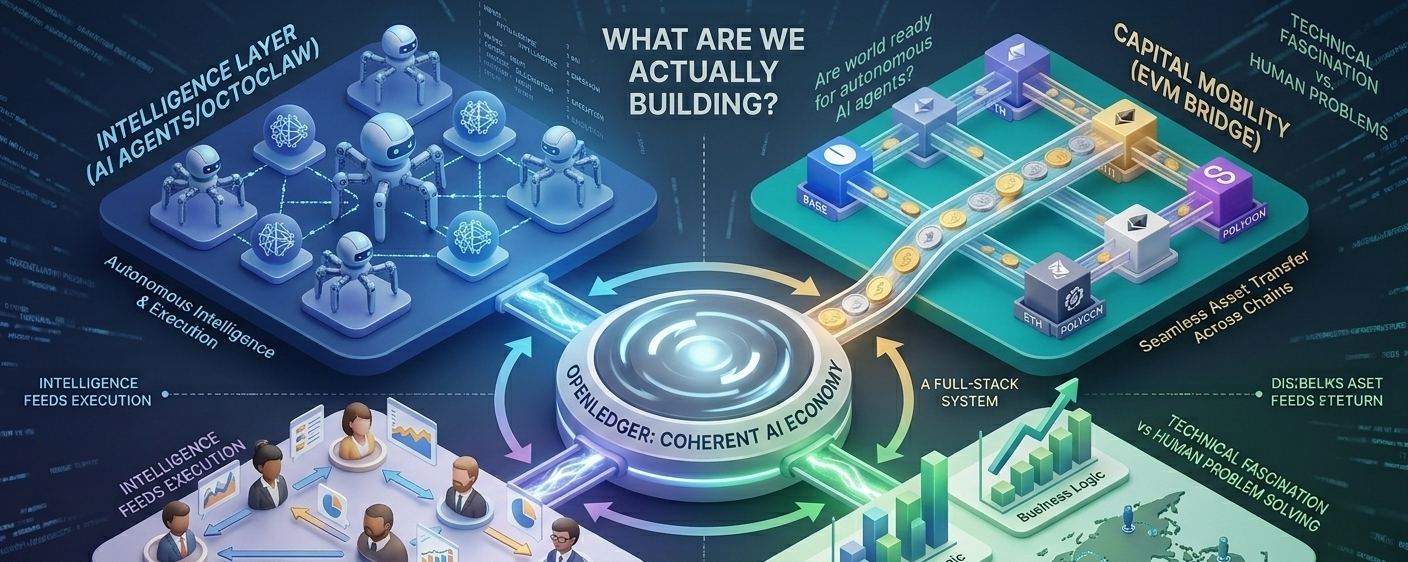

OpenLedger caught my attention not because of hype, but because of a question it quietly forced me to ask myself: what is the point of all this infrastructure if nothing connects?
I've been thinking about this for a while now. We've spent years building incredible things in crypto. Blockchains that process thousands of transactions per second. AI models that can write code, analyze markets, and hold conversations that feel genuinely human. Cross-chain bridges that move billions in liquidity. And yet, when I step back and look at the full picture, something feels off. These systems don't really talk to each other. They coexist, but they don't cooperate. And I think that gap is more important than most people realize.
Here's the honest problem. We built intelligence in one corner, execution in another, capital movement somewhere else, and payments in yet another layer. Each piece is impressive on its own. But the real world doesn't work in isolated corners. A business doesn't just need smart software it needs software that acts, moves value, and compensates the people who made it possible. Right now, crypto and AI are like a brilliant team where everyone is working in separate rooms and nobody shares notes.
What makes this frustrating is that the solution seems obvious in theory. Connect the layers. Build a system where intelligence feeds execution, execution moves capital, and capital rewards contribution. Simple to say. Brutally difficult to actually build. Most projects don't even try. They pick one layer, go deep, and leave the rest for someone else to figure out.
That's what made me stop and look more carefully at OpenLedger. It isn't positioning itself as another AI chatbot or another DeFi protocol. The ambition here feels different, almost uncomfortably different. OpenLedger appears to be attempting something that most serious builders would call either visionary or reckless: connecting all four layers into one coherent system.
The way I understand it, the foundation starts with AI models not just models that answer questions, but models that can actually do things. Their agent infrastructure, OctoClaw, is built around autonomous execution. Skills like automated research, proactive monitoring, and self-improving behavior suggest they're thinking about AI not as a tool you use, but as a system that operates on your behalf. That's a meaningful shift in thinking.
Then there's the bridge layer. When I first heard about OpenLedger's EVM bridge, my instinct was to shrug. Bridges are everywhere. But when you put it alongside autonomous agents, the logic changes. If an AI system can monitor market conditions, identify opportunities, and execute strategies, it needs to move freely across chains. The bridge isn't for the human anymore. It's for the agent. That reframing actually changed how I see the whole architecture.
And then there's what I think is the most underrated idea in their ecosystem: Proof of Attribution. The AI industry today has a quiet injustice baked into it. Data contributors, developers, and early builders create enormous value, but the economic rewards flow almost entirely to the platforms at the top. OpenLedger seems to be genuinely exploring a model where contributors participate in the value they help create. If that mechanism works at scale, it changes the incentive structure of how AI gets built. Not just in crypto everywhere.
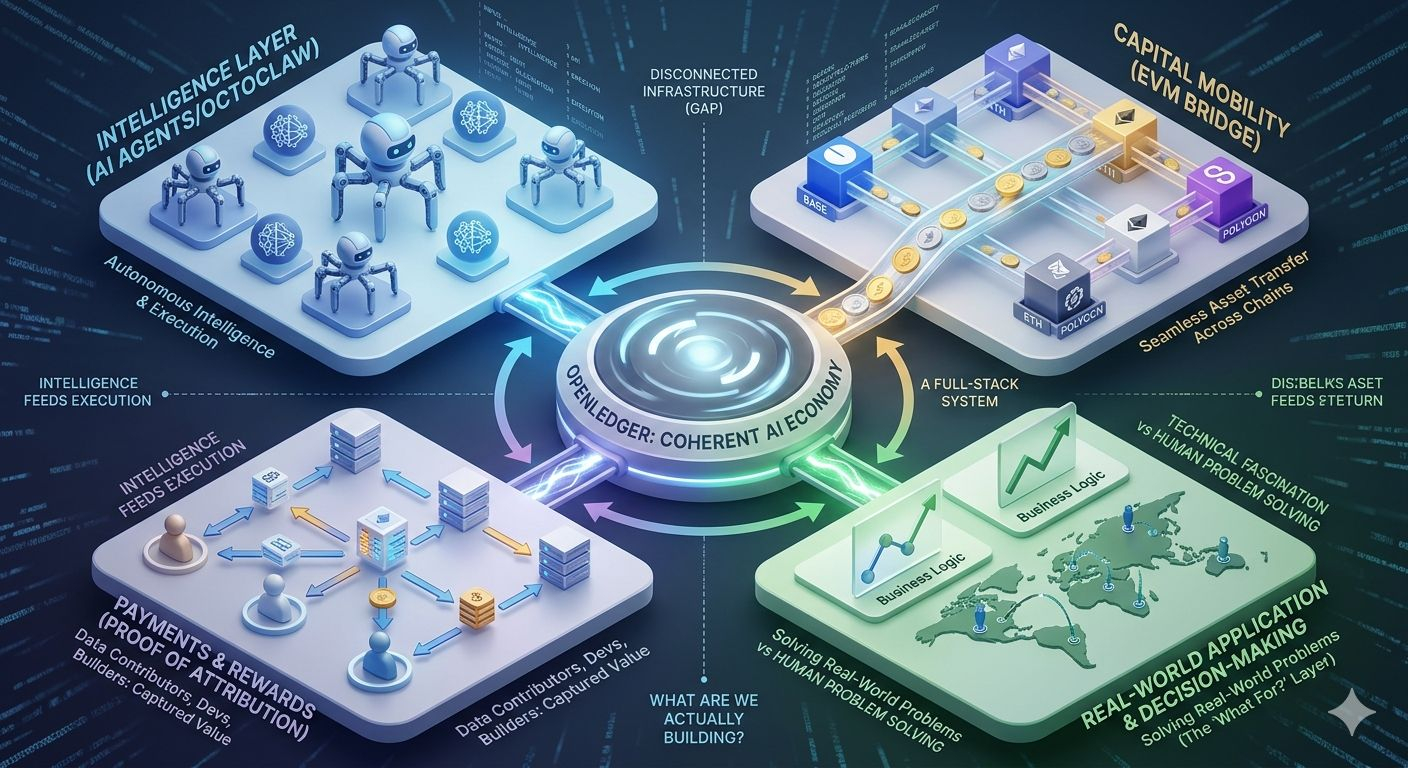
What I find genuinely interesting, and also genuinely uncertain, is whether all four layers can grow together at the right pace. This is the real risk, and I think most analyses miss it. The question isn't whether any single piece is good. The question is whether intelligence, execution, capital mobility, and payments can reach critical mass simultaneously. If one layer lags, the whole flywheel slows. That coordination challenge is harder than any technical problem. It requires timing, adoption, and a kind of ecosystem luck that even well-funded projects rarely achieve.
Still, I keep coming back to the idea itself. Because the honest truth is that most of what we're building in crypto today is parallel infrastructure. Impressive, but disconnected. And at some point, someone has to try to connect it. Someone has to ask the uncomfortable question: what does a full-stack AI economy actually look like?
OpenLedger is asking that question out loud, which alone makes it worth paying attention to.
So I want to leave this open for discussion, because I genuinely don't have all the answers. Is the world actually ready for AI agents that move capital autonomously across chains? If contributors could finally capture real economic value from the intelligence they help build, would that change who participates in AI development? And maybe most importantly are we building these systems because they solve real human problems, or because they're technically fascinating and we can't help ourselves?
The difference between those two motivations is probably the most important thing in crypto right now. And watching which answer OpenLedger gravitates toward over the next few years will tell us a lot about whether this vision is real or just another ambitious story.