
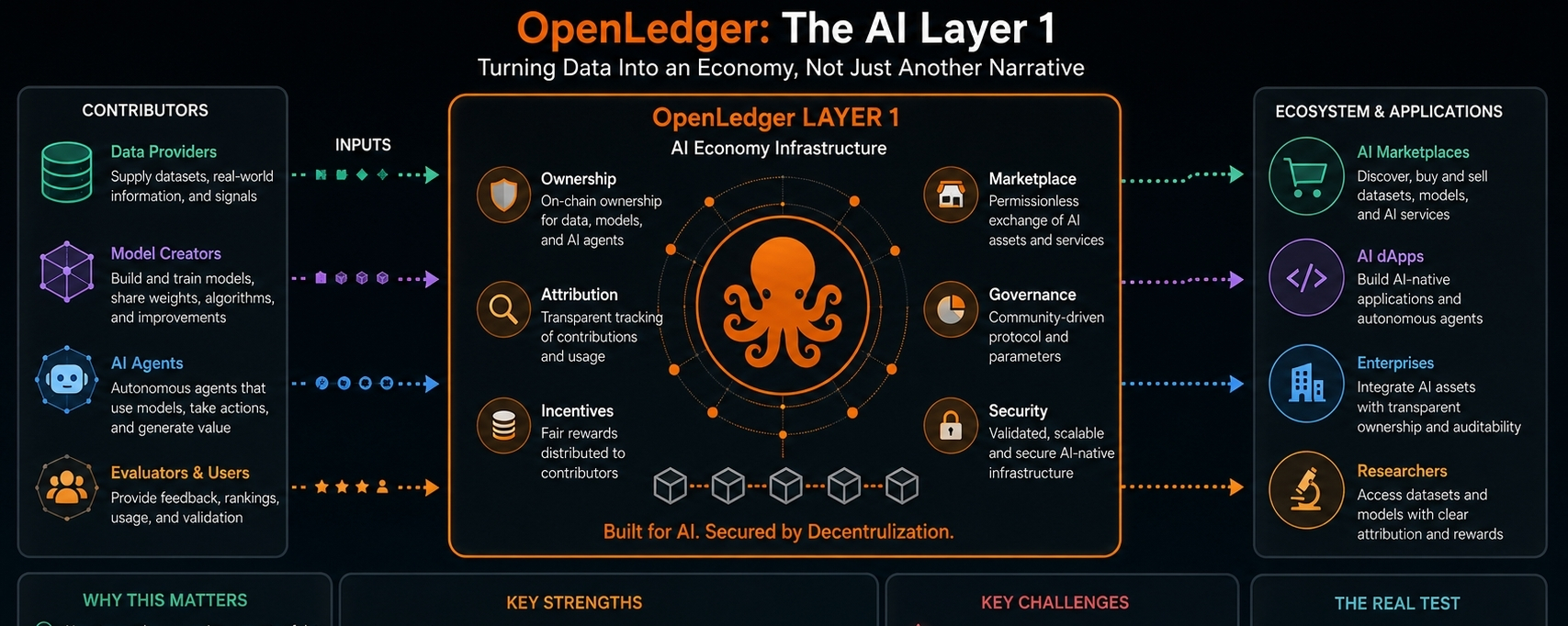
@OpenLedger The first time I looked at OpenLedger, I didn’t really know what box to put it in. Not because the idea was impossible to understand, but because it sits right at the intersection of two industries that have become extremely good at generating noise. AI and Layer 1 blockchains. If you've spent enough years around crypto, you develop a kind of reflex whenever you see those words together. Not hostility. Just caution.
Maybe that's unfair. But after watching several cycles unfold, you learn that some narratives arrive carrying more expectation than substance. Every few years there is another chain that promises to reorganize the internet, replace existing infrastructure, or become the foundation of an entirely new digital economy. Then reality arrives. Users arrive. Bots arrive. Markets arrive. And suddenly the conversation changes.
OpenLedger, at least from what I can tell, seems less interested in becoming "the fastest blockchain ever" and more interested in a specific question that keeps appearing around AI: who actually owns the value being created?
That question feels more interesting than another throughput benchmark.
The broader Layer 1 landscape has become strange. There are so many chains now that it feels difficult to remember why half of them were launched in the first place. Some were created because existing networks were expensive. Some because they were slow. Some because they believed a different consensus model would change everything. Some simply because funding was available and launching a chain was fashionable.
The pattern repeats enough times that eventually the excitement starts feeling familiar rather than convincing.
What makes Layer 1 discussions difficult is that most of them happen before meaningful stress exists. Everything works beautifully when there are few users. Everything scales on a chart. Every architecture looks elegant inside a whitepaper. The real test begins when thousands of people start doing things nobody anticipated.
Crypto has this habit of treating launch day as validation when launch day is really just the beginning of the experiment.
A blockchain rarely breaks because somebody forgot how databases work. More often it breaks because actual human behavior is messy. Traffic spikes. Arbitrage appears. Spam appears. Demand clusters around a single application. Suddenly all the clean theoretical assumptions meet reality.
Solana is probably one of the more interesting examples of this. On good days, using it feels almost invisible. Transactions settle quickly. Costs stay low. The user experience can feel surprisingly smooth compared to older networks. But Solana has also shown that scale isn't a permanent achievement. It's an ongoing negotiation with complexity. The more activity arrives, the more edge cases emerge. The more success a chain finds, the harder its job becomes.
That's something I think people often miss.
Success creates new problems faster than failure does.
Looking at OpenLedger through that lens, I find myself less interested in its AI branding and more interested in whether its infrastructure can survive if its core idea actually works.
Because the underlying concept seems to recognize a gap that a lot of projects either ignore or address awkwardly. AI systems consume enormous amounts of data, models, feedback, and increasingly autonomous behavior from agents. Yet the flow of value around those contributions remains surprisingly fuzzy. Everyone talks about models. Fewer people talk about attribution. Even fewer talk about compensation.
OpenLedger appears to be trying to build economic rails around that problem.
Not necessarily solving AI itself. More like creating a marketplace structure where data, models, and AI agents become assets that can be tracked, rewarded, and exchanged.
That feels more grounded than many AI narratives in crypto.
The challenge, of course, is that identifying a problem and solving a problem are very different things.
A blockchain can record ownership. It can track participation. It can distribute incentives. Those are relatively familiar tasks. What remains uncertain is whether people outside crypto actually care about solving those problems through blockchain infrastructure.
That's where adoption becomes uncomfortable.
Crypto discussions often skip over migration costs. We talk about ecosystems moving as if liquidity has legs and can casually walk across the room. In practice, users stay where their friends are. Developers stay where their tools are. Capital stays where opportunities already exist.
Moving entire economic systems is difficult.
Even when a new chain is technically superior.
Even when incentives are generous.
Even when the vision sounds reasonable.
People underestimate how powerful inertia is.
So when I look at OpenLedger, I don't really ask whether the technology makes sense. Parts of it do. The harder question is whether the participants it needs will actually arrive. Will data providers show up? Will model creators participate? Will developers build around it? Will enough activity emerge to create self-sustaining demand?
Those questions matter more than any architectural diagram.
There are also obvious trade-offs being made.
OpenLedger seems willing to narrow its focus rather than become a general-purpose blockchain attempting to serve every possible use case. That can be a strength. Focus creates clarity. But focus also creates dependence. If the AI economy it envisions develops differently than expected, specialization can become a constraint.
Every design choice closes some doors while opening others.
I also wonder whether tokenized incentives alone are enough to coordinate high-quality data and models over long periods. Crypto has repeatedly shown that incentives attract participation. What remains harder is attracting meaningful participation. Those aren't always the same thing.
The difference becomes visible after the rewards decline.
Still, I think there is something valuable about projects that notice practical coordination problems rather than abstract ideological ones. OpenLedger doesn't seem obsessed with replacing governments, rebuilding finance from scratch, or claiming to be the final blockchain architecture. At least that's not the impression I get.
Instead, it appears to be asking whether contributors to AI systems can receive clearer ownership and compensation structures.
That's a smaller question.
Sometimes smaller questions end up mattering more.
The future of blockchain may not belong to one dominant chain anyway. People have been predicting singular winners for years and reality keeps refusing to cooperate. Maybe we end up with multiple ecosystems handling different kinds of activity. Maybe liquidity fragments permanently. Maybe interoperability improves enough that users stop caring where applications actually live.
Or maybe none of that happens.
Sometimes crypto spends years constructing theories about a future that never arrives.
That's why I find myself sitting somewhere in the middle with OpenLedger.
Not excited enough to assume success.
Not dismissive enough to ignore it.
The project seems to recognize a real coordination issue around AI ownership and value distribution. The Layer 1 approach gives it room to shape those incentives directly rather than adapting to somebody else's infrastructure. Whether that advantage matters depends entirely on execution, adoption, and the messy behavior of real users once speculation fades into the background.
And that part nobody can model in advance.
It might work. Or nobody shows up.