
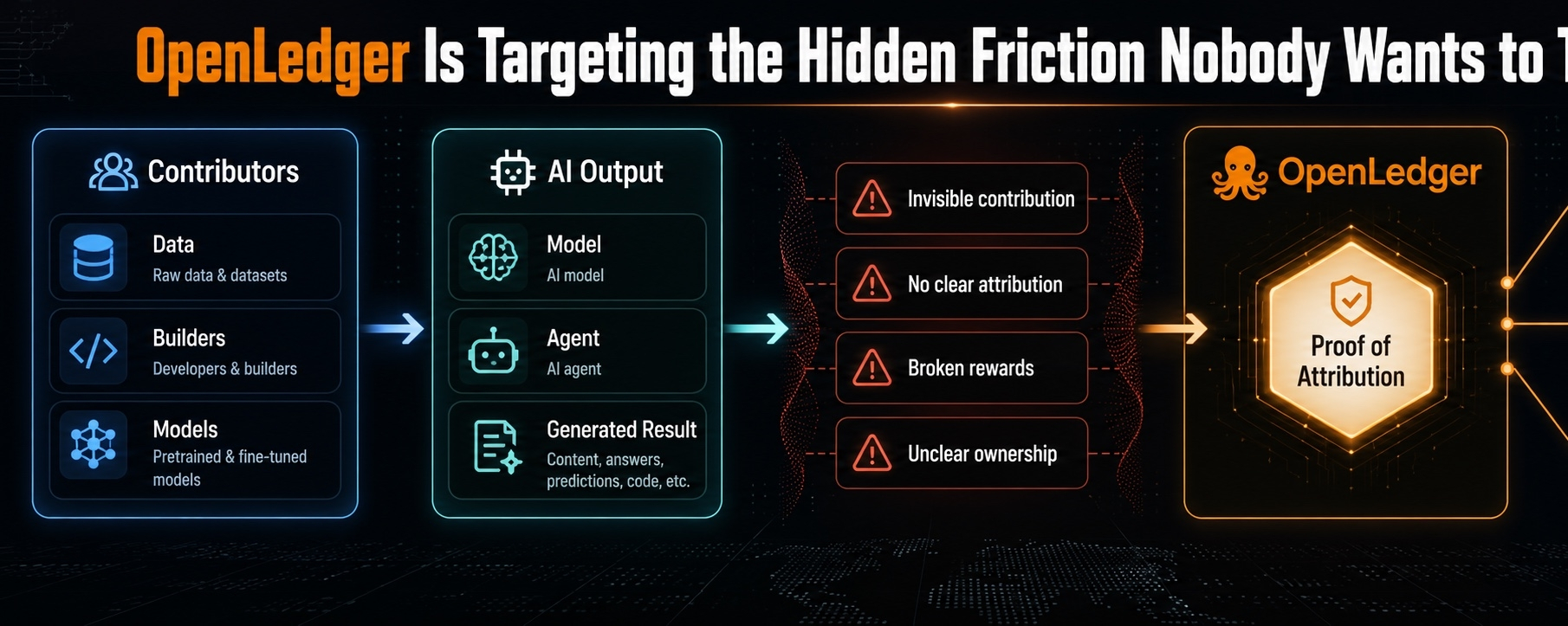
OpenLedger is trying to fix the value problem sitting under AI.
I’ve seen enough projects make clean promises to know that the clean part is usually where the trouble starts. Crypto is full of teams that found the right words before they found real usage. AI, ownership, attribution, agents, data monetization. The market has recycled these words so many times that most people barely hear them anymore.
But OpenLedger’s core idea still has weight.
AI keeps pulling value from data, models, agents, builders, users, creators, and all kinds of hidden contribution layers. Then the final output gets packaged nicely, sold, used, automated, and scaled. Everyone sees the answer. Nobody sees the grind behind it.
That is the problem.
And honestly, it is not a small one.
Most AI systems today feel like black boxes with a payment button attached at the end. Data goes in. Intelligence comes out. Somewhere in the middle, value gets created. But the people or layers that helped create that value usually vanish from the reward path. No clean credit. No proper trail. No real ownership flow.
OpenLedger is trying to build around that missing trail.
The project is focused on attribution, which sounds boring until you understand how messy AI value really is. If a model improves because of certain data, that should matter. If an agent creates useful output because of a specific model or dataset, that should matter too. If contributors are helping make the system smarter, they should not be treated like background noise forever.
That is where OpenLedger has a real angle.
Not a perfect one.
A real one.
I’m not looking at this like some magical AI chain that fixes everything. I’m too tired for that kind of pitch. I’m looking at it more like this: AI is going to keep eating more of the internet, more workflows, more decisions, more automation, and more economic activity. If that happens, then the question of who created the value becomes harder to ignore.
Right now, the market still acts like it can ignore it.
Maybe because speculation is easier. Maybe because traders only care when the chart moves. Maybe because “fair attribution” does not sound as exciting as a new agent demo or some clean narrative thread. But here’s the thing. Once AI agents start doing real work and touching real value, this issue gets heavier.
Who owns the data?
Who gets paid when a model is useful?
Who proves where an output came from?
Who earns when an agent creates value?
These questions are not noise. They are the friction under the whole AI economy.
OpenLedger is trying to turn that friction into infrastructure.
That is what I find interesting.
The project is not only trying to make AI more usable. It is trying to make AI’s value chain more visible. Data, models, and agents are not just technical pieces in its design. They are economic pieces. They can be tracked. They can be connected. They can be rewarded.
At least, that is the idea.
The real test, though, is whether this becomes something people actually use when the market stops clapping for AI buzzwords.
Because I have seen this movie too many times.
A project finds a strong narrative. The early crowd gets excited. The words sound sharp. The graphics look clean. Everyone talks about the future. Then the hard part arrives quietly. Users do not show up. Developers do not stay. Rewards feel thin. Activity dries out. The token keeps trading, but the economy underneath it never really wakes up.
That is the part I’m watching with OpenLedger.
Not whether the idea is smart.
It is smart enough.
I’m watching whether the value actually moves.
Do contributors earn in a way that feels real?
Do builders care enough to build here instead of somewhere easier?
Do agents create actual activity, or just good-looking demos?
Do models and data assets become useful economic objects, or do they stay as words in a pitch?
That is where most projects break.
OpenLedger has a strong reason to exist, but reason alone is cheap in this market. Execution is the grind. Adoption is the grind. Keeping people around after the first wave of attention is the grind.
And this market is exhausted.
People have heard every version of “AI plus crypto” already. They have watched narratives rotate, cool down, come back, and get recycled again with different branding. So OpenLedger cannot win by sounding bigger. It has to make the value flow obvious.
Show the contributor earning.
Show the model being used.
Show the agent doing something that matters.
Show the attribution system working when there is real demand, not just controlled conditions.
That is the moment I’m looking for.
Because if OpenLedger can make invisible contribution visible, and then connect that visibility to real rewards, then the project starts to feel less like another AI narrative and more like something with a working spine.
But if it cannot, then it gets dragged into the same pile as every other project that had a good idea and not enough pull.
The good thing is, the problem it is chasing is not fake.
AI really does have a value problem. Data really does need better ownership. Models really do need cleaner monetization paths. Agents really will need accountability if they are going to operate inside real digital economies. Contributors really are being pushed into the background while platforms capture most of the upside.
OpenLedger is aiming at the right wound.
Now it has to prove it can do more than point at it.
I’m not waiting for louder marketing.
I’m waiting for the moment where the system shows that value can move back to the people and layers that created it.
Until then, the question stays open.
Can OpenLedger actually fix the value problem, or will it become another smart idea buried under market noise?