
I was sitting at a small tea stall in Lahore a few nights ago, scrolling through charts while waiting for a friend to arrive. The market felt unusually quiet. Bitcoin was moving sideways, most traders were arguing about short-term price action, and yet one topic kept showing up everywhere I looked: AI.
The conversation wasn't surprising. Every cycle has its dominant narrative. What caught my attention was something happening beneath the surface. While everyone debated which AI project might be the next winner, very few people seemed interested in a more important question.
Who actually captures the value created by AI?
The more I thought about it, the more I found myself looking back at OpenLedger and the broader vision behind $OPEN.
Most AI discussions today focus on models, computing power, and performance improvements. Those things matter, but they are only part of the story. Every AI system ultimately depends on data. Without data, there are no models to train, no intelligence to improve, and no products to scale.
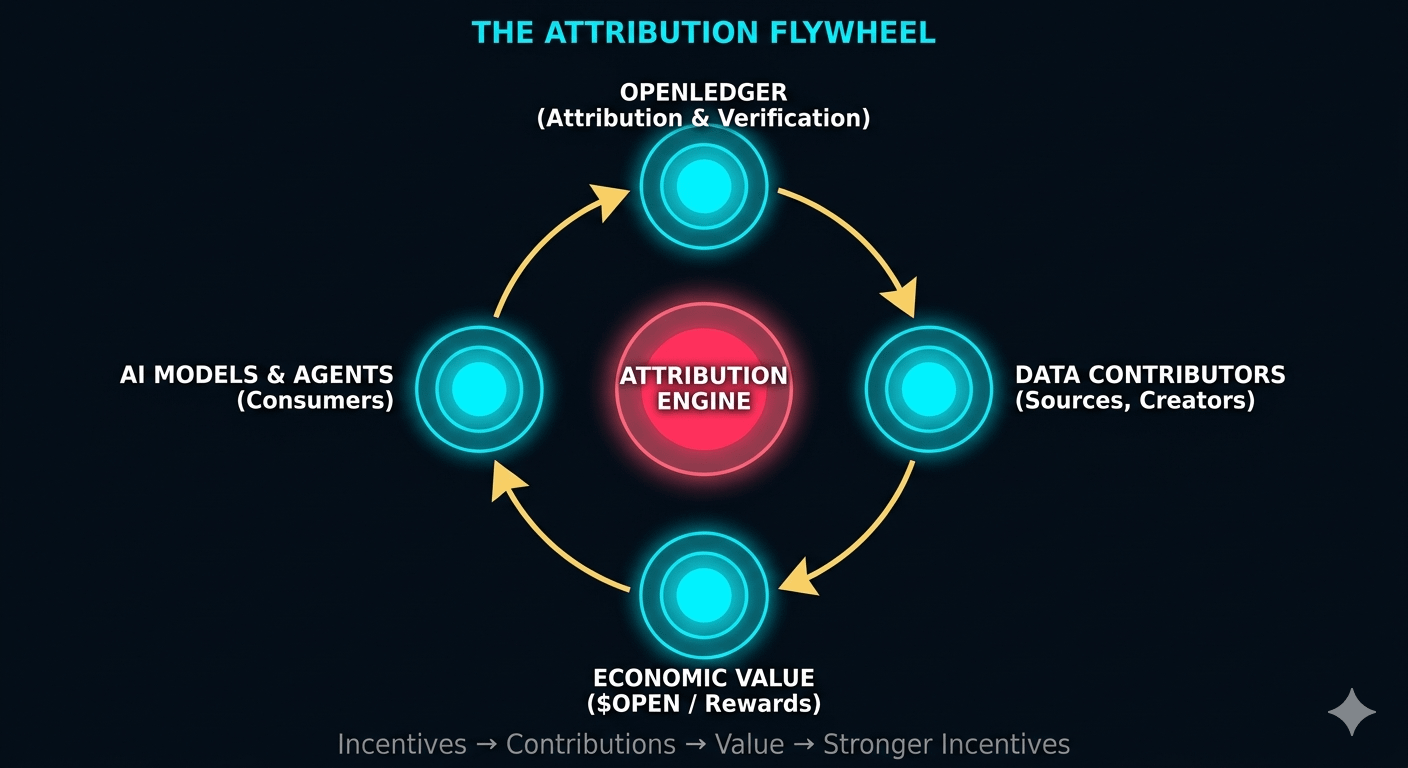
Yet the people and sources contributing that data often disappear from the economic equation entirely.
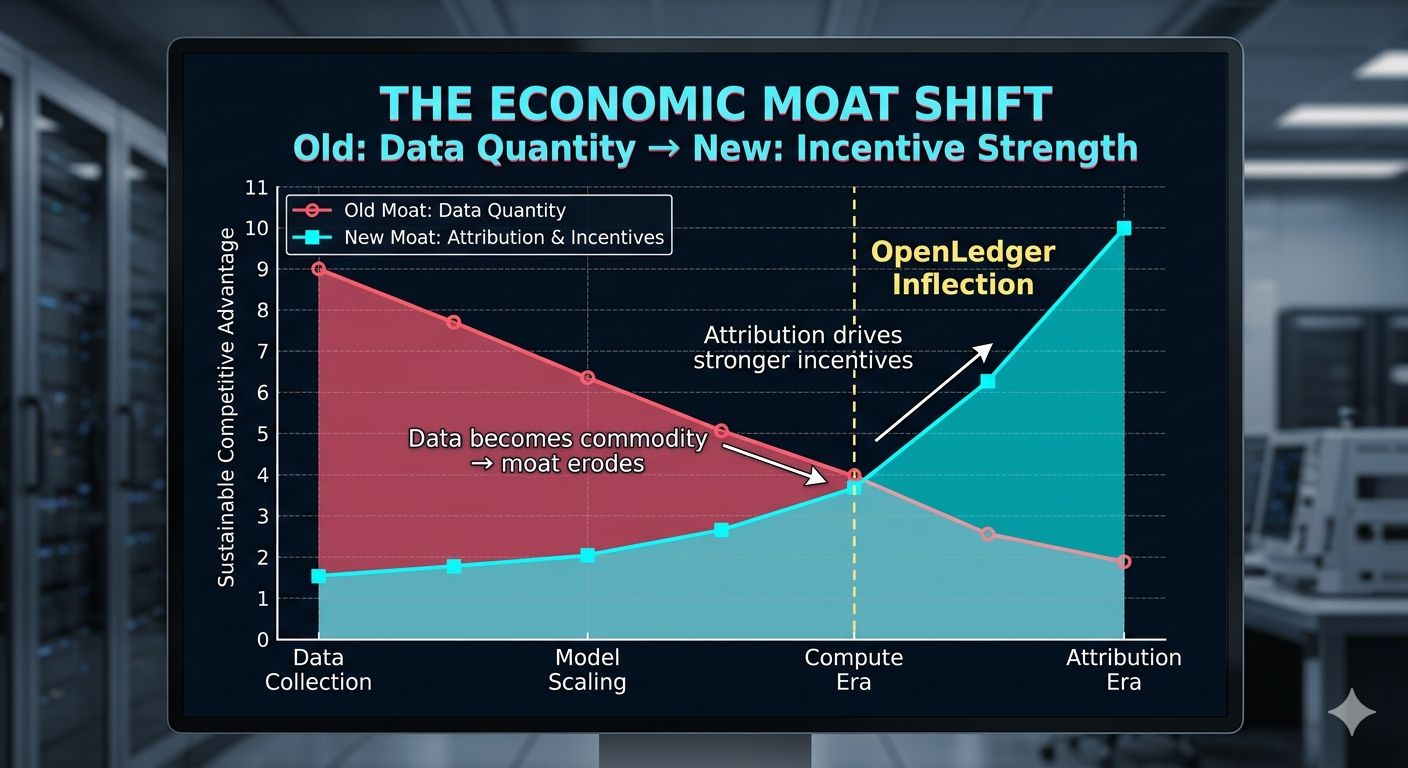
For years, the technology industry has operated on a simple assumption. The organizations that collect the most data build the strongest advantage. Data is gathered, stored inside private systems, and transformed into products that generate value. The larger the dataset becomes, the stronger the moat appears.
It sounds like a winning formula.
But crypto has a habit of challenging assumptions that once seemed permanent.
OpenLedger approaches the AI economy from a direction that feels much closer to crypto's original principles. Instead of treating data as something that disappears into a black box, it explores a future where contributions become measurable, traceable, and economically connected to the value they help create.
That idea may end up being more important than many people realize.
Think about it this way.
Imagine two different datasets contributing to the training of an AI model. One significantly improves accuracy and performance. The other adds very little value. In today's AI ecosystem, those differences are often invisible. The contribution happens, the model improves, and the economic value accumulates elsewhere.
OpenLedger's broader vision points toward a system where those contributions can be identified and rewarded more effectively.
Once that becomes possible, incentives start changing.
And whenever incentives change, entire markets can change with them.
One lesson crypto has taught us repeatedly is that participation follows incentives far more reliably than ideology. People do not contribute to networks simply because they like the mission statement. They contribute because the economic structure makes participation worthwhile.
We've seen this dynamic play out across multiple cycles.
Some ecosystems attracted builders, users, and liquidity because they created strong alignment between contributors and outcomes. Others had solid technology but struggled to maintain momentum because the incentives gradually stopped making sense.
The same principle may eventually apply to AI.
Today, many investors still evaluate AI projects primarily through market narratives and price movements. They focus on which token is trending, which sector is attracting attention, and which headline dominates social media for the week.
But underneath all of that noise, a deeper economic battle is taking place.
Who owns the value generated by intelligence?
Who benefits when data improves a model?
Who verifies the quality of contributions?
And who gets rewarded when that value is created?
Those questions could become increasingly important as AI systems continue to grow.
This is where OpenLedger becomes interesting to me.
The project is not simply trying to place AI activity on-chain. The larger ambition appears to be creating an economic framework where datasets, models, agents, and contributors can interact through transparent incentive structures rather than isolated silos.
Importantly, this is not about making everything public.
That is a common misunderstanding.
Modern blockchain infrastructure has already shown that privacy and verification can coexist. The goal is not radical transparency. The goal is accountability. There is a meaningful difference between protecting information and hiding the economic relationships behind it.
As AI continues evolving, I suspect the market will begin paying closer attention to that distinction.
History suggests that industries eventually move toward systems that reduce hidden inefficiencies. The transition is rarely immediate. Established players benefit from scale, capital, and distribution advantages. They do not disappear overnight.
But gradual changes have a way of becoming powerful over time.
Contributors begin recognizing the value of their participation.
Developers gravitate toward ecosystems that evolve faster.
Users place greater trust in systems where incentives are easier to understand.
And eventually the old model starts carrying costs that were once ignored.
Whether OpenLedger ultimately succeeds is something the market will decide. But I think it is focused on a question that the AI industry cannot avoid forever.
The biggest winners in artificial intelligence may not be the companies that collect the largest amount of data.
They may be the networks that build the strongest economic incentives around data creation itself.
If that turns out to be true, then OpenLedger is doing more than building AI infrastructure.
It is challenging one of the oldest assumptions in the digital economy.
And from where I sit, that feels like a conversation worth paying attention to long before the rest of the market notices.