
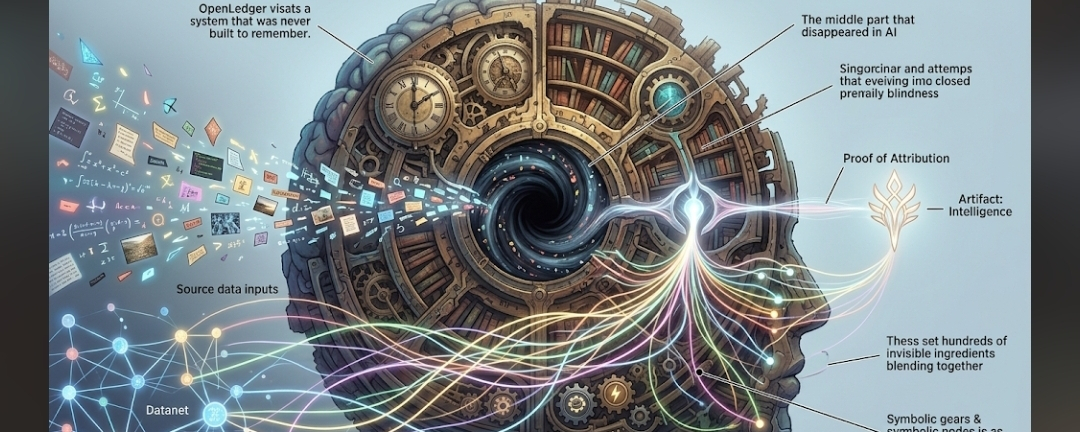
I keep coming back to OpenLedger, but not because it feels polished. It actually feels kind of messy once you sit with it for a while. Still, the idea it’s poking at is hard to ignore.
Who gets credit when an AI produces something useful?
Right now, the honest answer is: nobody really knows. Data goes in, models get trained, outputs come out… and the whole middle part disappears. Like it was never there.
That’s the part OpenLedger is trying to change.
The key idea is something called Proof of Attribution. I’ll simplify it. It’s basically an attempt to trace which pieces of data actually influenced an AI’s output. Not just “this data was used somewhere in training,” but “this specific input helped shape this result.”
Sounds reasonable. But also… hard. Really hard.
I keep circling back to this: AI systems don’t work like simple recipes. It’s not flour + eggs = cake. It’s more like hundreds of invisible ingredients blending together over time, across multiple stages, until you get something that works. Trying to pull out exact influence from that mix is… messy.
Maybe even impossible to do perfectly.
Then there are Datanets. Think of them as shared spaces where data is constantly being added, checked, reused, and reshaped. Not a static database. More like a living system that keeps moving.
The idea is that if your data helps improve an AI, the system should be able to recognize that contribution.
In theory, that changes behavior. People might care more about the quality of what they contribute, not just dumping random information. Because now there’s a chance it actually matters later.
I’m not fully convinced it plays out that neatly in real life, but the direction makes sense.
The OPEN token sits underneath all of this as the payment and coordination layer. It’s how rewards and governance would actually work. But honestly, that part feels less interesting than the attribution idea itself. Tokens are just the mechanism. The real shift is about tracking contribution in the first place.
Here’s where I get skeptical.
Even if you try really hard, AI systems are complicated. A single output can depend on training data, retrieved documents, model updates, prompt context, and a bunch of hidden interactions. It’s not clean. It’s layered.
So when you ask, “which data caused this result?” you don’t get a simple answer. You get a rough estimate at best.
And that matters.
Because the whole system is built on estimation, not certainty.
Still, the alternative we have today isn’t great either. Right now, most of the time, data contributors get nothing. Their work just gets absorbed into a system and disappears.
That feels too invisible. Too one-sided.
So even if OpenLedger doesn’t solve attribution perfectly, it’s trying to make the system more honest about where intelligence comes from.
And I think that’s the real point.
Not perfect tracking. Just less blindness than we have now.
