

Before electricity grids were standardized, power wasn’t something you could reliably depend on at scale. Cities ran on isolated systems, voltages differed, and industries had to adapt to whatever local infrastructure happened to exist. The breakthrough wasn’t a new machine—it was the ability to move energy across different environments in a consistent, predictable way.
That shift changed everything.
Not because electricity itself was new, but because it became interoperable.
That’s the frame I keep coming back to when looking at AI systems like OpenLedger. Most conversations in AI still orbit around models—what they can generate, how large they are, or how fast they respond. That’s the visible layer, the part people interact with directly.
But the more interesting question is what sits underneath it.
How does value move between the people who contribute data, the systems that train on it, and the applications that ultimately monetize it?
Right now, that flow is fragmented. Contributions enter systems through one path, get processed in another, and often exit with attribution or compensation either diluted or entirely disconnected. It works, but it doesn’t scale cleanly. It behaves more like a collection of isolated utilities than a unified system.
And that’s usually where the real constraint hides.
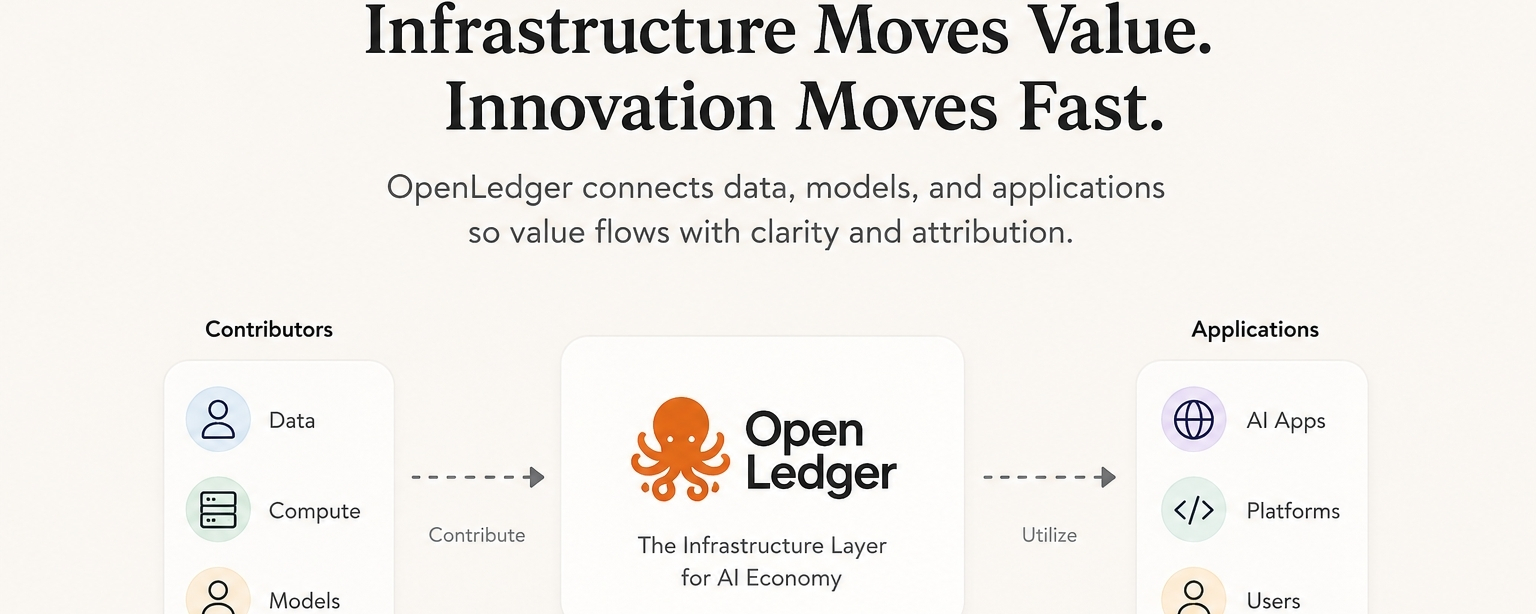
What stands out about @OpenLedger is not that it tries to build “better AI,” but that it focuses on the connective tissue between participants in the AI economy. It treats data, attribution, compute, and rewards as components of a single transport system rather than independent layers that just happen to interact.
In that sense, it feels less like a model-centric project and more like infrastructure design.
The analogy that keeps resurfacing for me is not about invention, but standardization. When power grids unified voltage and frequency, it didn’t make electricity more powerful—it made it movable. Once movement became reliable, entire industries could plug into the same backbone without negotiating bespoke systems for every environment.
AI today feels early in that same transition.
We already have capable models. We already have massive datasets. We already have applications being built at scale. But what we don’t yet have is a universally clean way for value to travel across all of them without friction, loss of attribution, or opaque settlement paths.
That missing layer is rarely exciting on the surface. It doesn’t produce flashy outputs or viral demos. But historically, these are exactly the layers that determine which ecosystems scale and which ones stall.
The real leverage is not in producing intelligence—it is in routing the economic signals around intelligence in a consistent way.
Seen through that lens, @OpenLedger is less about competing in the AI race and more about defining how participation in that race gets recorded, rewarded, and recombined across systems. It is an attempt to make contribution portable, so that datasets, models, and applications don’t exist as closed loops but as parts of a wider economy with traceable flows.
If that abstraction holds, the implication is subtle but significant: the winners in AI may not just be those who build the strongest models, but those who build the most reliable rails for value movement between everyone building around them.
That’s usually how infrastructure wins behave.
They don’t replace the visible layer.
They make it scale.Make one lind comment on this totally human write
