Most discussions about artificial intelligence focus on models.
People compare benchmarks.
They compare reasoning capabilities.
They compare speed, context windows, and performance scores.
The assumption is that better models automatically create better outcomes.
But the longer I watch the AI industry evolve, the more I think something important is being overlooked.
Models are only one part of the equation.
What matters just as much is the system surrounding them.
Where does the data come from?
Who contributes knowledge?
Who provides feedback?
Who improves the outputs?
Who verifies quality?
And perhaps most importantly, who gets rewarded when value is created?
These questions rarely receive the same attention as model performance.
Yet they may determine which AI ecosystems survive over the long term.
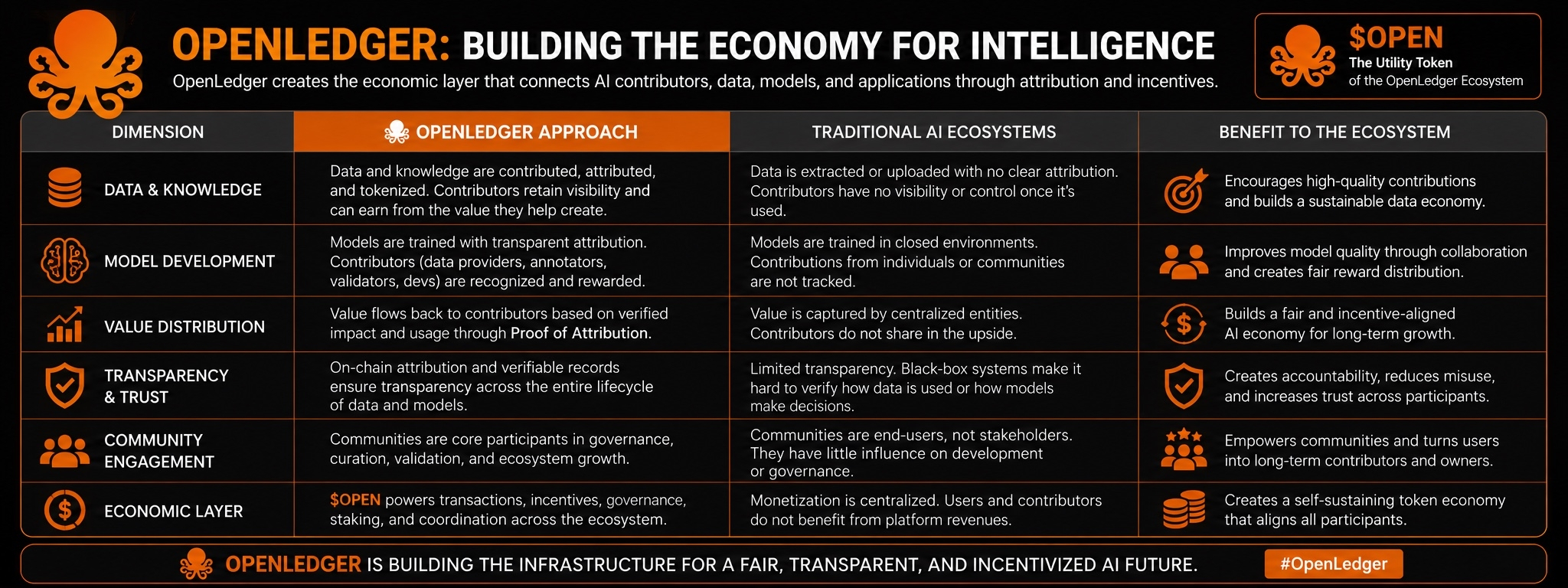
This is why I have been spending more time studying @OpenLedger.
What caught my attention is that OpenLedger does not seem focused on winning the race for the smartest model.
Instead, it appears focused on building the economic infrastructure that intelligent systems need in order to function sustainably.
When I look at today’s AI landscape, I see a strange contradiction.
Everyone agrees that data is valuable.
Everyone agrees that knowledge is valuable.
Everyone agrees that human expertise is valuable.
Yet the people providing those resources often have very little visibility into how their contributions create value after they enter the system.
Think about it.
A researcher publishes insights.
A creator generates content.
A developer contributes tools.
A community provides feedback.
A specialist shares domain expertise.
Together these inputs help AI systems become more capable.
But once intelligence is produced, the connection between the original contribution and the resulting value often disappears.
The contributor becomes invisible.
The output remains visible.
That model may have worked during the early stages of AI development.
I am not sure it works forever.
As AI grows, the demand for specialized information will continue increasing.
General internet data has already been heavily utilized.
The next phase of AI will require expertise.
Healthcare expertise.
Financial expertise.
Legal expertise.
Scientific expertise.
Engineering expertise.
Industry-specific expertise.
The challenge is that expertise is expensive.
People do not spend years developing knowledge simply to give it away indefinitely without incentives.
This creates a coordination problem.
AI systems need increasingly valuable contributions.
Contributors need meaningful reasons to participate.
Without proper incentives, the quality of contributions eventually suffers.
This is where OpenLedger becomes interesting.
Rather than viewing AI as a purely technical problem, the project appears to view AI as an economic network.
That distinction changes everything.
Because economic networks succeed when incentives align.
The internet scaled because millions of participants benefited from joining.
Blockchains scaled because economic rewards encouraged participation.
Open source ecosystems scaled because contributors received recognition, reputation, and opportunity.
AI may require similar mechanisms.
The future of artificial intelligence may depend less on creating intelligence and more on coordinating intelligence.
OpenLedger’s approach seems built around this idea.
Creating systems where contributions can be recognized.
Creating systems where attribution matters.
Creating systems where value does not simply flow in one direction.
Instead of treating data as fuel that gets consumed once, OpenLedger appears to be exploring ways to connect contribution and economic outcomes.
That idea may sound subtle.
In reality, it could be transformative.
Because attribution changes behavior.
When people know their contributions matter, they become more willing to contribute.
When contributors can participate in value creation, ecosystems become more sustainable.
When incentives align, network effects become stronger.
History provides countless examples.
The most successful networks are rarely built through technology alone.
Technology creates possibilities.
Incentives create participation.
Participation creates growth.
Growth creates value.
The strongest systems understand all four.
Another reason I find OpenLedger interesting is the timing.
AI is entering a phase where autonomous agents are becoming increasingly important.
The industry is moving beyond simple chat interfaces.
Agents are beginning to perform tasks.
Agents are beginning to execute workflows.
Agents are beginning to interact with applications.
Agents are beginning to make decisions.
As these systems become more sophisticated, they will rely on enormous amounts of information and coordination.
The challenge will no longer be generating outputs.
The challenge will be managing the relationships between contributors, agents, applications, and users.
This creates an entirely new economic layer.
A layer that many people are still underestimating.
Most market participants focus on visible applications.
Applications attract headlines.
Infrastructure rarely does.
But infrastructure often captures lasting value.
Roads are infrastructure.
Payment rails are infrastructure.
Cloud computing is infrastructure.
Internet protocols are infrastructure.
These systems quietly enable everything built above them.
The companies and networks that control critical infrastructure often become some of the most important players in an industry.
OpenLedger appears to be positioning itself within that category.
Not as a single AI application.
Not as a single model.
But as a foundational layer that helps coordinate how value moves throughout AI ecosystems.
Whether that vision succeeds remains to be seen.
Building economic systems is difficult.
Building attribution systems is difficult.
Building scalable AI infrastructure is difficult.
There are no shortcuts.
But difficult problems are usually where meaningful innovation happens.
What makes OpenLedger worth watching is not that it promises an easy solution.
It is that it is focused on a problem many others are ignoring.
The AI industry spends enormous amounts of time discussing intelligence.
Far fewer people discuss incentive alignment.
Yet incentive alignment may become one of the defining challenges of the next decade.
Because intelligence alone does not create sustainable ecosystems.
People do.
Contributors do.
Builders do.
Researchers do.
Communities do.
And if AI is ultimately built by people, then the systems that reward participation may become just as important as the systems that generate outputs.
That is why I believe OpenLedger deserves attention.
The project is exploring a future where AI is not only intelligent.
It is economically coordinated.
A future where contributors are not invisible.
A future where attribution becomes infrastructure.
A future where value can flow back to the people helping create it.
As artificial intelligence continues expanding across industries, those questions will only become more important.
The winners may not simply be the projects that build the smartest models.
They may be the projects that build the strongest economies around intelligence itself.
That is the lens through which I view @OpenLedger today.
Not simply as an AI project.
But as an attempt to build a market for intelligence.