

I was sitting at a small café in Gulberg, Lahore a few evenings ago, reading through old notes on OpenLedger while waiting for a meeting to start. My original goal was simple. I wanted to better understand the project's current focus on AI infrastructure, data attribution, and the broader vision behind $OPEN.
Instead, I found myself spending hours looking at something completely different.
The deeper I went into OpenLedger's history, the more often I came across a phrase that felt oddly out of place in today's crypto landscape: blockchain conglomerate.
At first, I didn't think much of it.
Crypto projects often use ambitious labels. Some stick. Most disappear. But this particular term kept appearing throughout OpenLedger's earlier story, and the more I saw it, the more curious I became.
What exactly was OpenLedger trying to describe?
The interesting thing is that there was never a simple answer.

It wasn't a standard industry category. It wasn't a technical framework. It wasn't something widely used across blockchain projects. Yet for a period of time, it appeared to be one of the best ways to explain how OpenLedger viewed itself.
That alone makes it worth examining.
Most crypto projects are built around a single identity. They launch a protocol, an exchange, an infrastructure network, or a specific application. Even when the technology becomes complicated, the core business is usually easy to explain.
OpenLedger's earlier structure looked different.
As I worked through its history, I found a collection of activities that stretched across multiple parts of the blockchain industry. There were exchange-related services, investment initiatives, infrastructure operations, educational efforts, and media-focused activities.
These were not simply different products being marketed under the same brand.
They represented different functions serving different needs.
For a moment, I stopped thinking about whether the term "blockchain conglomerate" was technically correct and started asking a more useful question.
Why would a project choose that structure in the first place?
The answer becomes clearer when viewed through the lens of crypto's earlier years.
Back then, the industry was still trying to discover which business models would survive long term. Entire sectors appeared and disappeared within a few years. What looked like the future one cycle could become irrelevant in the next.
Building around a single bet carried obvious risks.
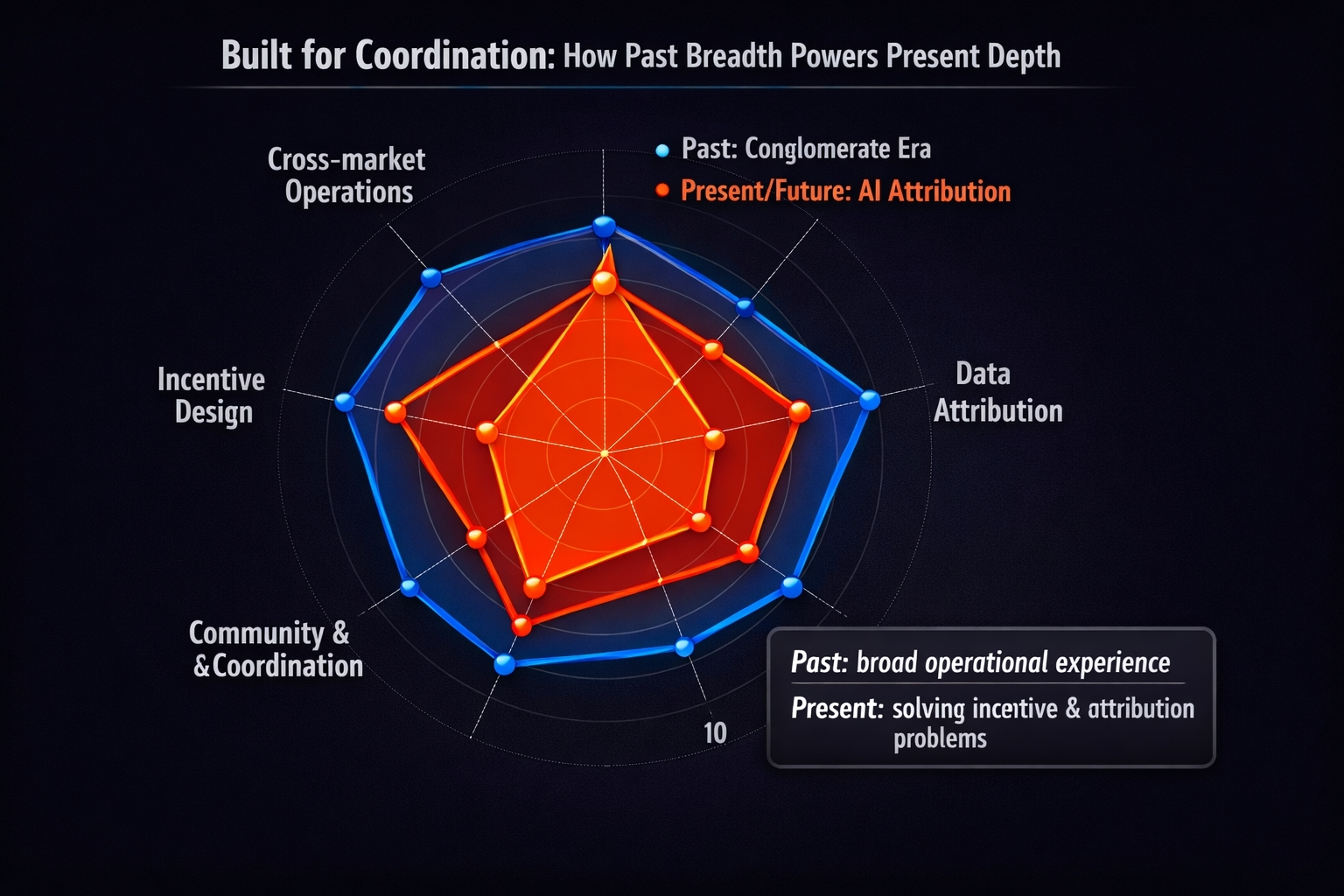
A broader structure offered flexibility.
If one segment struggled, another could continue growing. If one market opportunity faded, exposure elsewhere could help offset the impact. Diversification wasn't necessarily a sign of confusion. It may have been a practical response to uncertainty.
Seen from that perspective, OpenLedger's earlier structure makes more sense than many people might initially assume.
But there is another side to the story.
The broader an organization becomes, the harder it becomes to evaluate from the outside.
When multiple business lines operate under a shared identity, it can be difficult to understand what is actually driving progress. Strong areas can overshadow weaker ones. Resources can move internally without being visible. Success becomes harder to attribute to any single initiative.
That complexity is one reason investors often gravitate toward focused stories. Simplicity is easier to understand.
What surprised me most while researching OpenLedger wasn't the complexity itself.
It was how different that earlier chapter feels compared to the project's current direction.
Today, the conversation around $OPEN is far more focused.
The emphasis is increasingly on AI infrastructure, data provenance, attribution, and the challenge of connecting data contributors to the value they help create.
If I had removed the name "OpenLedger" from some of the older material and handed it to someone familiar only with the current project, they might not immediately assume they were looking at the same organization.
And yet, the more I thought about it, the more I wondered whether that difference is exactly the point.
Perhaps the most valuable thing about OpenLedger's earlier structure was not the structure itself.
Perhaps it was the experience that came from operating across different parts of the blockchain ecosystem.
Years spent working with infrastructure, markets, communities, and business models create lessons that cannot be learned from theory alone. Teams gain a better understanding of incentives. They learn where coordination breaks down. They see how industries evolve during both growth periods and downturns.
That kind of experience can become valuable when tackling more complex problems later.
Which brings us back to where OpenLedger is today.
The current focus on AI data attribution is, at its core, a problem of coordination and incentives. It asks how contributors can be recognized, how value can be measured, and how trust can be established across increasingly complex digital systems.
Those are difficult challenges.
They also happen to be the kinds of challenges that organizations with broad operational experience may be better equipped to understand. $H
I'm not saying OpenLedger's earlier structure guarantees future success. Markets do not work that way.
What I am saying is that history often matters more than people think.
Too often, crypto discussions treat projects as if they appeared yesterday. We focus on the latest narrative and ignore the years that came before it.
But sometimes the earlier chapters explain more than the current marketing ever could.
After spending time exploring OpenLedger's past, I've come away with a different view of the project.
The most important question is not whether the label "blockchain conglomerate" was perfectly accurate. $LAB
The more interesting question is what that period taught the organization.
Because if the lessons from those years are now being applied to a more focused vision around AI infrastructure and data attribution, then OpenLedger's history is more than background information.
It becomes context.
And in an industry that often forgets its own past, context can be a surprisingly valuable thing.