
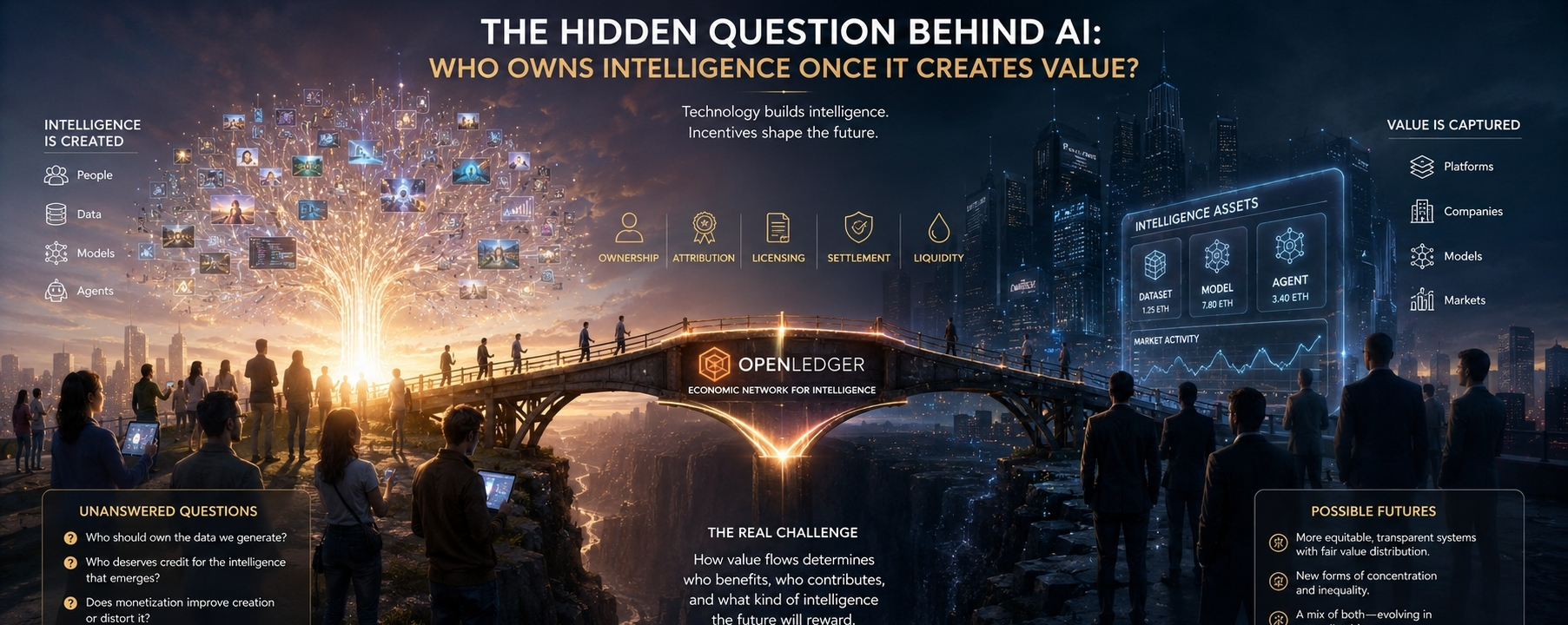
I kept returning to the same question while reading about OpenLedger: what happens when intelligence becomes something that can be owned, priced, and traded in smaller pieces?
For most of human history, knowledge existed in a strange state. It could create immense value, yet much of the process behind that value remained difficult to isolate. Ideas moved through institutions, communities, companies, and individuals. The person generating the knowledge was often separated from the person capturing the economic rewards. Sometimes by a little. Sometimes by a great deal.
Artificial intelligence seems to be making that tension more visible.
OpenLedger's attempt to create liquidity around data, models, and agents feels interesting not because it introduces another blockchain, but because it treats intelligence as an economic network problem. The focus shifts from building intelligence itself toward determining who owns it, who contributes to it, and who receives value from it once it begins producing useful outcomes.
That distinction feels increasingly important.
The conversation around AI often concentrates on capabilities. Better models. Better infrastructure. Better performance. Yet capabilities alone rarely determine how systems evolve. Incentives do. The moment value enters a system, attention follows. Then competition. Then coordination problems. Then questions of ownership that were previously easy to ignore.
Data is a useful example. For years, data was often described as a resource. But resources become political once they become scarce, valuable, or measurable. The more AI systems depend on data, the more difficult it becomes to avoid asking who should benefit from its use. The individuals generating it? The platforms collecting it? The companies refining it? The models learning from it?
There are no simple answers here.
What interests me is how economic structures quietly shape behavior long before anyone notices. A network may begin with ideals around openness and collaboration, but incentives have a way of revealing underlying realities. Participants adapt. New strategies emerge. Power accumulates in unexpected places. Systems that appear decentralized can slowly become concentrated. Systems designed to distribute value can sometimes create entirely new forms of inequality.
Not immediately. Gradually.
That gradual process is often more important than the original design.
If data, models, and agents become assets that can be monetized directly, entirely new behaviors may emerge around their production. People may become more deliberate about what they contribute. Organizations may become more selective about what they share. Markets may begin rewarding certain forms of intelligence while ignoring others.
And that raises another question that feels difficult to answer.
Does attaching economic value to intelligence improve its creation, or does it subtly change the nature of what gets created?
Markets are powerful coordination mechanisms. They solve many problems. But they also influence priorities. Once rewards become visible, participants naturally optimize for them. Sometimes that produces innovation. Sometimes it produces distortion. Often it produces both at the same time.
I find myself wondering whether future AI networks will be defined less by technical architecture and more by incentive architecture. The underlying models may matter, but the rules governing ownership, attribution, and value distribution may matter just as much. Perhaps even more.
Because intelligence itself is not emerging in isolation. It is emerging inside systems populated by humans, institutions, capital, and competing interests. Every technological layer eventually encounters these realities.
That is why projects like OpenLedger seem worth paying attention to, even if their long-term outcomes remain uncertain. They are exploring a question that sits beneath many discussions about AI but rarely receives equal attention: not how intelligence is created, but how value flows around it.
The answer is still unclear.
And perhaps that uncertainty is the most honest place to begin.
We may discover that tokenizing intelligence creates fairer and more efficient systems. We may discover that it introduces new forms of complexity and concentration. More likely, both possibilities will emerge simultaneously, each shaping the other in ways that are difficult to predict from the present.
For now, I find myself less interested in whether these networks succeed or fail in a conventional sense. What interests me is what they reveal about our assumptions. About ownership. About contribution. About value itself.
The technology is visible.
The deeper negotiation happening underneath it is much harder to see. And it may ultimately be the more important story.