
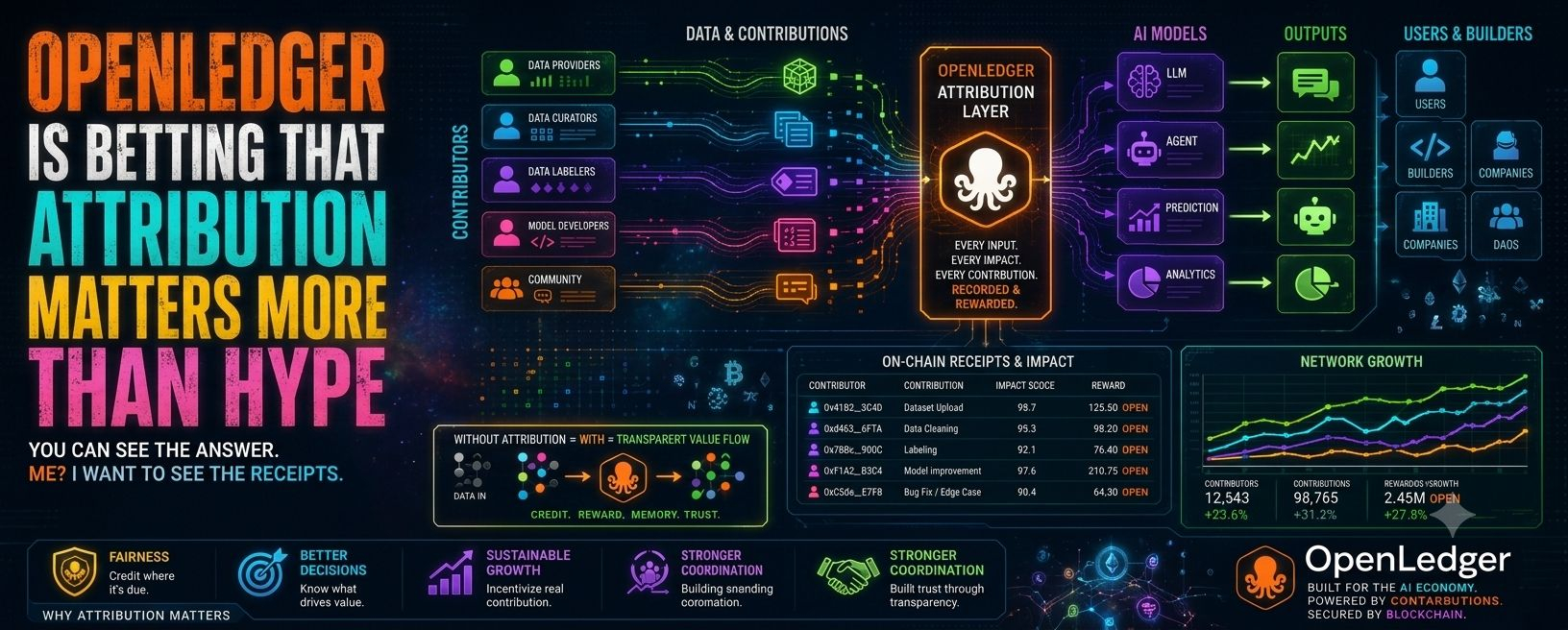

You can see the answer. Me? I want to see the receipts.
Most People chase the output. The smart AI reply, the Perfect trading Signal, the agent that seems to do everything for you. And honestlY, I get it. You can judge an output in a few seconds.
But after Spending years around Crypto, I've learned something kinda uncomfortable. The loudest part of a System usually isn't the most important one.
Think about crypto for a second. One thing it does really well is leave trails. Wallets, transactions, Governance votes, everything gets recorded somewhere. AI feels almost the opposite. Data goes in, models get trained, answers come out, and somewhere in the middle all the people who actually helped make it happen sort of disappear.
The People who uploaded data. The ones who cleaned it. Fixed mistakes. Added labels. Handled weird edge cases. Most of them never get mentioned again.
And somehow we've started treating that like it's normal.
Maybe because everyone got distracted by how smart the final output looked. Maybe because attribution sounds boring compared to AI intelligence. But honestly, boring stuff is usually where the real value sits.
That's one reason I keep paying attention to OpenLedger. Not because it makes better outputs than everyone else. A lot of projects can generate good outputs now.
What's actually rare is a system that tries to remember where those outputs came from.
Who contributed the data?
Which model improved it?
Which community kept adding value after the hype died down?
Without answers to those Questions, the AI economy starts looking like a giant memory hole. You put your best work in, and all you get back is a Slightly better answer for someone else's question.
That doesn't feel very sustainable.
And yeah, it's not exactly fair either.
But even putting fairness aside, attribution is useful because it helps coordination. It shows builders what data is actually valuable. It helps contributors figure out where to spend their time. It turns a one-time contribution into something that can keep creating value later.
Without attribution, Participation gets messy. With attribution, at least you can tell the difference between real contribution and random noise.
Now, let's be real. Every reward System gets abused eventually.
Crypto has seen this over and over again. Points become farming. Rewards become spam. Governance turns into a popularity contest.
If OpenLedger rewards contributions too loosely, people will flood the network with junk. If it rewards too narrowly, it might push away the weird but useful contributions that actually help things improve.
That's the hard part.
I do not know if they've solved it perfectly. Honestly, probably not.
But at least they're asking a Question that matters: how do you measure quality without making everyone optimize for a machine?
For me, that's where things get interesting.
Because output is temporary.
A smart answer today gets forgotten tomorrow.
But attribution affects what people do next.
If I know my work can be tracked and rewarded, I'll probably contribute better data. If builders can see which inputs actually mattered, they'll make better decisions. If users can see how value moves through a network, trust becomes less about marketing and more about visible mechanics.
That changes things.
Not because it guarantees success, but because it changes what people pay attention to.
Most people will probably look at $OPEN and just think, "another AI token."
That's the easy story.
The Harder story is that OpenLedger is trying to solve a much bigger accounting problem inside AI infrastructure. How Participation gets measured. How rewards get distributed. How Governance works. How value moves between contributors, builders, and users.
It's definitely messier than a simple narrative.
Maybe less exciting too.
But it feels closer to the actual problem.
And the funny thing is, the best AI Systems in the future might not be judged by how smart they sound. They might be judged by how well they preserve the chain underneath.
Who contributed.
What worked.
Who kept showing up after the first wave of hype disappeared.
Those are not flashy Questions. But markets always seem to come back to infrastructure once the exciting stuff gets overcrowded.
I'm not saying OpenLedger will get everything right. There will be friction. People will try to game the System. There will be trade-offs that nobody likes.
That's pretty much unavoidable.
But maybe that's also why it's worth watching.
It isn't really trying to make AI sound smarter. It's trying to make the Process behind AI more visible.
And that feels a lot more durable than another race to produce a slightly better answer.
Not excitement exactly.
More like curiosity... with a few doubts still attached.
And honestly, that's usually where the interesting stuff starts.