
Market had that weird empty mood today. Not a real dump. Not a real pump. Just screens sitting there like everyone was waiting for someone else to make the first move. Those are usually the days when I stop staring at candles and start digging through old things I saved and never properly read. That is how I ended up back on OpenLedger’s ERC-4626 update from March 20. I remember seeing it at the time and thinking, okay, AI-managed yield, tokenized vaults, another phrase that can either mean something or become another shiny crypto label. I saved it, forgot about it, and then today I actually gave it time. And the more I sat with it, the more it felt like most people are probably looking at the easiest part of the story and missing the part that actually matters.
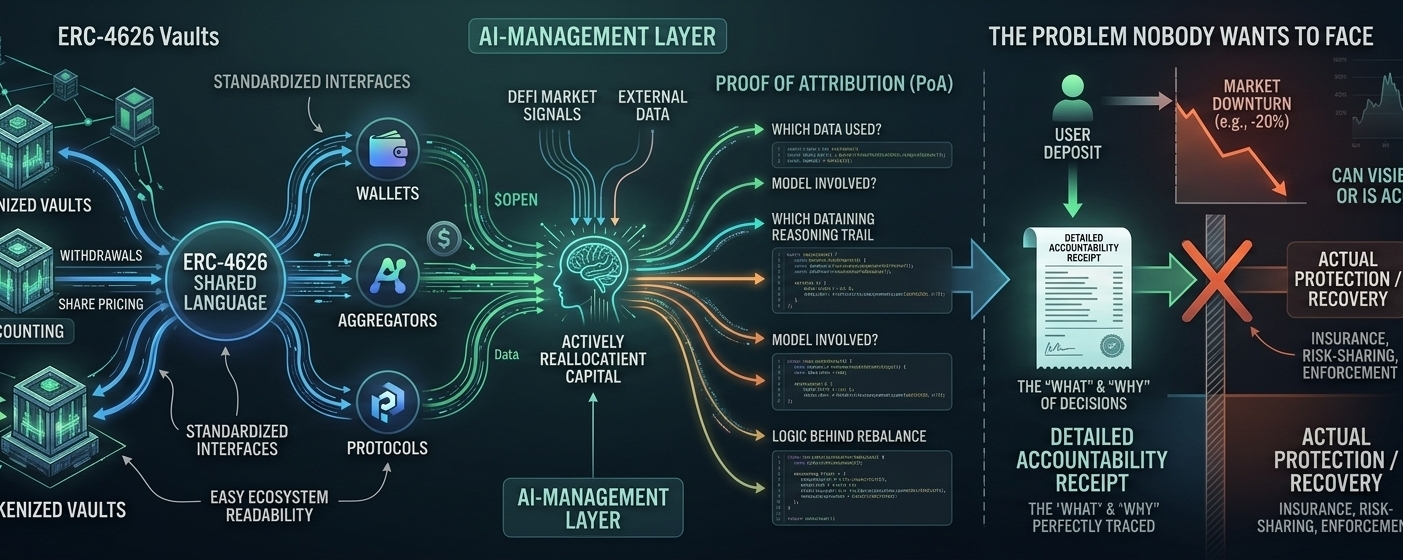
The simple version is obvious. OpenLedger adds ERC-4626, AI helps manage capital, vaults become easier to use, users do not have to manually chase DeFi yield across different protocols, and maybe the strategies become cleaner over time. That is the version people can understand quickly, so that is the version that spreads. But it also feels too flat. ERC-4626 is not just some yield wrapper. The real value is that it gives vaults a shared language. Deposits, withdrawals, shares, redemptions, pricing, accounting, all of that becomes easier for outside systems to read. Wallets can understand it. Aggregators can understand it. Other protocols can plug into it without needing a custom mess every time. That sounds boring, but boring standards are usually where crypto becomes usable instead of just loud.
That is why I do not think the real OpenLedger angle is simply “AI will find better APY.” Maybe it does. Maybe it does not. Markets have a way of embarrassing anything that sounds too confident. The more interesting point is that an AI agent managing capital inside a vault becomes part of a structure that other systems can actually read. The vault is not just some closed box where money goes in and some mystery strategy happens in the background. If it follows ERC-4626 properly, the rest of the ecosystem can understand the vault’s basic behavior in a standardized way. That means allocation changes, share values, deposits, exits, and strategy movement can become easier to track and easier to build around. Not sexy. But important.
Then Proof of Attribution makes the whole thing heavier. Because if ERC-4626 makes the vault readable, OpenLedger’s PoA is supposed to make the AI decision layer traceable. That is the part that kept pulling me back. Not just what happened to the capital, but why the AI made a certain move. Which data shaped the output. Which model was involved. What signal pushed the allocation. What logic sat behind the rebalance. In theory, you are not only watching funds move around a vault. You are watching the reasoning trail get attached to the decision. That is a very different thing from the usual DeFi answer of “trust the strategy” or “the model knows better.” I am tired of that answer. Most people are.
And this is where OpenLedger starts to look less like another AI yield product and more like an attempt to answer a much bigger question. Can AI-managed capital ever be trusted at scale? Not hyped. Not marketed. Trusted. Because that is the real wall. People might play with AI tools. They might use agents for small tasks. They might even let automation handle some trades. But handing over serious capital to an AI-managed vault is a different level of trust. If the vault makes money, nobody asks too many questions. Everyone suddenly becomes a believer. But if the vault loses money, then all the questions come back at once. Why did it make that decision? What data did it use? Did the model misread risk? Was the strategy broken? Was the market just bad? Was anyone actually responsible?
Most systems are not built to answer those questions in a clean way. That is the part I think OpenLedger is trying to move toward. Not perfect trust. Not some magical protection layer. But a system where the decision path is not completely hidden. A system where AI-driven capital decisions can be recorded, checked, compared, and maybe judged later. That matters more than people think, especially if AI starts touching more real financial flows. Nobody wants a black box managing money when the market turns ugly. A black box is fine when it prints yield. It becomes a nightmare when it loses funds and nobody can explain anything beyond a vague postmortem.
But I also do not want to oversell it, because this is where the uncomfortable part starts. Being able to see what happened is not the same as being protected from what happened. If an AI vault loses 20% and the system gives you a clean on-chain trail showing which model made the decision, which data influenced it, and why the allocation went wrong, what does that actually do for the person who deposited? It may help researchers. It may help auditors. It may help the protocol improve. It may even matter for future regulation. But the user is still down 20%. A perfect explanation does not put the money back in the wallet.
That gap is the thing I cannot ignore. Crypto has always had this habit of acting like transparency fixes everything. It does not. Transparency tells you what broke. It does not always stop it from breaking, and it definitely does not automatically make users whole. ERC-4626 can make vaults easier to understand. Proof of Attribution can make AI decisions easier to trace. Together, they can create a cleaner record than most DeFi systems have ever had. That is real. But unless something sits on top of that record, some kind of insurance, slashing, risk-sharing, enforcement, or recovery mechanism, then accountability is still mostly a receipt. A very detailed receipt, sure. But still a receipt.
That does not make me negative on OpenLedger. Actually, it makes me more interested, because at least the project is touching a real problem instead of just throwing AI on top of DeFi and acting like that is enough. The ERC-4626 direction makes sense. The Proof of Attribution layer makes sense. The combination is worth watching because it moves AI-managed finance away from pure opacity and closer to something people can inspect. Maybe not fully trust yet, but inspect. And in this market, that already puts it ahead of a lot of projects that are still surviving on vague AI language and recycled promises.
For $OPEN, the market side is still messy. Architecture is one thing. Token behavior is another. Unlocks, liquidity, sentiment, and timing can matter more in the short term than any clean technical idea. That is just how this space works. Good infrastructure can still trade badly if supply pressure hits at the wrong time or if the market has no appetite for anything that is not already moving. So I would not pretend ERC-4626 alone changes the chart overnight. It does not. The more honest signal will be whether real capital actually enters these vaults and stays there when the easy mood disappears.
That is what I would watch now. Not just announcements. Not just people repeating “AI yield” like it explains everything. Watch TVL. Watch behavior. Watch whether users trust the vaults after the first bad week. Watch whether the system can show its work when decisions get questioned. Because the real test for OpenLedger is not whether AI can manage capital in calm conditions. The real test is whether people still trust the system when the AI makes a hard decision, the market moves against it, and everyone suddenly wants answers.
That is where this whole thing either becomes meaningful or just another smart-looking crypto idea. ERC-4626 helps make the vault readable. Proof of Attribution helps make the decision trail visible. But trust lives in the space between visibility and protection. OpenLedger seems to understand the visibility part better than most. The next question is whether that can turn into something users actually rely on when money is on the line. Because AI-managed capital does not need more hype. It needs proof that people are not just handing their funds to another machine they cannot question.
