
@OpenLedger One thing I've noticed about technology is that it has a strange habit of forgetting where value comes from.
When people look at AI today, they usually see the final result. They see the chatbot answering questions, the image generator creating artwork, or the model solving complex problems. What they don't see is the enormous network of people, data, and infrastructure sitting behind those outputs. The finished answer gets attention, while the countless contributions that made the answer possible slowly fade into the background.
The more AI advances, the more important this observation becomes.
Every intelligent system depends on something before intelligence itself. It depends on information. It depends on participation. It depends on developers building applications, researchers creating breakthroughs, businesses generating useful data, and communities continuously contributing knowledge. AI is often presented as a machine producing value, but in reality it is part of a much larger ecosystem constantly supplying that value.
The challenge is that most existing systems are very good at capturing contributions but not very good at remembering them.
Data enters a platform. Models improve. Applications grow. Value is created. Yet over time, the connection between contributors and outcomes becomes increasingly difficult to see. The system remembers the result but often forgets the path that led there.
That is one reason OpenLedger feels different from many AI projects.
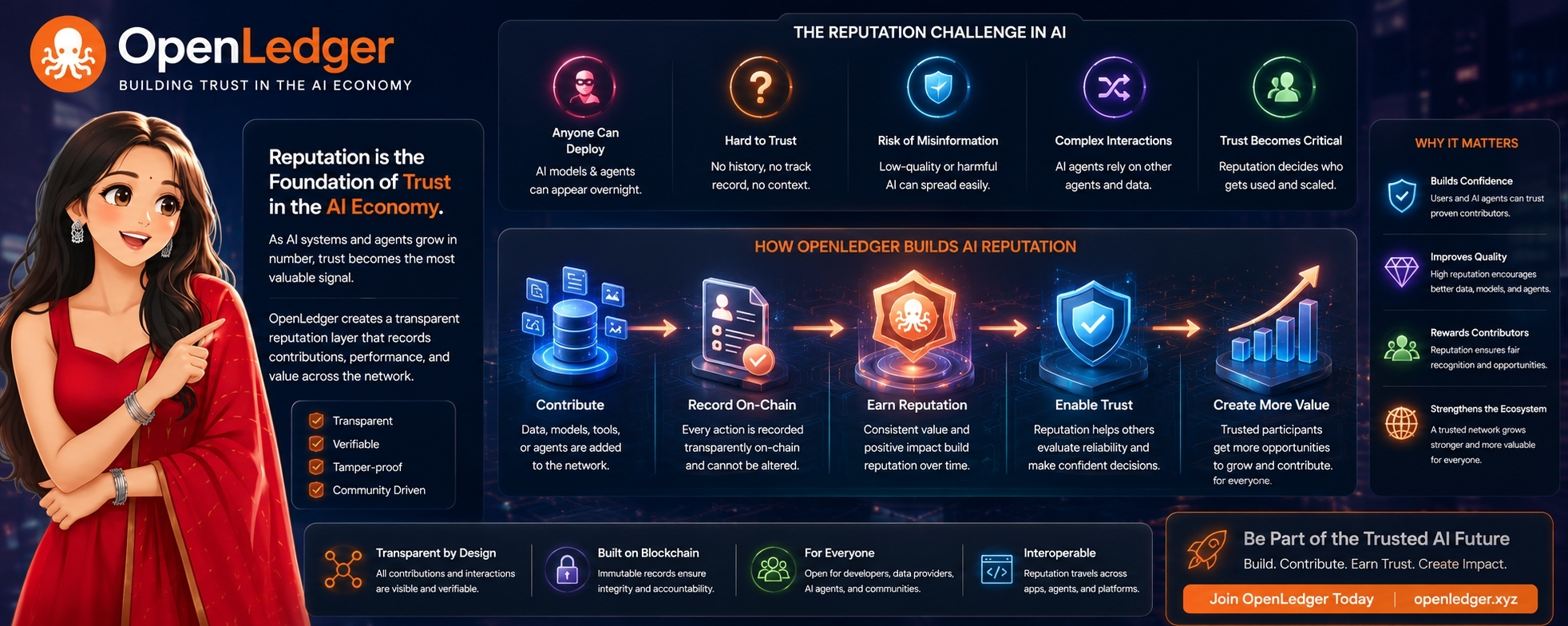
Rather than focusing only on creating intelligence, the project appears focused on preserving attribution inside the AI economy. In simple terms, it is trying to build a framework where contributions remain visible instead of disappearing into the background. Data providers, model builders, and AI agents are not treated as temporary inputs. They become identifiable participants within a larger network.
The more I thought about this idea, the more it reminded me of scientific research. A breakthrough discovery rarely comes from one person working alone. It is usually built on years of previous work from hundreds of researchers. Citations matter because they create a record of contribution. They provide context for where knowledge originated and how it evolved over time.
AI may eventually require something similar.
As AI systems become more interconnected, the flow of value becomes harder to track. Future AI ecosystems may involve thousands of models, millions of datasets, and countless autonomous agents interacting with one another. In that environment, understanding who contributed what becomes increasingly important.
Without attribution, participation weakens.
People are more willing to contribute when they know their contributions are recognized. Developers build more when ownership exists. Communities grow stronger when value can be traced back to those who helped create it. Incentives work best when participants can clearly see the connection between effort and reward.
OpenLedger appears to be built around that principle.
The project isn't simply asking how AI can become smarter. It's asking how AI economies can remain connected to the people and systems creating value inside them. That may sound like a small distinction, but it has significant implications. Because as intelligence becomes more common, contribution may become the scarce resource.
The future AI economy will need data. It will need specialized models. It will need autonomous agents. Most importantly, it will need people willing to participate. Sustainable ecosystems are not built solely through technology. They are built through aligned incentives that encourage continuous contribution.
This is where blockchain infrastructure starts making practical sense. Not because it magically improves AI performance, but because it creates transparent records of participation. It provides a way to track contributions, establish ownership, and distribute value across a network of independent participants.
The result is a different vision for AI. Instead of a system where value flows into a black box, it becomes a system where value remains connected to its source.
Of course, building that future is far from simple. Every infrastructure layer faces challenges involving scale, governance, and economic design. But those are often the same challenges that emerge when technology begins transitioning from products into ecosystems.
And AI is rapidly becoming an ecosystem.
The next chapter of AI may not be defined only by bigger models or better benchmarks. It may also be defined by how effectively the industry remembers the people, data, and systems that helped create intelligence in the first place.
That's why OpenLedger continues to stand out to me. It isn't just focused on generating value through AI. It is focused on ensuring that value remains connected to the contributors who helped make it possible.
In a future built on intelligence, that kind of memory may become one of the most valuable forms of infrastructure of all.
@OpenLedger #OpenLedger #openledger
