
Sometimes a project becomes more interesting the moment you stop looking at the thing it claims to be.
That was my experience with OpenLedger.
At first glance, it's easy to place it into a familiar category. Another blockchain project. Another AI project. Another attempt to combine two of the most talked-about technologies of the last few years.
But after spending hours reading about it, I found myself thinking less about blockchains and AI models and more about a surprisingly simple question:
What happens to the people whose knowledge quietly powers intelligent systems?
It's a question that has been sitting in the background of the AI conversation for years.
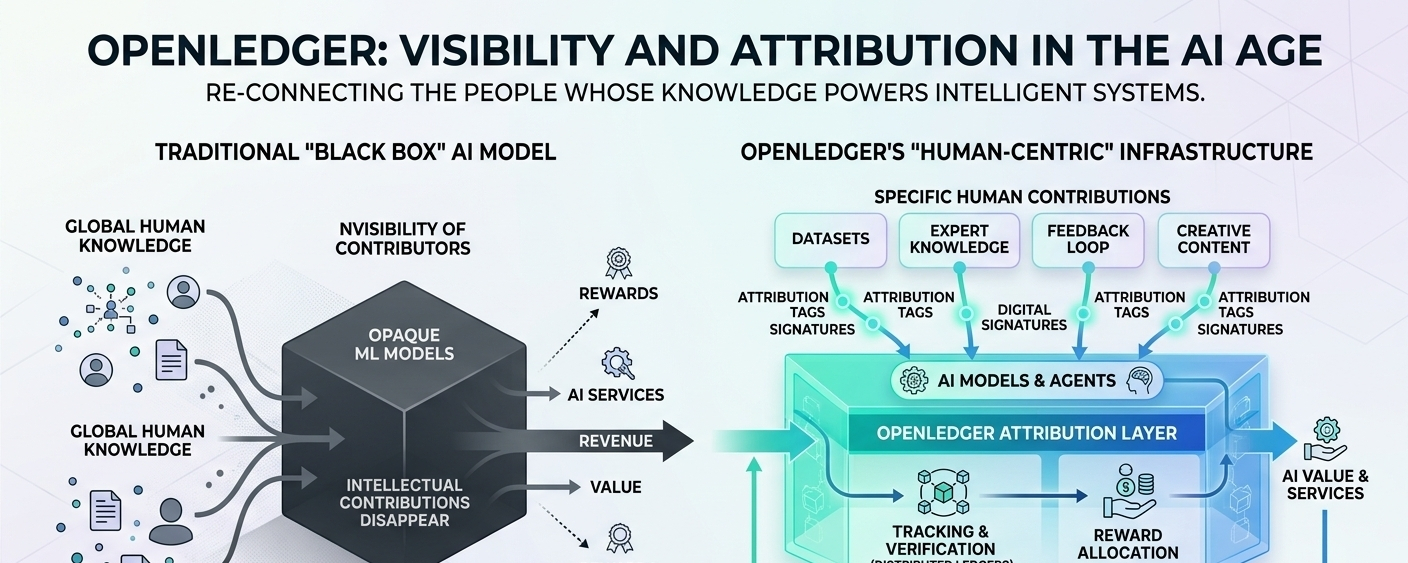
Every AI model learns from something. It learns from data, from human decisions, from countless pieces of information created, collected, or organized by real people. Yet once a model becomes useful, those contributions often disappear into the machinery. The value becomes visible. The people behind it usually do not.
OpenLedger seems to be built around that uncomfortable reality.
The project's core idea is relatively easy to understand. It wants to create a system where data, AI models, and autonomous agents can be tracked, attributed, and rewarded. In simple terms, if someone's contribution helps an AI system create value, OpenLedger wants there to be a way to recognize that contribution instead of letting it vanish inside a black box.
The idea sounds almost obvious when stated that way.
But the more I thought about it, the more I realized how difficult it actually is.
It's one thing to say people deserve credit. Almost everyone agrees with that. It's another thing entirely to build a system capable of figuring out who contributed what in a world where billions of pieces of information blend together inside machine learning models.
That's where OpenLedger becomes genuinely interesting.
Most projects in this space talk about bigger models, faster performance, cheaper computation, or more powerful AI agents. OpenLedger seems to be looking at a different problem altogether. It is less concerned with making AI smarter and more concerned with making AI accountable.
There is something refreshing about that.
The modern AI industry often feels obsessed with outputs. We celebrate what the models can do. We measure benchmarks. We compare capabilities. We chase the next breakthrough.
Far fewer people spend time thinking about the invisible infrastructure beneath those achievements.
Who supplied the knowledge?
Who created the data?
Who should benefit when that knowledge becomes valuable?
These questions are not nearly as exciting as talking about artificial intelligence. Yet they may prove to be just as important.
What I found myself appreciating about OpenLedger is that it starts from the assumption that attribution matters.
Not because attribution is fashionable.
Because attribution is fundamentally connected to trust.
As AI systems become more integrated into everyday life, people will inevitably ask where information came from, who contributed to it, who owns it, and who benefits from it. These aren't technical questions. They're social questions. Economic questions. Human questions.
OpenLedger is essentially trying to build infrastructure around those concerns.
Whether it succeeds is impossible to know.
In fact, this is where I become more cautious.
The vision is compelling, but reality is rarely as clean as a whitepaper.
Attribution inside AI systems is extraordinarily difficult. Human knowledge doesn't exist in neat, isolated containers. Data overlaps. Ideas influence one another. Contributions become intertwined. Trying to measure influence precisely may turn out to be much harder than it sounds.
There is also the practical challenge that every infrastructure project faces.
People only use systems that solve real problems better than existing alternatives.
It doesn't matter how elegant a concept is. If contributors don't see meaningful rewards, if developers don't find the tools useful, or if organizations don't see clear advantages, adoption becomes an uphill battle.
Those are not criticisms unique to OpenLedger.
They're simply the realities any ambitious project has to confront.
Still, after spending time with the idea, I came away thinking that many people may be looking at OpenLedger through the wrong lens.
The story isn't really about blockchain.
And it isn't even primarily about AI.
The deeper story is about visibility.
For decades, digital systems have become increasingly powerful while simultaneously becoming harder to understand. More intelligence, more automation, more complexity. Yet less clarity about where value originates and how it flows.
OpenLedger feels like an attempt to push against that trend.
Not by slowing technology down, but by making contributions easier to see.
Maybe that works.
Maybe it doesn't.
What I find worth paying attention to is the question behind the project itself.
In a future where AI generates more value than ever before, will we have systems capable of remembering the people whose knowledge made that value possible?
OpenLedger is trying to answer that question.
And regardless of where the project ultimately ends up, I suspect that question will only become more important with time.