
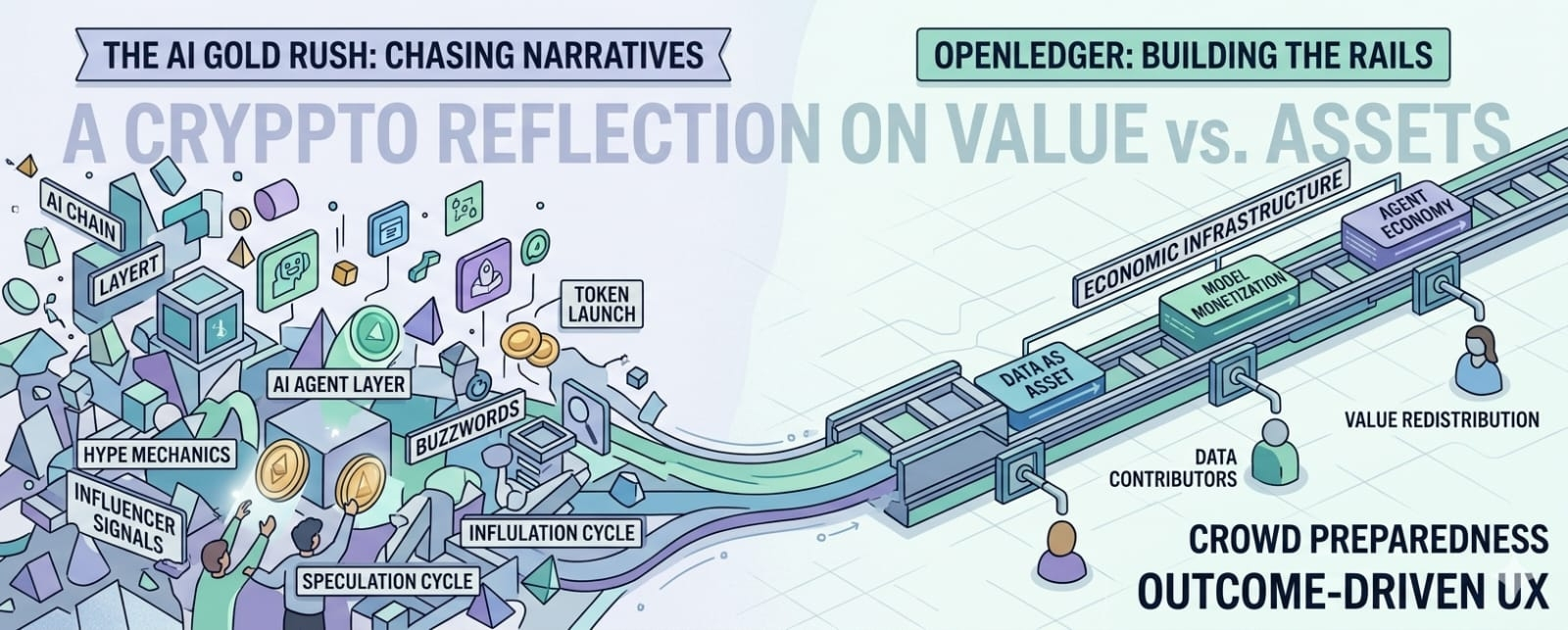
I was scrolling through crypto again tonight, half awake, half bored, watching another wave of AI projects fight for attention like it's some digital talent show nobody asked for. Every timeline looks the same now. New logos. New token tickers. New promises about intelligence, automation, agents, data ownership, decentralized futures, and whatever combination of buzzwords happens to trend that week.
After a while it all starts blending together.
AI chain.
AI agent layer.
AI economy.
AI marketplace.
AI infrastructure.
Everyone is building the future. Somehow nobody can explain who is actually using it.
That's probably why OpenLedger caught my attention.
Not because I think it's guaranteed to win. Not because I suddenly became convinced AI blockchains are the next trillion-dollar narrative. Mostly because it's trying to attack a problem I've been watching grow for years without anyone really solving it.
The value problem.
Crypto has become very good at creating assets.
Not necessarily value.
We tokenize everything. We launch tokens before products. We create incentives before users. Liquidity appears, speculation follows, charts move, influencers arrive, and then everyone spends six months pretending adoption is happening while volume quietly evaporates.
The cycle is almost mechanical now.
AI somehow made this even worse.
Every project suddenly discovered artificial intelligence at exactly the same time. Whitepapers were updated. Roadmaps changed. Old infrastructure projects woke up one morning and realized they were actually AI infrastructure all along.
The funny thing is that AI itself isn't fake.
The demand is real.
The data is real.
The models are real.
The compute requirements are definitely real.
What's less clear is how the economic value generated by all those systems gets distributed.
Most people creating useful data don't get paid.
Most people contributing training information don't get paid.
Most users feeding AI systems every day don't get paid.
Meanwhile the platforms collecting everything become increasingly valuable.
That's where OpenLedger starts becoming interesting.
The idea isn't simply another AI blockchain. We've heard that story enough times already.
The bigger idea seems to revolve around turning data, models, and AI agents into assets that can actually generate value for contributors instead of simply feeding centralized systems.
At least in theory.
And crypto is full of theories.
I've been around long enough to know that a good theory and a successful network are completely different things.
The graveyard is full of brilliant ideas.
Technology usually isn't what kills them.
People do.
Or more specifically, the absence of people.
Crypto loves discussing throughput numbers, consensus mechanisms, execution environments, latency improvements, modular architecture, and every other technical metric imaginable.
Meanwhile the real question remains embarrassingly simple.
Will anyone show up?
Because networks don't fail when they're empty.
They fail when they're crowded.
That's the irony.
Everyone celebrates a chain surviving with ten thousand users.
The real test starts when millions arrive.
Suddenly wallets break.
Interfaces lag.
Infrastructure strains.
Validators complain.
Costs increase.
User experience collapses.
I've watched it happen repeatedly across different cycles.
Technology looks unstoppable until actual humans start touching it.
Humans are chaos generators.
They click the wrong buttons.
They forget passwords.
They spam transactions.
They chase incentives.
They exploit loopholes.
They leave when rewards disappear.
No amount of architecture diagrams can fully prepare for that.
Which is why I find infrastructure projects fascinating and terrifying at the same time.
Infrastructure doesn't get rewarded immediately.
Speculation gets rewarded immediately.
Infrastructure gets rewarded years later if it survives.
That's a much harder game.
OpenLedger is entering a space where competition isn't exactly lacking either.
Everyone wants to become the foundation layer for AI economies.
Everyone wants to host agents.
Everyone wants to monetize data.
Everyone wants to facilitate model marketplaces.
Everyone wants to own the rails.
The challenge is that users generally don't care about rails.
They care about outcomes.
Nobody wakes up excited to use infrastructure.
People use infrastructure because it helps them accomplish something else.
That's where many crypto projects get trapped.
They build impressive systems and then spend years searching for reasons people should use them.
Sometimes they find those reasons.
Sometimes they don't.
The thing that keeps pulling me back toward OpenLedger isn't necessarily the technology itself.
It's the economic question sitting underneath everything.
Data has become one of the most valuable resources on the planet.
Everybody knows it.
Yet most contributors remain disconnected from the value they help create.
The internet evolved into a machine where participation generates enormous economic output, but ownership remains concentrated.
Crypto has been trying to solve versions of that problem forever.
Some attempts were ridiculous.
Some were scams.
Some were early.
Some simply arrived before the market was ready.
Maybe this attempt lands differently.
Maybe it doesn't.
I genuinely don't know.
And honestly, anybody claiming certainty probably doesn't know either.
One thing I've learned from crypto is that investors consistently underestimate user laziness.
That's not an insult.
It's reality.
People don't want complicated systems.
They don't want ten-step onboarding processes.
They don't want to manage five wallets, twelve passwords, and three bridges just to access a feature.
They want convenience.
The most elegant economic model in the world becomes useless if normal users can't be bothered to interact with it.
That's a bigger challenge than consensus mechanisms.
It's a bigger challenge than scalability.
It's a bigger challenge than decentralization.
Making people care is hard.
Keeping them around is even harder.
And AI introduces another layer of complexity.
Because unlike traditional crypto applications, AI systems continuously evolve.
Models improve.
Agents become smarter.
User expectations increase.
Competition accelerates.
The pace feels relentless.
What works today can become obsolete frighteningly fast.
That's why I keep approaching AI-related projects with skepticism.
Not hostility.
Just skepticism.
We've entered an environment where narratives move faster than infrastructure can mature.
Capital flows into stories before products are fully tested.
Expectations inflate before adoption arrives.
Then reality eventually catches up.
Reality always catches up.
Sometimes that's good.
Sometimes it's brutal.
OpenLedger appears to be positioning itself where those worlds collide.
AI growth.
Data ownership.
Blockchain incentives.
Agent economies.
Model monetization.
All wrapped into a single ecosystem attempting to create liquidity around digital intelligence itself.
That's an ambitious target.
Maybe too ambitious.
Crypto history suggests ambitious targets have a mixed success rate.
For every network that becomes foundational, dozens disappear quietly into forgotten Discord servers and abandoned GitHub repositories.
Nobody likes talking about that part.
Everyone prefers discussing winners.
The survivors get documentaries.
The failures get silence.
Still, I find myself paying attention.
Not because I'm convinced.
Because I'm curious.
Curiosity survives longer than hype.
Hype burns fast.
Curiosity lingers.
The deeper I look into crypto these days, the more I realize the next phase probably won't be won by whoever shouts the loudest.
It'll be won by whoever quietly solves a problem people actually feel.
Not a theoretical problem.
Not a conference-panel problem.
A real problem.
Something painful enough that users return even when token incentives disappear.
That's the benchmark.
That's always been the benchmark.
Can the system create enough value that people stay when speculation leaves?
OpenLedger seems to be betting that AI-generated value needs better economic rails and that contributors deserve more direct participation in the upside.
It's a reasonable thesis.
Maybe even an important one.
But crypto has never rewarded reasonable theses automatically.
Markets are emotional.
Investors are impatient.
Users are unpredictable.
Infrastructure takes time.
Narratives move instantly.
And somewhere between those forces, projects either become essential or irrelevant.
Tonight, sitting here watching another flood of AI announcements roll across my screen, I can't say whether OpenLedger becomes a major piece of the next AI economy or just another ambitious experiment buried beneath newer narratives six months from now.
What I do know is that the conversation it's pushing feels more important than another memecoin, another yield scheme, or another recycled promise about revolutionizing finance.
Data has value.
Models have value.
Agents probably will too.
The unanswered question is who captures that value.
Maybe OpenLedger helps answer it.
Maybe the market never cares.
Maybe adoption arrives slower than everyone expects.
Or maybe one day people realize the real opportunity wasn't building more AI hype—it was building the infrastructure underneath it.
I've been in crypto long enough to know the difference isn't obvious until years later.
For now, all I see is an interesting bet sitting in the middle of a noisy industry that can't stop chasing the next story.
It might become something important.
Or it might become another lesson.
And if crypto has taught me anything, sometimes those end up being the exact same thing.