
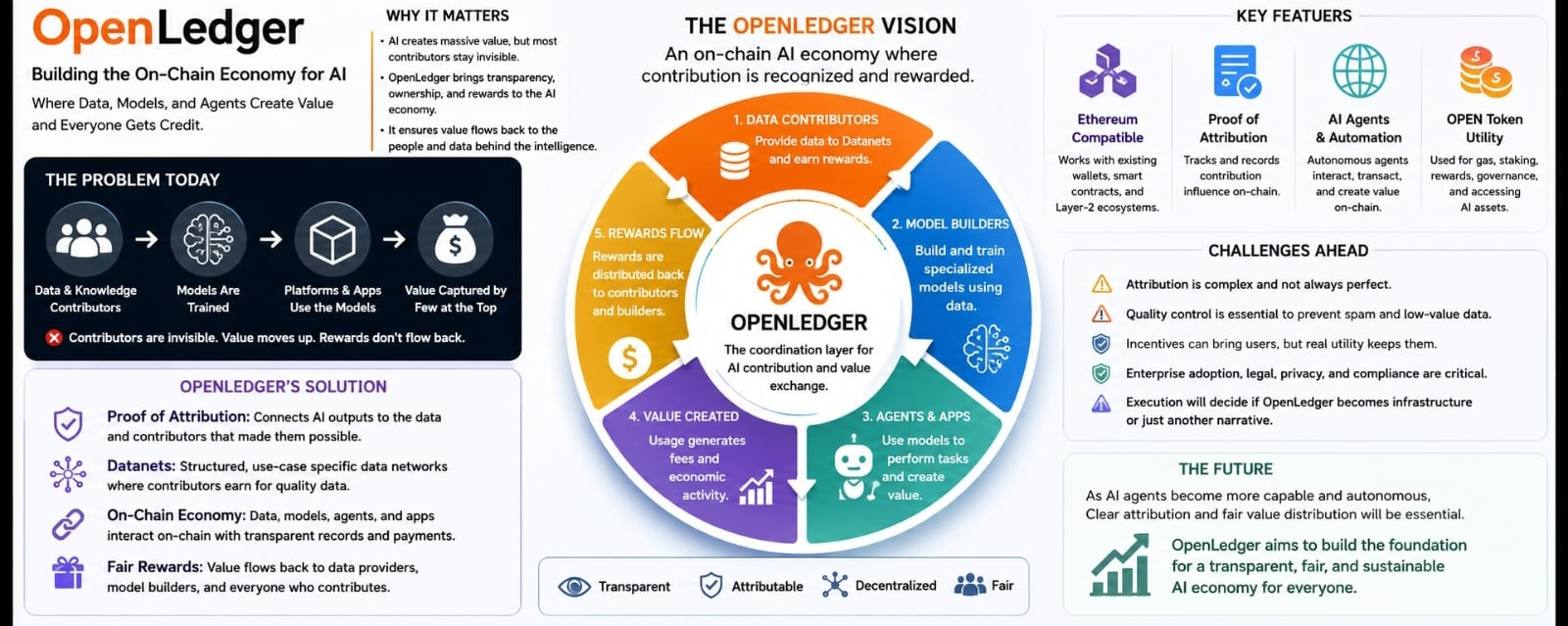
OpenLedger made me think about fairness in a different way. The project is not just talking about AI, data, and Web3 for hype. It is trying to build a system where people who contribute data, verify information, build models, support Datanets, or help the ecosystem can actually be recognized and rewarded through $OPEN.
That idea matters because AI value does not come from nowhere. It comes from human knowledge, datasets, contributors, builders, validators, users, and communities. OpenLedger’s focus on Proof of Attribution feels important because it tries to make those invisible contributions visible.
But the fairness question is still not simple.
An open door does not always mean equal opportunity. Early users, strong validators, bigger contributors, and people who understand the system faster may naturally get more upside. Smaller or late contributors can still join, but they may not always receive the same level of benefit.
That does not make OpenLedger wrong. Early networks need early believers, builders, and supporters. But it does make the project more interesting to watch.
For me, the real question around @OpenLedger and $OPEN is not only whether the rewards are real. It is whether the system can stay fair as it grows.
Can quality beat volume?
Can small contributors still matter?
Can attribution avoid farming?
Can rewards reflect real value, not just early positioning?
OpenLedger is working on one of the biggest problems in AI: who gets paid when human contribution creates machine value.
The idea is strong.
The mission is serious.
But the real test is execution.
Fairness sounds easy at the start. The hard part is keeping it alive once the market arrives.