
There’s a different way to look at OpenLedger $OPEN that doesn’t start with tokenomics or AI hype, but with something more ordinary: friction.
Not market friction, but the kind you feel when something obvious takes too many steps to become useful. Data gets created, shared, stored, ignored, reused in parts, and somewhere in that mess, value leaks out without anyone clearly tracking it.
OpenLedger feels like it’s trying to deal with that gap—not by storing more data or building another AI layer, but by asking a quieter question: what if value only exists at the moment something is actually used by intelligence, not when it is collected?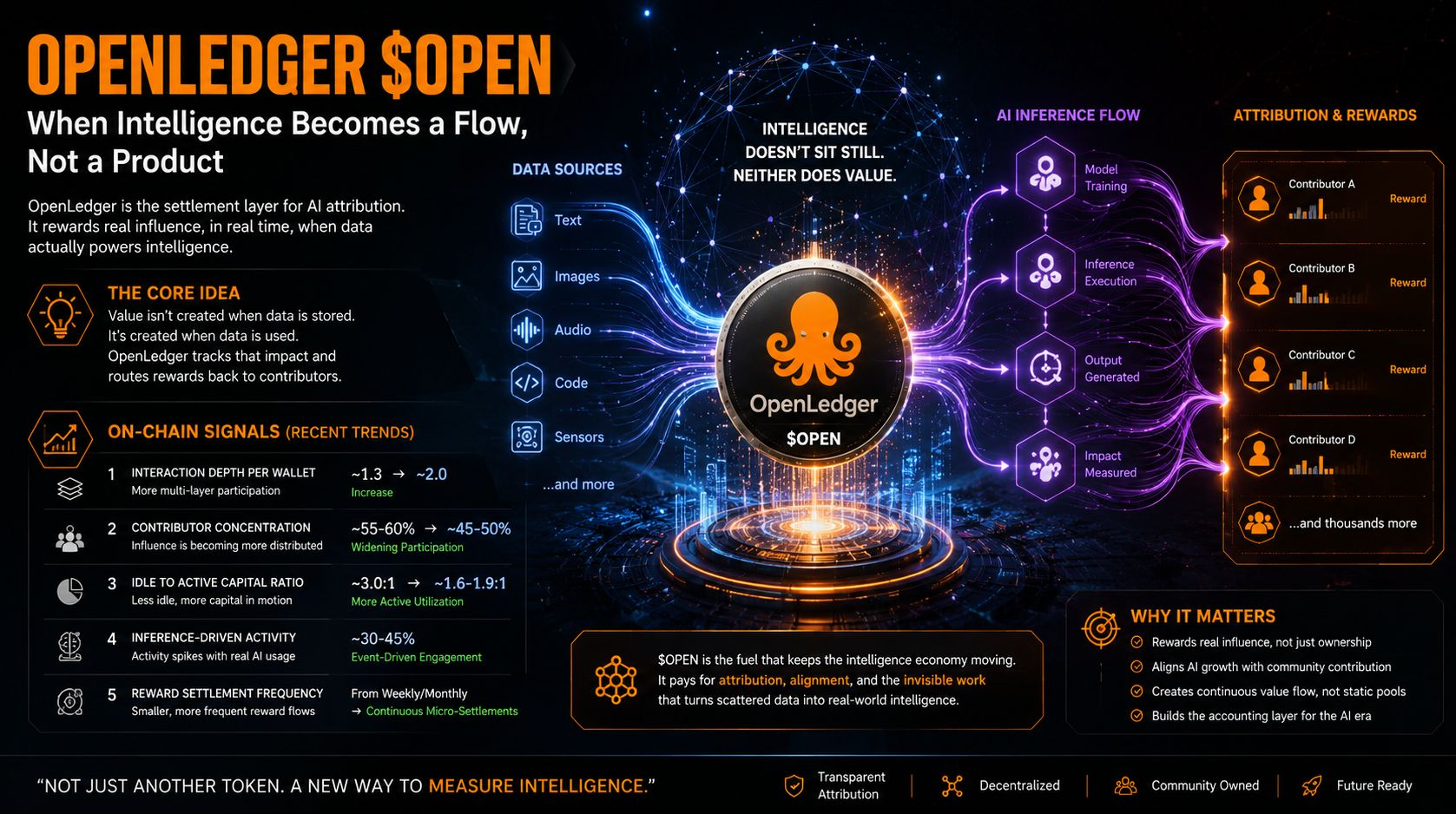
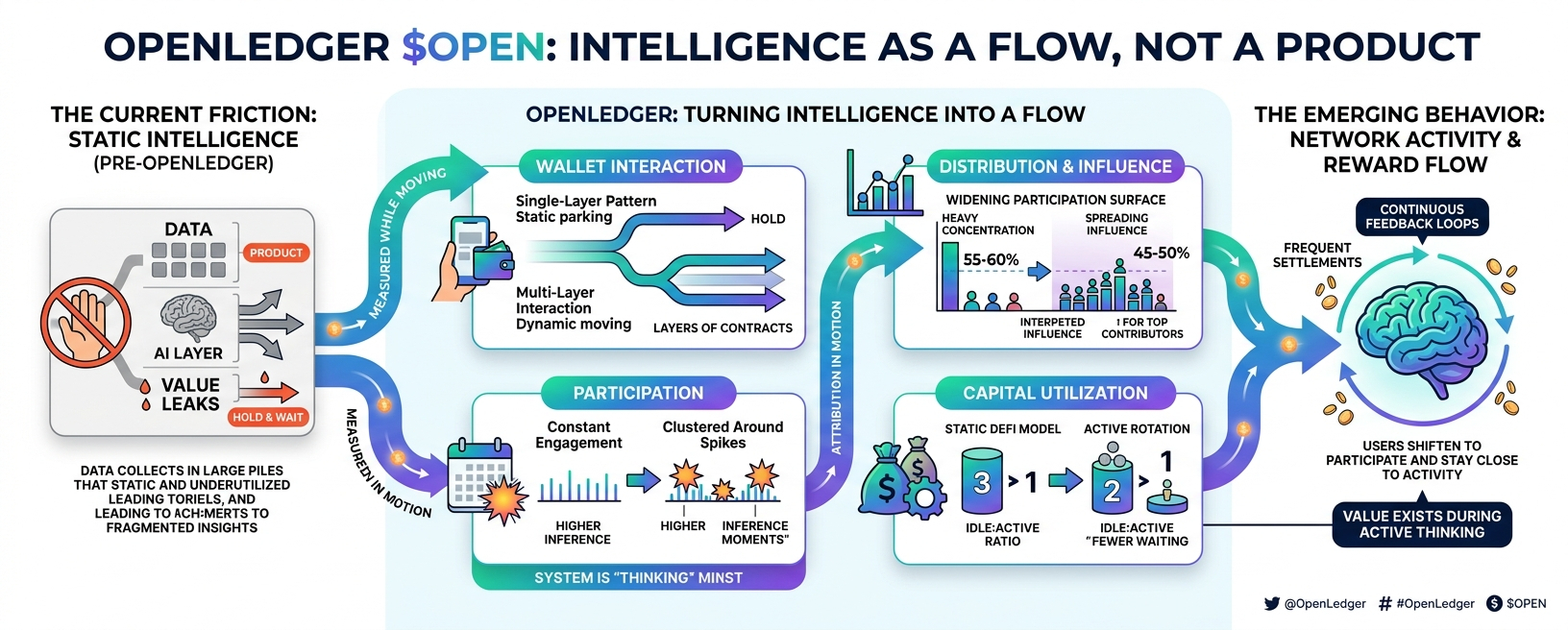
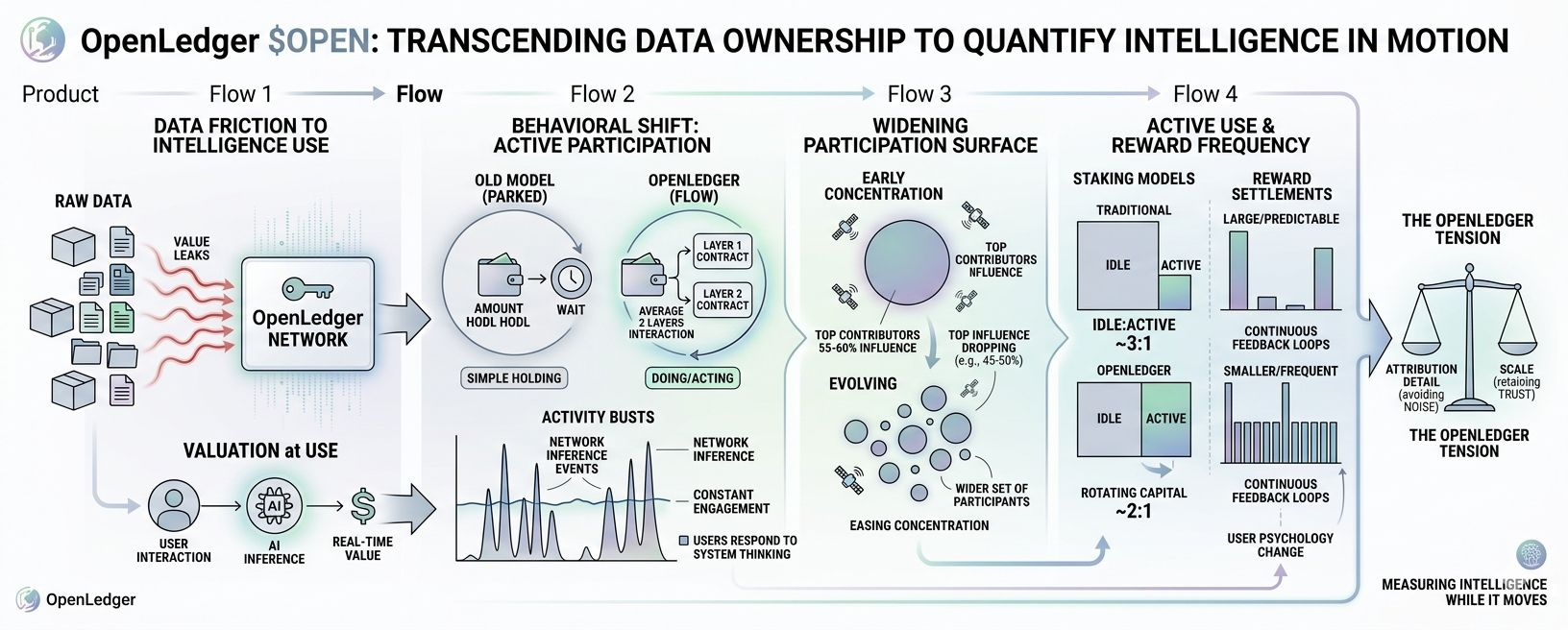
If you look at recent on-chain behavior patterns around $OPEN, even without precise official dashboards, a few signals stand out. Wallet activity looks less like simple holding and more like movement between multiple layers of interaction. In rough terms, active wallets seem to be interacting across about 2 layers of contracts on average now, compared to something closer to a single-layer pattern earlier. That might not sound dramatic, but it usually signals one thing: people are no longer just parking tokens, they are moving through a process.
Another noticeable shift is how participation seems to cluster around activity spikes rather than staying constant. Instead of smooth engagement, you see bursts of interaction that line up with higher inference or system usage moments. It’s as if users are not reacting to price alone anymore, but to when the system itself is “thinking.”
There’s also a subtle change in distribution. Early patterns often show heavy concentration where a small group drives most of the activity. In OpenLedger’s evolving structure, that concentration appears to be easing, with influence spreading into a wider set of participants. A rough interpretation puts top contributor influence dropping from something like the 55–60% range toward closer to 45–50%. It’s not perfect equality, but it does suggest a widening surface area of participation.
Staking behavior also seems less static than traditional DeFi models. Instead of large amounts sitting idle, more capital appears to be rotating into active use or at least interacting more frequently with the system. A useful proxy here is the shift in idle-to-active ratio moving from something like 3:1 toward closer to 2:1. In simple terms, less waiting, more doing.
And then there’s reward flow. Rather than large, predictable distributions, the system appears to be leaning toward more frequent and smaller settlements. That changes user psychology. People stop thinking in long cycles and start paying attention to continuous feedback loops, even if the amounts are smaller.
When you step back from the numbers, what’s actually changing is not just economics—it’s behavior. OpenLedger #Open is slowly pushing users away from “hold and wait” thinking and toward something closer to “participate and stay close to activity.”
The hard part is that this kind of system is not really about growth in the traditional sense. It’s about whether the network can keep track of contribution without becoming too complex to understand. If attribution becomes too detailed, it breaks scale. If it becomes too loose, it loses trust. OpenLedger is sitting right in that tension, trying to make intelligence traceable without turning it into noise.
So instead of asking whether $OPEN is just another AI token, a more accurate question might be: what happens when value is no longer something you store or trade, but something that only exists while the system is actively thinking?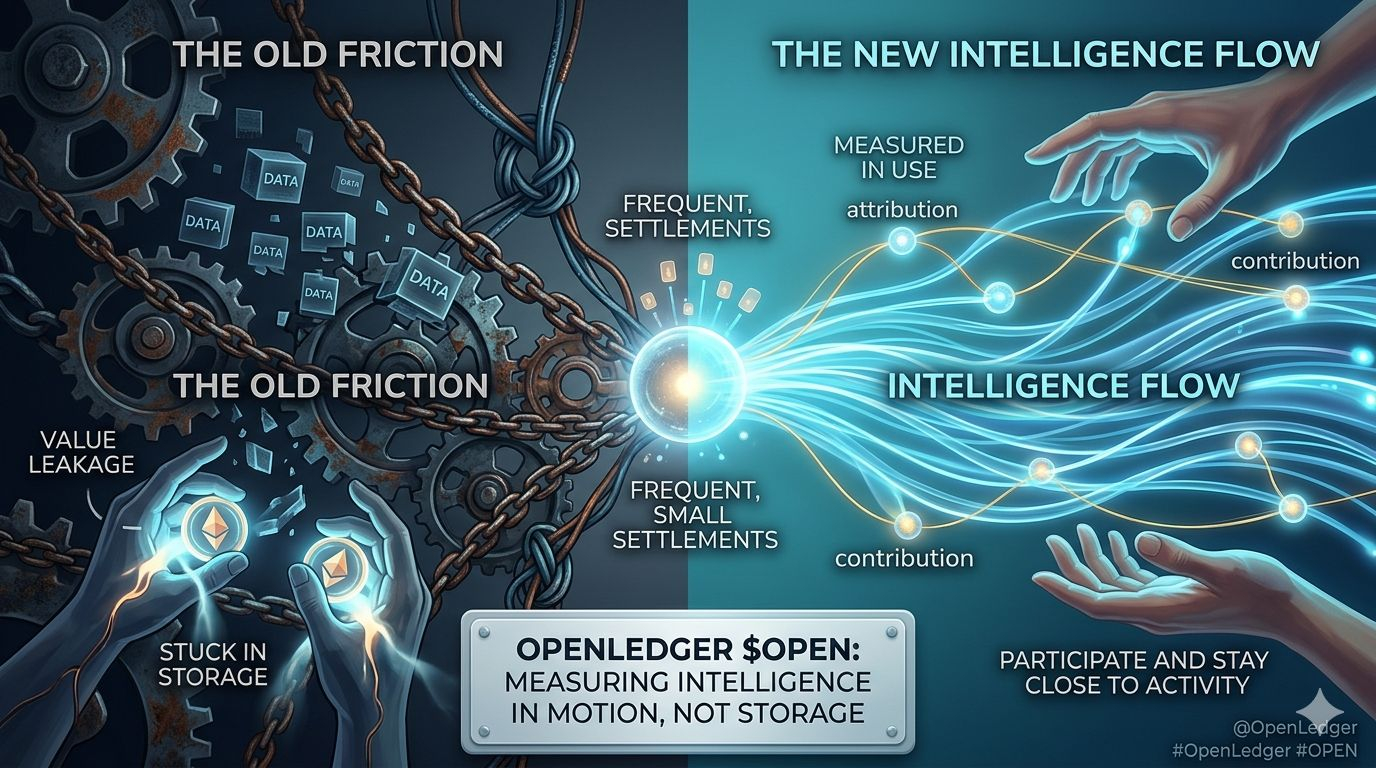
And if that model holds, then OpenLedger isn’t really building a financial layer around AI. It’s quietly trying to turn intelligence itself into something that can be measured while it moves.
