

I was looking at AI all wrong.
For years, when someone said "AI infrastructure," my brain went straight to models, computing power, and maybe data marketplaces. Inputs go in. Intelligence comes out. End of story.
Yeah, I was pretty off.
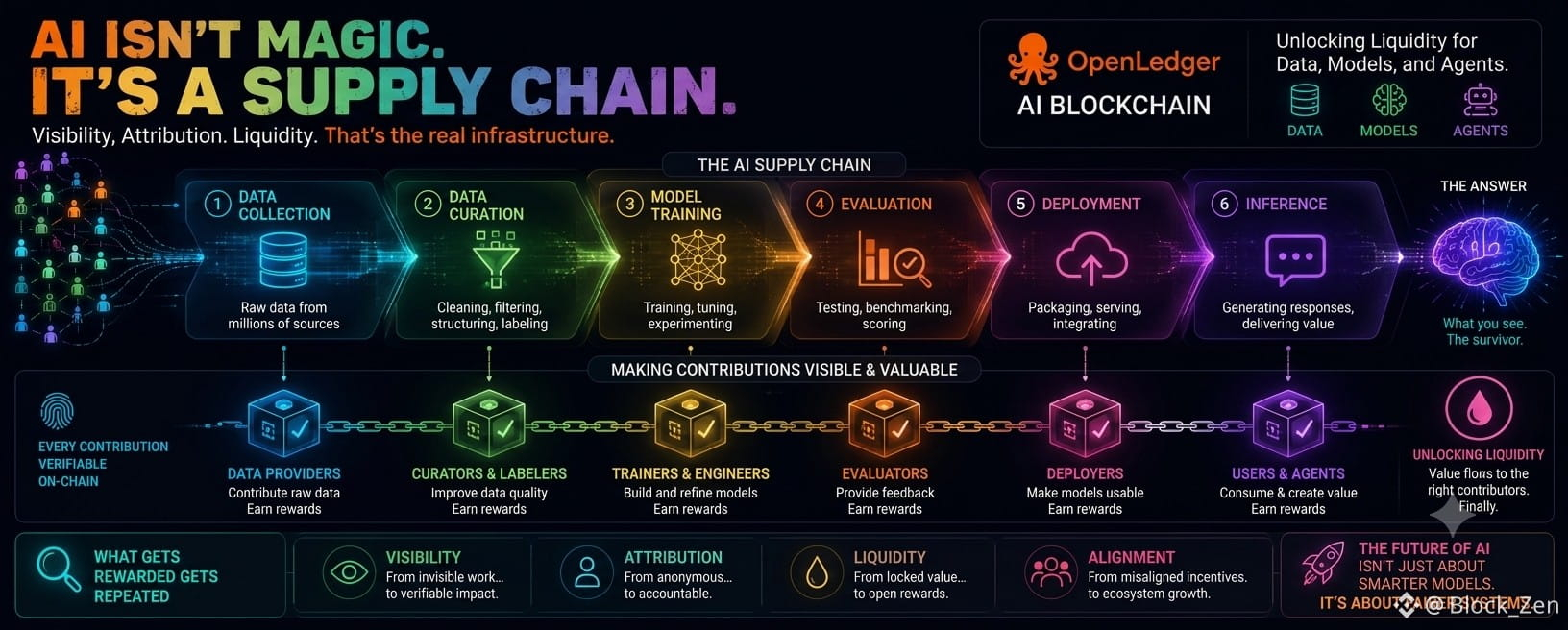
OpenLedger (OPEN) is an AI blockchain that unlocks liquidity to monetize data, models, and agents. That's the official line. And it's fine, as far as it goes. But lately, I can not shake a different picture. What if the model is not even the main event? What if AI is quietly building supply chains?
I know that sounds Obvious when you say it out loud. Every industry has supply chains. But somehow we talk about AI like answers just appear out of thin air. Like the text you see on your screen is the actual product. Like monetizing data and models is just about slapping a price tag on them.
I do not think that's true anymore.
Here's what changed for me. most of the work is already inviSible by the time you see the answer. Training data gets swallowed up into numbers. ContriButors fade into datasets. The people who did the evaLuating just vanish into benchmarks. By the time a response reaches you, thousands of tiny Decisions have been squished into something small enough to travel. What you get is the survivor. Not the messy, beautiful, chaotic process behind it.
And that's where OpenLedger started bothering me in a good way, I think. Not because it promises some erfect fix. I do not really believe any system can track every forgotten dependency. But it forced me to ask a different question. What is the system actually deciding on?
Because once you start caring about attribution about who contributed what, and who gets paid AI stops looking like Software and starts looking like logistics. Data moves. Proof moves. Value moves. Different people show up at different times and add different pieces. All of a sudden, intelligence is just a Supply chain passing through Invisible checkpoints. And unlocking liquidity? That's just a fancy way of saying making sure the right people actually get paid for once.
Here's the Part that gets weird.
Supply chains have this funny property. The final product gets all the attention. Nobody claps for the bolt that held the shelf together. Same thing happens with those Creator ranking things. You see a leaderboard spot. You don't see the drafts that got deleted. The researcH Paths that went nowhere. The true idea that was not flashy enough to survive. Those things might as well have never existed.
AI feels exactly the same. Everyone treats a model's answer like it's the Object. But maybe the real object is the supply chain itself. Maybe monetizing models and agents is secondary to something deeper monetizing the proof that someone actually helped build it. That still sounds strange when I write it, but it keeps coming back.
The system rewards what it can see. Thats the quiet filter nobody talks about. If attribution actually becomes economically meaningful if OpenLedger somehow makes it matter through this whole AI blockchain thing then people won't just compete to build smart things. They'll compete to become legible inside the supply chain. And those are not the same thing at all.
One person creates huge value but stays invisible. Another creates less value but is easier to verify, easier to track, easier to replay downstream. Who gets rewarded? The visible one. Every Single time. That's what unlocking liquidity really means when you think about it. Not just moving money around. Making sure the money knows where to go.
This honestly makes me uncomfortable. Because every system creates clarity by throwing stuff away. Complexity has to shrink into something transportable. But that compression always leaves something behind. Someones work. Someones insight. Someones quiet contribution that mattered but never became attestable. Did it fail? Or did it just never exist in the only place downstream applications bother to check? A blockchain like OpenLedger can only reward what became visible on chain. The rest isn't false. It's just missing.
I used to think AI's hidden question was whether models would get smarter. Now I find myself staring at something else entirely. The supply chain. The Quiet filtering. The weird boundary between what survived and what disappeared before the record was even written.
Maybe OpenLedger isn't really about intelligence versus stupidity, or CEntralized versus decentralized. It's about something stranger. A World where the real scarcity isn't even information anymore. It's recognized participation inside the systems that turn raw work into something the rest of us can actually trust. And if a blockchain can actually unlock liquidity around that? Around the invisible work? Around the people who never get credited?
That changes almost everything about how I watch AI grow.